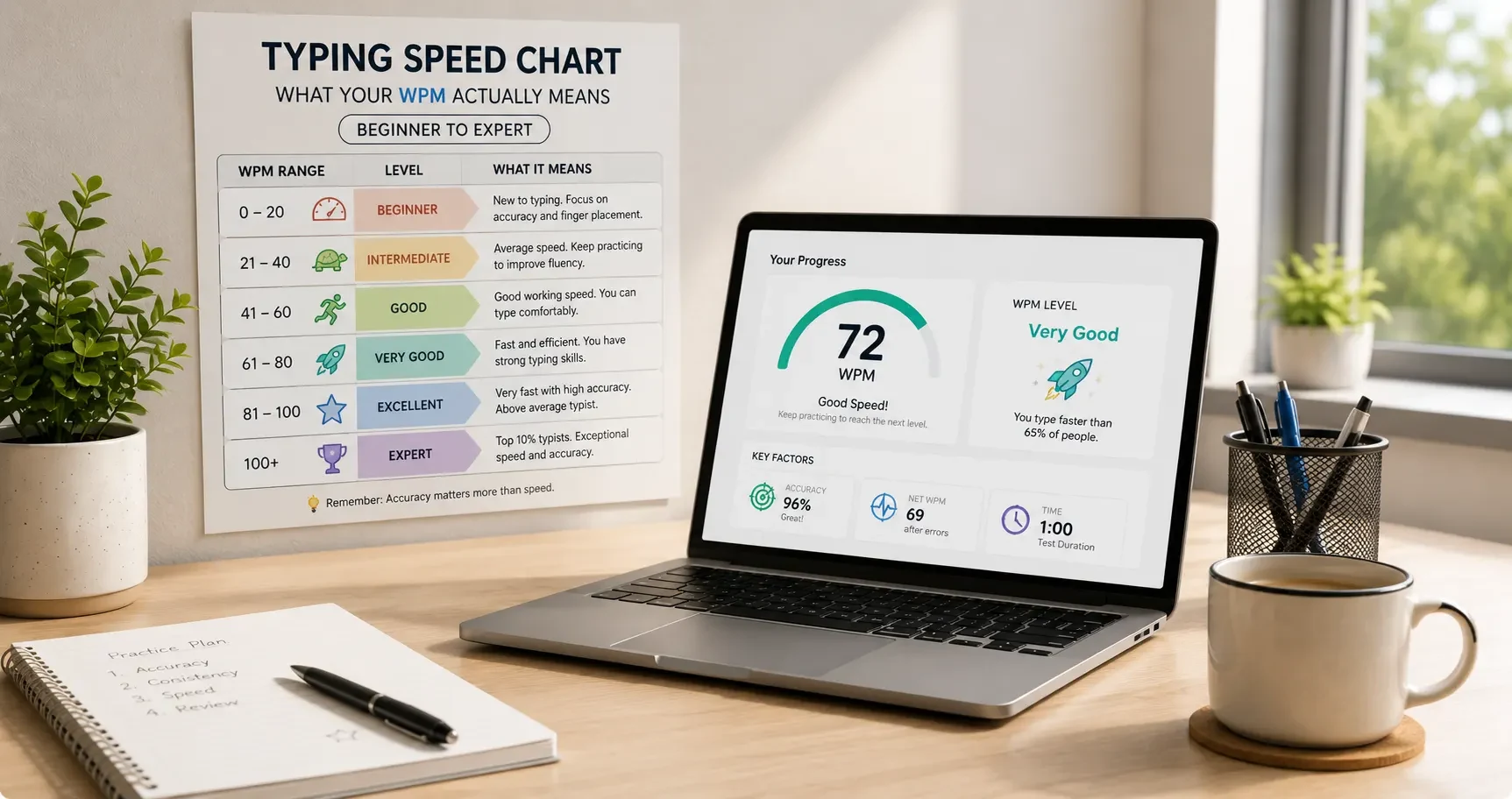
You finish a typing test at 78 WPM, feel briefly invincible, and then sit down to write a two-paragraph email that takes you six minutes. Something doesn't add up. Either the test is lying to you, or your email is lying to you — and the honest answer is that neither one is lying. They're measuring two different skills that happen to both involve a keyboard. One is copy-typing. The other is composing. Understanding the gap between them explains a lot of confusion about typing speed, and it also points to exactly why typing practice is still worth your time even if you already "know" the keyboard.
- Two Skills Hiding Behind One Word
- What Copy-Typing Actually Trains
- What Composing Actually Demands
- Why Your Test Score and Your Real Writing Speed Disagree
- The Stop-Start Rhythm of Composing
- Copy-Typing vs Composing at a Glance
- How Copy-Typing Practice Still Makes You a Faster Composer
- A Real Scenario: Elena's Two Speeds
- How to Train Both, On Purpose
- Key Takeaways
Two Skills Hiding Behind One Word
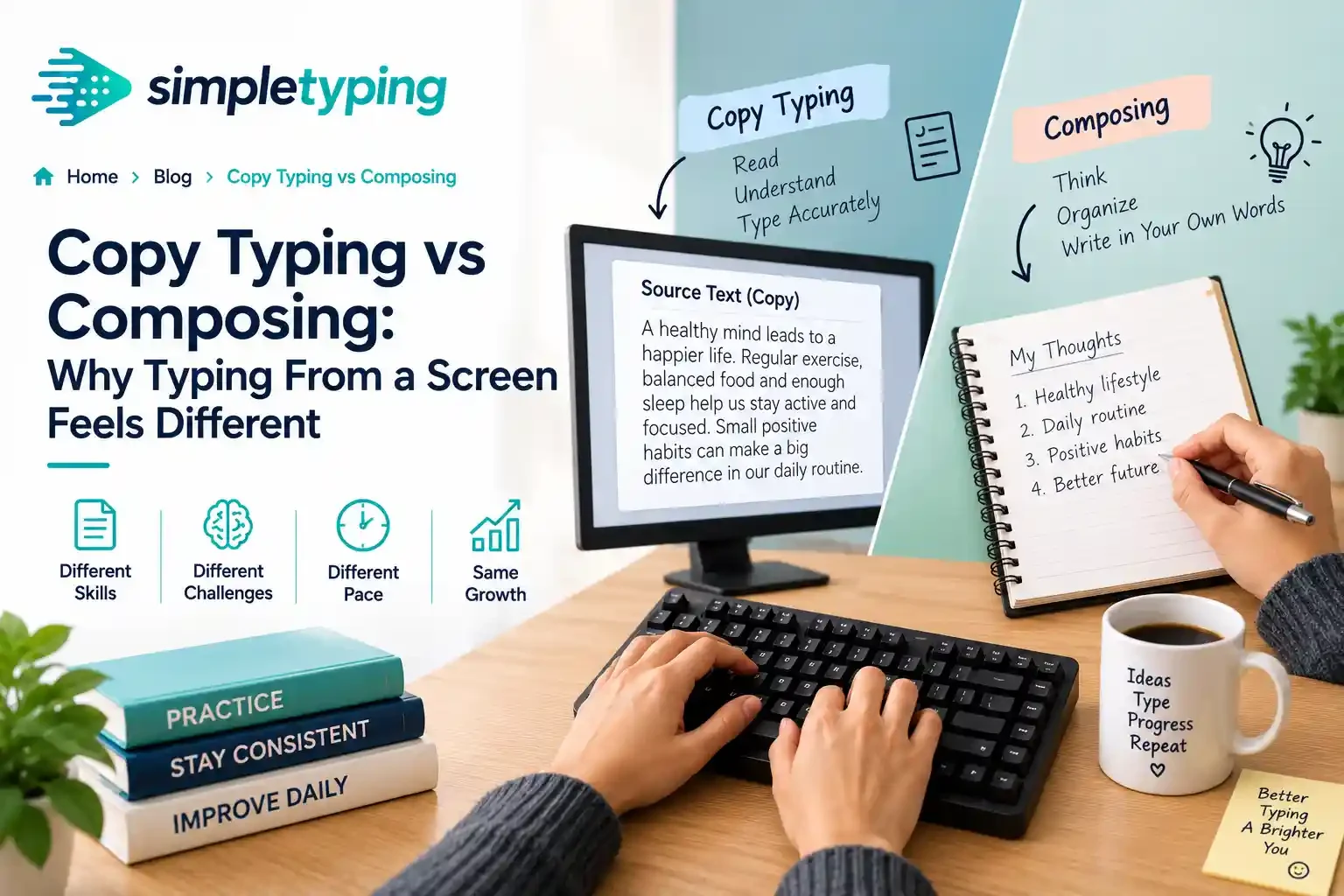
"Typing" gets used as if it's one activity, but it's really a bundle of at least two very different tasks that share the same fingers and the same keyboard. The first is transcription — taking text that already exists somewhere (on a screen, on paper, in your ear) and reproducing it. The second is composition — generating the text yourself, sentence by sentence, while you type it. A typing test is transcription. A work email, a college essay, a chat reply, a report, a social media post — those are composition. They feel different because they are different, cognitively speaking, even though the physical act of pressing keys looks identical from across the room.
This distinction matters because almost every typing test, typing game, and typing certificate on the internet measures transcription speed. That's not a flaw in the tests — it's the only thing that can be measured consistently, since everyone types the same passage and gets scored against the clock. But it quietly trains people to believe that their transcription number is their "real" typing speed, full stop. It isn't. It's one very real, very useful number — just not the whole story.
What Copy-Typing Actually Trains
When you copy-type, the words are already decided. Your brain's job is narrow and mechanical: read a chunk of text, hold it in short-term memory for a second or two, and fire off the finger movements that reproduce it. There's no uncertainty about what comes next, no decision-making, no second-guessing whether a sentence sounds right. The bottleneck is almost purely motor — how fast your fingers can execute a known sequence.
That's exactly why copy-typing is such a good training ground. With the "what to say" question removed entirely, every ounce of effort goes toward:
- Building finger-to-key muscle memory so common letter pairs fire without conscious thought
- Training your eyes to move ahead of your fingers instead of watching the keyboard
- Smoothing out rhythm so keystrokes flow instead of arriving in bursts
- Reducing errors caused by hesitation rather than by not knowing what to type
It's a controlled environment, almost like practicing scales on a piano. You're not writing music yet — you're making sure your hands can do whatever the music eventually asks of them.
What Composing Actually Demands
Composing asks for something the typing test never asks for: the content itself. Before a single word can be typed, your brain has to decide what idea comes next, choose the words for it, arrange them into a grammatical sentence, and often reconsider that choice mid-sentence. Only after all of that does the motor system get a finished instruction to execute. Typing is no longer the bottleneck — thinking is.
This is why composing recruits a much wider set of mental resources than copy-typing does: working memory (holding the shape of the sentence you're building), language retrieval (finding the right word, not just any word), structure and logic (does this paragraph actually make the point you want it to make), and self-editing (rereading and revising as you go, sometimes before you've even finished the sentence). Your fingers are capable of far more speed than your composing brain typically asks of them. The keyboard was never the limiting factor here — your thinking was.
Why Your Test Score and Your Real Writing Speed Disagree
Once you separate the two skills, the mismatch stops being mysterious. A typing test isolates the motor skill and removes the thinking. Real writing does the opposite — it keeps the thinking and simply lets the motor skill ride along in the background. Two people can have identical test scores and wildly different "real" typing speeds depending on how quickly they generate ideas, how confident they are in their wording, and how much they second-guess themselves.
It also explains a pattern a lot of fast typists notice and find slightly annoying: doubling your copy-typing speed does not double your email-writing speed. Past a certain point, your fingers stop being the constraint at all, and extra motor speed just sits there unused while your brain catches up. This isn't a sign that practice stopped working — it's a sign you've hit the ceiling of what motor speed alone can buy you, and the next gains have to come from somewhere else.
The Stop-Start Rhythm of Composing
Copy-typing, done well, has a steady, almost hypnotic rhythm — keys fall at a fairly even pace because the input (the text you're reading) arrives at a steady pace too. Composing rarely looks like that, and that's completely normal, not a sign of bad typing. Watch anyone write an original paragraph and you'll see bursts of fast typing followed by pauses, backspacing, a sentence started and abandoned, a word replaced with a better one. That stop-start pattern isn't inefficiency — it's what thinking looks like when it's happening in real time, out loud, on a screen.
People sometimes interpret their own hesitant composing pace as proof they "can't type," when what's actually happening is that they're doing something much harder than typing: they're drafting. A slow, choppy composing session can still involve very fast, accurate keystrokes in the bursts where the fingers actually move — the slowness lives in the gaps, not in the fingers.
Copy-Typing vs Composing at a Glance
| Dimension | Copy-Typing | Composing |
|---|---|---|
| Primary cognitive load | Motor execution and short-term visual memory | Idea generation, word choice, grammar, self-editing |
| Typical speed | Higher and steadier (bottleneck is the fingers) | Lower and uneven (bottleneck is the thinking) |
| What it measures | Raw transcription ability — how fast fingers reproduce known text | How fast you can turn thoughts into finished, typed sentences |
| Rhythm | Continuous, even keystroke flow | Bursts of typing separated by pauses and revisions |
| How to practice it | Timed typing tests, paragraph drills, structured lessons | Freewriting, journaling, drafting emails/messages without over-planning first |
How Copy-Typing Practice Still Makes You a Faster Composer
Here's the part that surprises people: even though copy-typing and composing are different skills, getting better at copy-typing genuinely improves your composing speed too. The mechanism is cognitive load, not magic. If your fingers already know, without conscious thought, exactly how to produce the letters "t-h-e" or "-tion" or your own name, then none of your limited mental bandwidth gets spent on motor execution. All of it becomes available for the actual hard part of composing — deciding what to say.
Think of working memory as a small stage that can only hold a few things at once. A slow, hunt-and-peck typist has to keep part of that stage occupied with "where is the letter K" while also trying to hold the sentence they're building. A fluent touch typist's stage is almost entirely free for the sentence itself, because the letter-finding step has been automated away. That's why touch typists tend to compose not just faster, but with fewer derailed sentences — they lose their train of thought less often, because typing never interrupts the thought in the first place.
This is also why copy-typing drills are not a waste of time even for someone whose real goal is writing faster emails or essays. The drill isn't teaching you what to say. It's clearing the mechanical obstacle out of the way so that when you do sit down to compose, your brain gets to spend its full effort on the one part of the job that a typing test can never practice for you.
A Real Scenario: Elena's Two Speeds
Elena, a customer support lead, took an online typing test out of curiosity and scored 82 WPM — well above average, and she was proud of it. That same afternoon, she timed herself writing a routine reply to a customer complaint. It took her four minutes for roughly 90 words: about 22 WPM. She assumed something was wrong with her typing.
Nothing was wrong. Her 82 WPM measured how fast her fingers could reproduce a passage she was reading off the screen — pure transcription. Her 22 WPM measured something completely different: reading the complaint, deciding on a tone that was firm but polite, choosing precise wording, and rereading each sentence before moving to the next. Her fingers weren't the bottleneck at any point in that email — her judgment was, and that's exactly as it should be for a message that a customer would actually read. Once Elena understood the difference, she stopped chasing a higher test score to fix a writing-speed problem, and instead worked on drafting faster and editing less obsessively — the actual bottleneck.
How to Train Both, On Purpose
Because the two skills respond to different kinds of practice, it helps to train them separately rather than assuming one drill covers both:
- For copy-typing: use timed tests and paragraph drills regularly. The goal is automaticity — getting to the point where your fingers move without your attention checking in on every keystroke.
- For composing: practice generating text under light time pressure — a two-minute journal entry, a quick reply drafted without over-planning, a short freewrite with no backspacing allowed. The goal here is fluency of thought, not finger speed.
- Notice which one is actually slowing you down before trying to fix it. If you're pausing to think about what to say, more typing drills won't help much. If you're pausing to hunt for keys, more composing practice won't help much either.
- Let the two feed each other. As copy-typing gets more automatic, composing gets a little smoother, because there's more mental room left for the thinking. And as you compose more, you get faster at trusting your first draft instead of endlessly rereading it, which speeds things up from the other direction.
Key Takeaways
- Copy-typing (retyping text you're reading) and composing (typing your own original thoughts) are different cognitive tasks, even though they use the same keyboard.
- Typing tests measure copy-typing speed — a real and useful number, but not the same thing as how fast you write original content.
- Composing is slower and stop-start because the bottleneck is thinking, not finger movement — that unevenness is normal, not a typing flaw.
- Faster, more automatic copy-typing frees up mental bandwidth that composing can then spend on word choice and structure instead of finger-hunting.
- If composing feels slow, diagnose whether the delay is mechanical (typing itself) or cognitive (deciding what to say) before choosing how to practice.
- Training both skills deliberately — drills for transcription, timed freewriting for composition — improves real-world writing speed more than chasing a higher test score alone.
Your test score isn't wrong and your slower email isn't a contradiction — they're two honest measurements of two different skills. If you want both to improve, keep the drills going: a little steady copy-typing practice clears the mechanical noise out of the way, so the next time you sit down to actually write something, your fingers can keep up with your thinking instead of getting in its way.