If you never learned touch typing but can bang out 40-50 words a minute with two fingers while barely looking at the screen, you don't have a typing problem — you have a typing habit that works, until the day it doesn't. The real question isn't whether two-finger typing is "wrong," it's whether the ceiling you're bumping into is worth the few weeks of feeling clumsy that switching to touch typing would cost you. Here's the actual speed math, the real costs, and a concrete way to decide instead of just being told to "type properly."
- What Two-Finger Typing Actually Is (and Why It Works at All)
- How Fast Can Two-Finger Typing Really Get?
- The Real Costs: Fatigue, Eye Strain, and the Keyboard-Watching Trap
- Where It Becomes a Real Problem: Exams and Timed Tests
- Two-Finger, Touch Typing, and Hybrid: A Straight Comparison
- The Self-Test: Should You Switch or Just Get Faster?
- A Realistic Transition Path (Without Losing All Your Speed)
- If You're Not Switching: How to Get Faster Anyway
- Key Takeaways
What Two-Finger Typing Actually Is (and Why It Works at All)
True hunt-and-peck typing is a beginner's habit: you search for every single key, every single time, with your eyes doing all the navigation work. Almost nobody who types daily for years stays at that stage. What actually happens is that people evolve into what's better described as "search-and-pinpoint" typing — usually with two, but sometimes three or four fingers, often one from each hand plus a thumb for the spacebar. They've quietly memorized where most keys are. The eyes only drop to the keyboard for less common letters, punctuation, or when they lose their place after a mistake.
This is why two-finger typing isn't automatically "bad." It's a real, learned skill with its own muscle memory — it's just built on a much smaller set of moving parts than touch typing. Two fingers doing all the reaching, instead of ten fingers each covering a small zone, is inherently less efficient. But "less efficient" and "doesn't work" are very different things, and plenty of two-finger typists have been doing their jobs — including data entry — for years without ever hitting a wall they cared about.
How Fast Can Two-Finger Typing Really Get?
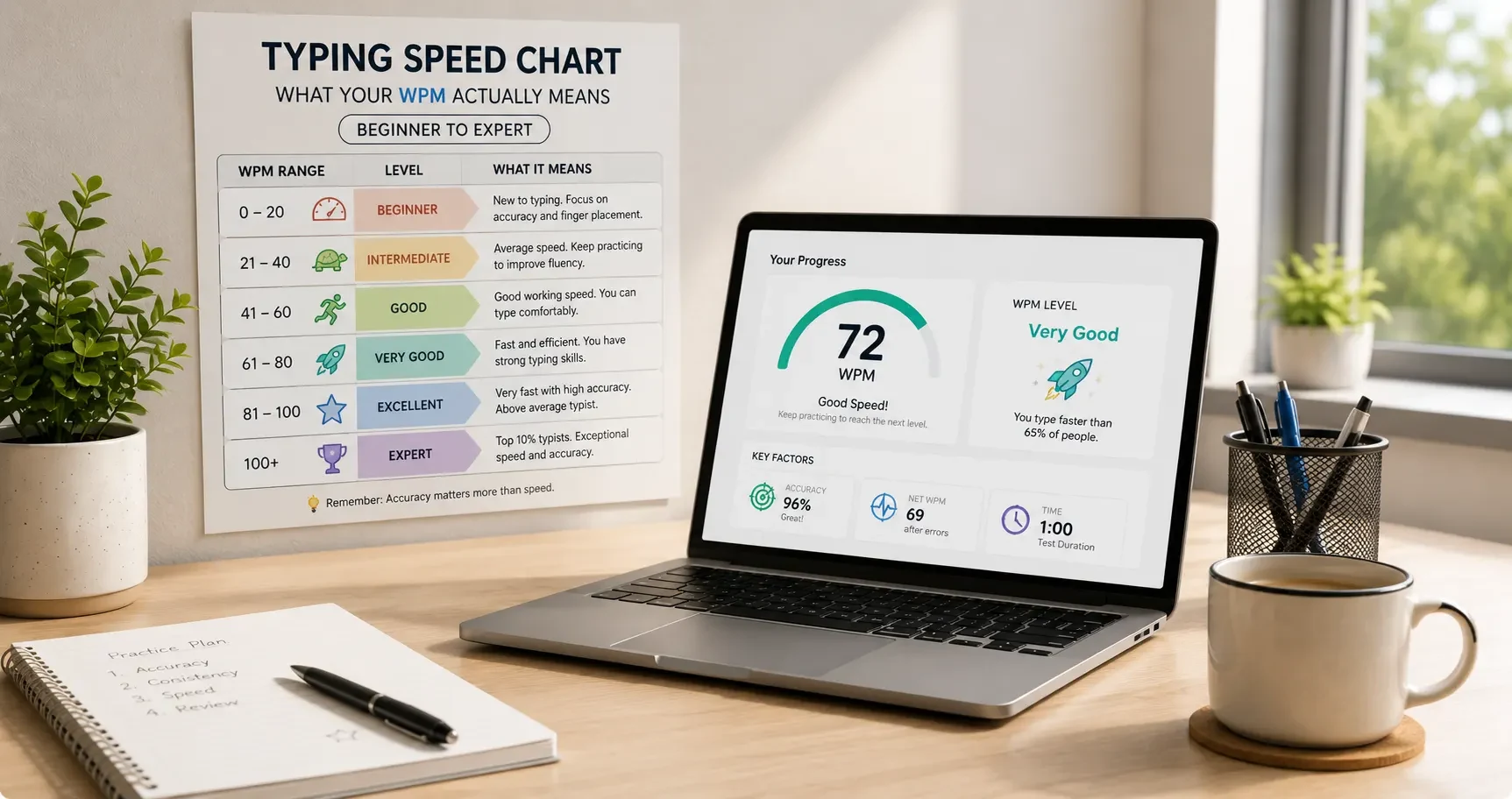
This is the number people actually want, so here it is straight. A true beginner hunting for every key usually sits around 10-15 WPM. Someone who types two-finger style regularly for a year or two — texting, chatting, basic office work — typically settles somewhere between 25-35 WPM. That's not the ceiling, though. People who type two-finger style for years, especially in jobs that involve a lot of repeated, familiar text (billing, form-filling, customer support scripts), commonly plateau in the 40-60 WPM range. A genuine outlier who has typed two-finger style for a decade or more, on a keyboard layout they know cold, can occasionally push into the 65-80 WPM range — but that's the exception, not something to plan around.
Compare that to touch typing. A trained touch typist averages 80-120 WPM once the skill is solid, and competitive or professional-level touch typists regularly clear 130+ WPM. The gap exists for a simple mechanical reason: touch typing lets multiple fingers move toward their next keys in parallel while another finger is still striking the current one. Two-finger typing can't do that — each finger has to travel further, and only one movement happens at a time. No amount of practice removes that physical bottleneck; it just gets you closer to the ceiling that bottleneck allows.
The Real Costs: Fatigue, Eye Strain, and the Keyboard-Watching Trap
Speed isn't the only thing on the table. Two-finger typing carries a few costs that people tend to underestimate because they build up slowly.
Fatigue concentration. With ten fingers sharing the load, no single finger or wrist angle takes much repetitive strain. With two fingers doing everything, those specific fingers, and often the wrists twisting to reach across the keyboard, absorb a disproportionate amount of repetitive motion. Over a long typing session — an hour of data entry, say — that shows up as hand or shoulder fatigue that touch typists rarely report at the same pace.
The keyboard-watching trap. Constantly glancing down at the keys and back up to the screen isn't free. It costs time on every glance, but it also costs focus — you lose your place in the source text or your own train of thought each time your eyes leave the screen. Typists who do this all day often describe a mild neck or eye strain by the end of it, sometimes called "typing whiplash," that touch typists mostly avoid because their eyes stay on the screen.
The plateau. Because two-finger typing isn't taught in any structured way, there's no natural next drill once you hit your comfortable speed. Touch typists have a clear path — home row, then reaching rows, then speed drills. Two-finger typists usually just keep doing what already works, which is exactly why so many stall out for years at the same 40-something WPM without realizing they've stopped improving at all.
Where It Becomes a Real Problem: Exams and Timed Tests
Everyday use is one thing. A timed, high-stakes test is another. Government typing exams — SSC CGL's typing test, various state-level skill tests, CPCT, and similar — set a minimum WPM along with an accuracy threshold, and both have to be hit inside a fixed window, usually on an unfamiliar keyboard, under exam-hall pressure.
This is exactly the situation where two-finger typing tends to fall apart. The visual-navigation habit that works fine at your own desk, on your own keyboard, gets worse under stress — people revert toward genuine hunt-and-peck when nervous, which tanks both speed and accuracy at the same time. A candidate who comfortably types 45 WPM at home might find themselves at 30 WPM with a spike in errors in the exam hall, simply because the unfamiliar keyboard removes the small positional cues they'd unconsciously relied on. If you're preparing for a timed government exam, it's worth working through structured drills on the government exam typing practice section rather than assuming your everyday two-finger speed will hold up under test conditions.
Two-Finger, Touch Typing, and Hybrid: A Straight Comparison
Here's how the three common typing styles stack up against each other on the things that actually matter day to day.
| Style | Typical WPM Range | Accuracy Under Time Pressure | Fatigue Level | Best Use Case |
|---|---|---|---|---|
| Two-Finger Typing | 25-60 WPM (rare outliers to ~80) | Drops noticeably under pressure or on unfamiliar keyboards | High — concentrated on few fingers/wrists | Casual use, chat, light data entry where speed isn't tested |
| Touch Typing | 80-130+ WPM | Stays consistent even under time pressure | Low — load spread across all ten fingers | Exams, professional data entry, long writing sessions |
| Hybrid / Self-Taught Multi-Finger | 50-80 WPM | Moderately consistent, some drop under pressure | Medium — better distributed than two-finger, less than touch typing | People who type a lot but never formally trained; solid middle ground |
The hybrid row matters here — a lot of self-taught fast typists aren't strictly "two-finger," they've informally recruited four to six fingers without ever learning formal home-row placement. If that's you, you're already closer to touch typing than you might think, and the jump to full touch typing is smaller than it looks.
The Self-Test: Should You Switch or Just Get Faster?
Take Naveen, a claims processor at an insurance office who has typed two-finger style for eight years processing repetitive claim forms. He types comfortably at 48 WPM, rarely makes mistakes on the standard forms he sees every day, and has never once needed to pass a timed typing test. For Naveen, switching to touch typing would cost weeks of slower output for a benefit he doesn't actually need — his current skill fits his actual work.
Use this quick self-test to figure out which camp you're in:
- Take a real timed test right now. Note both your WPM and your accuracy percentage on a proper typing test, not just how fast you feel typing a WhatsApp message.
- Are you already above 50 WPM with two fingers? If yes, you're near the natural ceiling for this style — further two-finger practice will yield small, slow gains.
- Does your job or an exam require a specific WPM/accuracy threshold? If a number is written into a requirement somewhere, that changes the calculation — comfortable everyday speed and exam-passing speed are not the same thing.
- How many hours a day do you actually type? Under one hour a day, the fatigue costs of two-finger typing matter less. Several hours a day, and the strain and plateau issues compound fast.
- Do you frequently type on unfamiliar keyboards (exam halls, shared computers, new jobs)? Two-finger typing degrades more on unfamiliar layouts than touch typing does.
If you answered "above 50 WPM," "no fixed requirement," "under an hour a day," and "mostly my own keyboard" — you're probably better off getting faster within two-finger typing. If you hit a hard requirement, type for hours daily, or need to perform on unfamiliar keyboards under pressure, the switch to touch typing is worth the temporary dip.
A Realistic Transition Path (Without Losing All Your Speed)
The biggest reason people abandon touch typing halfway through is that they quit their old habit cold turkey, immediately drop to 15 WPM, and get discouraged. A better path keeps both skills running at once during the transition.
Keep using two-finger typing for actual work — emails, forms, whatever pays the bills — while running short, dedicated touch-typing drills separately, 15-20 minutes a day. Start strictly on the home row until it's automatic, then add the top row, then the bottom row, then numbers and punctuation last. Prioritize accuracy over speed in these drills; speed that comes from accurate muscle memory sticks, speed that comes from rushing doesn't.
Expect a real dip: for roughly two to four weeks, your deliberate touch-typing speed will sit below your old two-finger speed, because you're actively overriding a habit instead of using it. That's normal and temporary, not a sign it isn't working. Most people who stick with daily practice match their old two-finger speed again within six to ten weeks, and meaningfully exceed it — often by 30-50 WPM — within three to four months.
If You're Not Switching: How to Get Faster Anyway
If the self-test above points you toward staying with two-finger typing, you can still meaningfully improve without a full retrain. Consciously recruit more fingers even without formal home-row placement — most two-finger typists can comfortably add a third and fourth finger for common keys with a little deliberate practice, which alone can add 10-15 WPM. Work on reducing keyboard glances by drilling the same handful of common words until your fingers find them without a look. Practice on full paragraphs rather than isolated words, since real text builds the pattern recognition that actually shows up in daily typing. And watch your error-correction habit — every backspace-and-retype costs more time than typing carefully the first time, so slowing down slightly on tricky words often nets a faster overall result than rushing and correcting.
Key Takeaways
- Two-finger typing realistically plateaus around 40-60 WPM, with rare outliers near 80; touch typing routinely reaches 80-130+ WPM.
- The gap exists because touch typing allows parallel finger movement, while two-finger typing can only move one finger at a time.
- Two-finger typing carries real costs beyond speed: concentrated fatigue, more eye/neck strain from watching the keyboard, and a habit-driven plateau.
- Timed exams and unfamiliar keyboards are where two-finger typing is riskiest — speed and accuracy both tend to drop under pressure.
- Use a quick self-test — current WPM, fixed requirements, daily typing hours, keyboard variety — to decide whether to switch or improve in place.
- A gradual transition, running two-finger typing alongside daily touch-typing drills, avoids the discouraging speed crash of switching cold turkey.
Whichever path you choose, the only way to actually know your numbers is to test them. Head over to free English typing practice to check your current WPM and accuracy, then decide from real data instead of a guess.