You just ran a typing test and got 47 WPM. Is that good? Bad? Something to fix before your next exam, or a number you can stop thinking about entirely? A raw WPM figure by itself tells you almost nothing — it only becomes useful once you place it next to a chart that shows where it sits, what it qualifies you for, and how much accuracy is quietly inflating or deflating it behind the scenes.
- Why Your WPM Number Depends on How You Measure It
- The Typing Speed Chart: Beginner to Expert
- Under 35 WPM: Beginner and Below Average, Explained
- 35-50 WPM: Average, and Why That's Not an Insult
- 50-70 WPM: Good, Professional, and Exam-Ready
- 70-90+ WPM: Fast, Elite, and Court-Reporter Territory
- How Accuracy Changes What Your Number Really Means
- Using the Chart to Set a Target That Actually Fits You
- Key Takeaways
Why Your WPM Number Depends on How You Measure It
Before any chart means anything, you need to know which number you're actually looking at. Most typing sites, including ours, show two figures: gross WPM and net WPM. Gross WPM counts every keystroke you typed, correct or not, divided into five-character "words" over your time. Net WPM subtracts a penalty for errors — typically one word deducted per mistake — so it reflects what you actually produced correctly.
The formula most tests use is: Net WPM = Gross WPM − (Errors ÷ Minutes). So if you typed 60 gross WPM in a one-minute test but made 6 errors, your net score is 54 WPM. That six-word gap might not sound like much, but at higher speeds or longer tests it compounds fast, which is why two people who both "type 60 WPM" can have noticeably different real-world output.
When you compare your score against any chart — this one included — always check whether the chart (and your test) is talking about gross or net. This article uses net WPM throughout, because that's the number employers, exam boards, and certification bodies actually care about. It's the honest one.
The Typing Speed Chart: Beginner to Expert
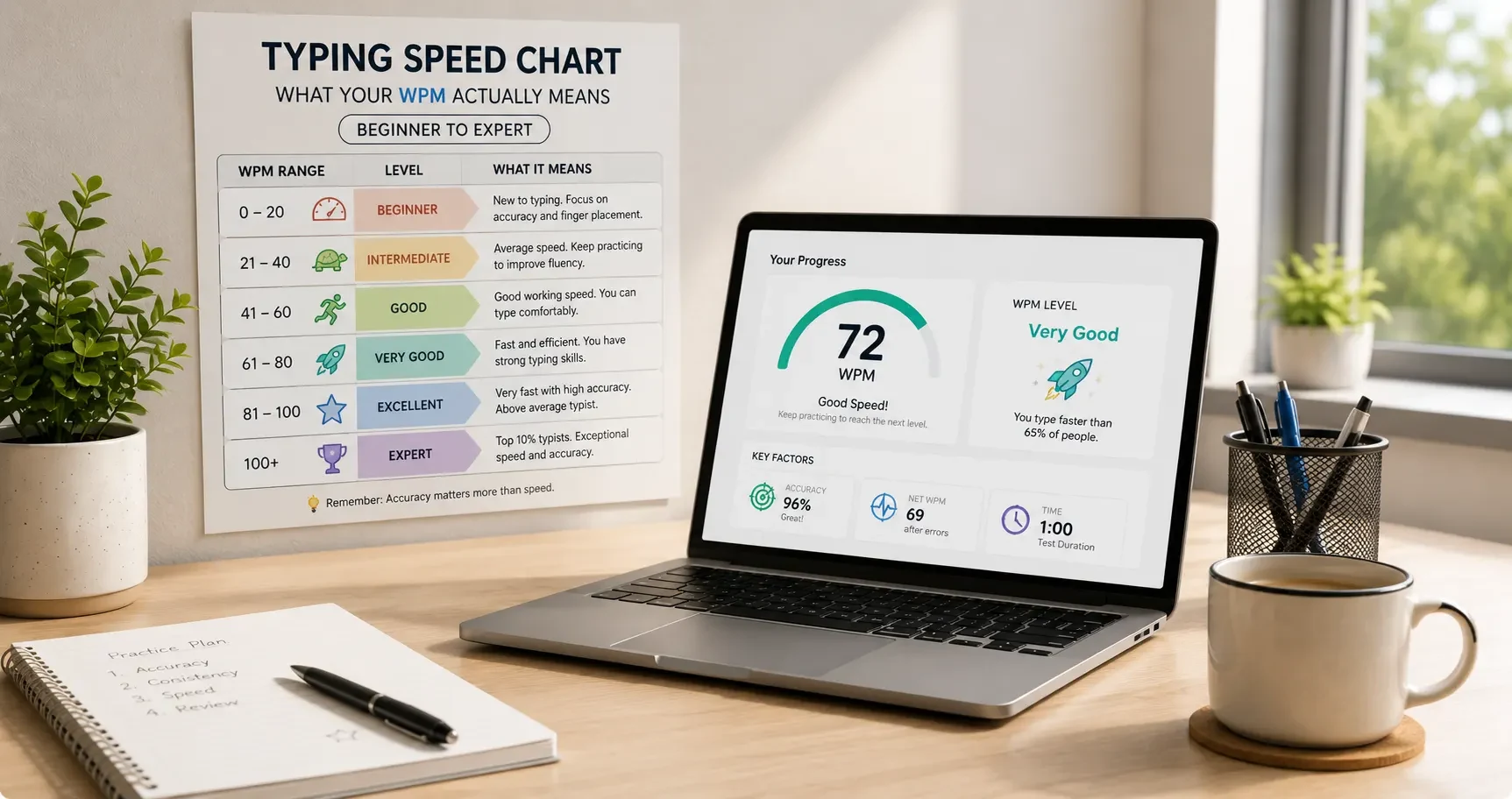
Here's the full breakdown. Treat the ranges as reasonably firm guidelines, not laws — a 34 WPM typist isn't meaningfully different from a 36 WPM typist, but the bands become useful once you're comparing yourself across a wider spread.
| Band | Net WPM Range | What It Means | Typical Context |
|---|---|---|---|
| Beginner | Under 20 WPM | Still hunting for keys or building muscle memory; typing takes conscious effort | First few weeks of practice, young kids, total newcomers to keyboards |
| Below Average | 20-35 WPM | Functional for casual use but slow for anything typing-heavy; usually hunt-and-peck or partial touch typing | Most adults who never formally learned typing but use a computer daily |
| Average | 35-50 WPM | Matches the general population average; comfortable for emails, messages, and light data entry | Typical office worker, student, general clerical roles |
| Good / Professional | 50-70 WPM | Solid, reliable speed that meets or beats most job and exam requirements | SSC CGL and CPCT qualifying range, data entry operators, administrative assistants |
| Fast | 70-90 WPM | Faster than roughly 95% of typists; noticeably quicker at drafting, transcribing, and exam writing | Experienced transcriptionists, competitive typists, power users |
| Elite | 90+ WPM | Rare tier reached only through years of deliberate practice; approaches professional stenography speed | Court reporters, elite competitive typists, top-tier data entry specialists |
Under 35 WPM: Beginner and Below Average, Explained
If you're under 20 WPM, don't read anything into it beyond "you're new." Everyone starts here, including people who eventually clear 80+ WPM. At this stage you're usually still looking at the keyboard, or your fingers haven't settled into home-row positions yet. The fix isn't more speed drills — it's accuracy-first touch typing practice so your fingers learn the map before you ask them to move fast.
The 20-35 WPM band is where a huge number of working adults actually sit, even people who've used a computer for a decade. This usually means you learned to type by habit rather than by method — you know where most keys are, but you're using two or four fingers instead of ten, or you glance down constantly to check yourself. It's genuinely fine for casual use. It becomes a problem the moment a job posting or exam lists a minimum WPM requirement above this range, which is extremely common for government and clerical roles in India.
35-50 WPM: Average, and Why That's Not an Insult
Landing at "average" sounds unremarkable, but it puts you ahead of a large share of casual typists. Most general studies on adult typing speed put the population average somewhere between 38 and 44 WPM, so if your score falls in this band, you're typing at a completely normal, employable pace for most non-specialist roles.
Where this band starts to matter is exam eligibility. Several government typing tests set their qualifying speed right around the top of this range or just above it, which means someone at 40 WPM might be a few weeks of focused practice away from clearing a real exam threshold — not a complete beginner needing months of retraining. That distinction matters when you're deciding how much time to budget before a test date.
50-70 WPM: Good, Professional, and Exam-Ready
This is the band where typing stops being a background skill and starts being a genuine asset on a resume. Most professional data-entry roles, and most government exam typing sections — including the general speed bar for SSC CGL Skill Test and CPCT — sit inside or just below this range. If you're consistently netting 50+ WPM with reasonable accuracy, you're not just "good at typing" in a casual sense; you're at a speed that opens up specific jobs and clears specific eligibility bars.
The gap between 50 and 70 also tends to separate people who learned touch typing properly from people who got fast through sheer repetition without ever fixing their technique. If you're stuck around 50-55 WPM and can't seem to push past it, the ceiling is often technique rather than practice volume — awkward finger assignments, reaching instead of shifting your whole hand, or a keyboard layout you've never fully committed to memory.
70-90+ WPM: Fast, Elite, and Court-Reporter Territory
Once you cross 70 WPM net, you're typing faster than the overwhelming majority of people who've ever taken a typing test — genuinely faster than roughly 19 out of 20 typists. This range is where transcription professionals, competitive typists, and people who type for a living as a core function of their job tend to live. It's achievable with sustained, deliberate practice, but it's not a "few weeks" goal for most people starting from average.
Above 90 WPM you're in territory that overlaps with trained stenographers and court reporters, some of whom push into the 200+ WPM range using specialized shorthand machines rather than standard QWERTY keyboards — worth knowing so you don't chase an unrealistic apples-to-oranges comparison. On a standard keyboard, sustaining 90+ WPM with high accuracy over a full test, not just a lucky ten-second burst, puts you in genuinely elite company.
How Accuracy Changes What Your Number Really Means
A high gross speed with poor accuracy is a mirage. Say you type 65 gross WPM but only manage 88% accuracy over a one-minute test — roughly 12 errors. Run that through the net formula and you drop to roughly 53 WPM, which quietly bumps you down a whole band on the chart above, from "Fast" territory down toward "Good/Professional." Meanwhile, someone typing a calmer 55 gross WPM at 97% accuracy nets out close to 53-54 WPM too — nearly identical real output, achieved far more comfortably.
This is why most exam boards and typing certifications set a minimum accuracy threshold — commonly 90-95% — alongside the speed requirement. A blazing gross score with too many errors simply won't clear the bar. Practically, this means: if you're chasing a specific band on this chart, don't train by mashing keys faster and hoping accuracy catches up. Train at a speed where you're consistently hitting 95%+ accuracy, then nudge speed up gradually. Speed built on top of sloppy accuracy tends to collapse the moment a test adds real pressure.
Using the Chart to Set a Target That Actually Fits You
Take Sneha, a college student preparing for a state-level clerical exam. She scored 42 WPM on her first practice test and had no idea if that was close to ready or nowhere near it. Once she checked it against a chart like this one, the picture got much clearer: she was solidly in the Average band, one step below where her exam's cutoff sat in the Good/Professional range. Instead of panicking and assuming she needed to double her speed, she realized she needed roughly 8-10 more net WPM — a realistic six-to-eight-week goal with focused daily practice, not a fantasy.
That's the real value of a chart like this: it turns a vague feeling ("I should type faster") into a specific, bounded goal ("I need to move up one band"). To use it for yourself, find your current net WPM band, then look one band up — not three. Jumping from Below Average straight to Elite in a month isn't realistic for almost anyone and sets you up to feel like you're failing when you're actually progressing normally. Set the adjacent band as your target, hold your accuracy above 95% while you train, and re-test every couple of weeks to see which band you're actually sitting in now.
Key Takeaways
- Always check whether a WPM score is gross or net — net WPM (which subtracts errors) is the number that actually matters for jobs and exams.
- 35-50 WPM net is the general population average; 50-70 WPM covers most professional and government exam requirements.
- 70+ WPM puts you ahead of roughly 95% of typists, and 90+ WPM approaches professional stenography territory.
- Poor accuracy can silently drop you a full band on the chart — a fast, error-heavy typist often nets the same real score as a slower, accurate one.
- Train for 95%+ accuracy first and let speed follow, rather than chasing raw speed and hoping accuracy keeps up.
- Set your target one band above your current one, not three — it keeps the goal realistic and the progress visible.
Not sure which band you're actually in right now? Take a free, timed test on our English typing practice page and get your real net WPM and accuracy in under a minute — then use this chart to set your next target.