{ "@context": "https://schema.org", "@type": "BreadcrumbList", "itemListElement": [ {"@type": "ListItem", "position": 1, "name": "Home", "item": "https://simpletyping.in/"}, {"@type": "ListItem", "position": 2, "name": "Blog", "item": "https://simpletyping.in/blog/"}, {"@type": "ListItem", "position": 3, "name": "Do Typing Games Actually Improve Your Typing Speed? A Skeptical Breakdown", "item": "https://simpletyping.in/blog/are-typing-games-actually-effective/"} ] }
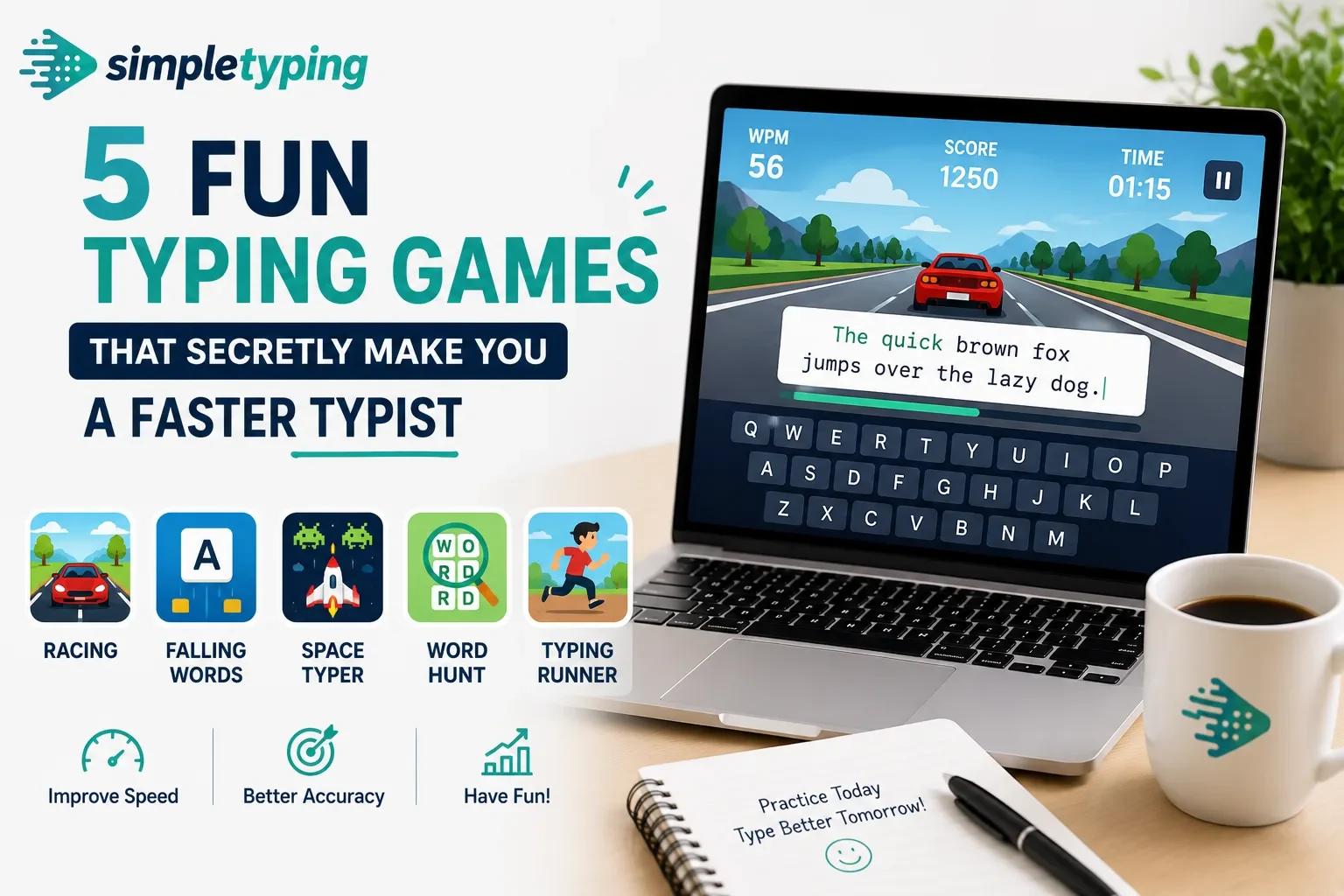
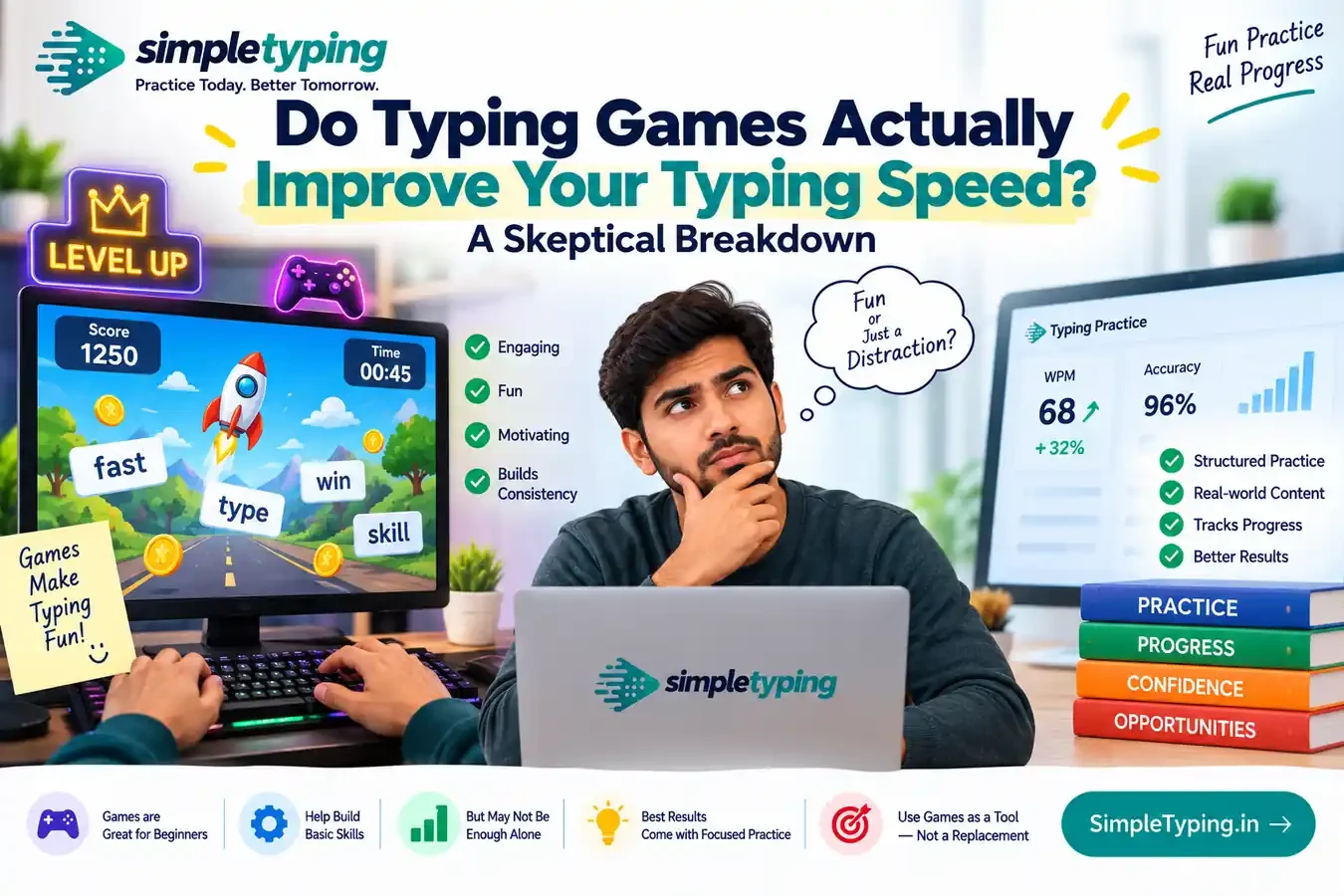
Search “typing games” and you will find hundreds of pages insisting that a few rounds of falling-letter arcade games will turn your kid into a 60 WPM typist by summer. Some of that is true. A lot of it is marketing dressed up as pedagogy. Before you hand your child — or yourself — a browser tab full of games and call it typing practice, it is worth asking the question nobody answers honestly: do these things move the needle, or do they just feel like progress while your fingers keep doing the same wrong thing, faster?
- The short, slightly annoying answer
- What typing games are actually good for
- What typing games cannot teach you
- Games vs. structured practice: side by side
- Kids, adults, and why the verdict splits
- A tale of two typists
- How to actually use typing games
- If you are prepping for a typing exam, read this first
- Key takeaways
- Frequently asked questions
The short, slightly annoying answer
Typing games improve typing speed the way a video game about weightlifting improves your bench press — sometimes, indirectly, and only if you were already doing the actual lifting elsewhere. They are excellent at reinforcing muscle memory you already have and weak at building muscle memory you don’t. A game can make a kid who already knows where the ‘F’ and ‘J’ keys are noticeably faster and more confident. It will not teach a kid who has never touch typed which finger belongs on which key, because the game rewards speed, not correct form.
That distinction — reinforcement versus instruction — is the whole article.
What typing games are actually good for
Give games credit where it is due. There are three things they do genuinely well, and none of them are “teach typing from zero.”
- Reinforcing finger-key mapping you already have. Once a learner knows the home row, a game that rewards quick, accurate key presses drills that association thousands of times without it feeling like drilling.
- Motivation, especially for kids. A 9-year-old will grind through a typing game for 20 minutes chasing a high score in a way they never would through a plain word list. A game that gets a reluctant kid to touch the keyboard daily beats zero practice.
- Low-pressure repetition. Games strip away timed-test anxiety. For someone who freezes during a formal test, a game environment rebuilds keyboard comfort before returning to structured practice.
Notice what all three share: they assume the underlying technique is already correct, or irrelevant to the score. That is exactly where the trouble starts.
What typing games cannot teach you
Most typing games score speed and maybe per-key accuracy. They almost never check which finger pressed the key, whether wrists are positioned correctly, or whether you glanced at the keyboard. That gap matters more than people assume.
- Correct technique from scratch. A beginner playing a fast-paced game will find the quickest path to a high score, and that path is almost always hunt-and-peck with two fast fingers, not touch typing. Games optimize for score, not method.
- Real accuracy discipline. Arcade-style games often let mistakes slide, or penalize them so lightly that players learn to type fast and sloppy rather than correct errors. Habits built under game pressure rarely survive a real typing test.
- Exam-relevant skills. Government exam typing tests grade sustained accuracy over structured paragraphs, not reflexes on falling words. Someone excellent at a 60-second arcade game can still fail an SSC or CPCT-style passage because the skills do not transfer. See our breakdown of government exam typing requirements for what actually gets measured.
None of this means games are bad. It means they solve a narrower problem than most parents and self-taught adults assume.
Games vs. structured practice: side by side
What each format is actually built to do well, stripped of marketing language.
| Skill or outcome | Typing games | Structured practice (lessons/drills) |
|---|---|---|
| Teaching finger placement from zero | Weak — rewards whatever is fastest, not correct form | Strong — built around home row and finger assignment |
| Keeping a reluctant beginner engaged | Strong — scoring and levels drive motivation | Weak — can feel repetitive without a coach or reward loop |
| Building sustained accuracy over long text | Weak — most games use short words or phrases | Strong — paragraph-based drills mirror real writing |
| Preparing for a graded exam typing test | Weak — format mismatch with exam passages | Strong — can mimic exact exam timing and text style |
| Reinforcing an already-correct habit | Strong — high-volume, low-boredom repetition | Moderate — effective but can feel like a grind |
| Diagnosing which fingers or keys are weak | Weak — rarely tracks finger-level data | Strong, when the tool reports per-key accuracy |
Games win on engagement, structured practice wins on precision. A smart plan uses both, in that order: technique first, games second.
Kids, adults, and why the verdict splits
The “do games work” question actually has two different answers depending on who is asking.
For kids, especially ages 7-12, games are close to essential. Children have short attention spans for anything that looks like a worksheet, and a game-based on-ramp genuinely increases the odds they stick with typing long enough to build a habit. The catch is sequencing: a few structured sessions on finger placement should come first, so the game reinforces the right pattern instead of cementing a workaround. Our typing practice for kids resources are built around exactly that order — basics first, games as the reward layer.
For adults, the calculus is different. Adults usually already know where the keys are; their problem is a speed plateau or accuracy under pressure, not basic mapping. Games can help an adult loosen up in short bursts, but adults chasing a specific goal — a certificate, an exam speed requirement, a professional benchmark — get far more out of paragraph-based, timed practice that mirrors the real test.
A tale of two typists
Priya’s 8-year-old son started on a typing game app because it was the only thing that held his attention for more than five minutes. Six weeks in, his in-game score had climbed steadily, but when Priya watched him type a sentence outside the game, he was still looking at the keyboard, using four fingers total. The game had made him faster at spotting letters on screen, not at touch typing. She backed up, spent two weeks on basic finger-to-key drills, and only then let him return to the games. His score dipped at first, but three months later his real, ungamed typing speed had doubled — something the first six weeks of pure gaming never delivered.
Rohit, a 26-year-old preparing for an SSC typing test, had the opposite problem. He was already fast from years of casual game-based practice, comfortably above 45 WPM on games. His first mock exam on a real exam-format passage came back at 31 WPM, accuracy under the threshold. The games had trained short bursts with forgiving scoring; the exam demanded five sustained minutes of clean, accurate text. He switched to full-length practice passages closer to the actual test, and his exam-condition speed caught up within a month.
Same underlying question, two different lessons: games can hide a technique problem, and they can hide a stamina-and-format problem. Both are fixable, once you stop trusting the game’s scoreboard as the whole picture.
How to actually use typing games
None of this is an argument to avoid games. It is an argument for sequencing them correctly.
- Learn the basics first. Spend a week or two on finger placement and home-row drills before introducing games, so the game reinforces good habits instead of a shortcut.
- Treat games as dessert, not dinner. A reasonable ratio is roughly 70-80% structured, paragraph-based practice and 20-30% games, once past the absolute beginner stage.
- Check real-world speed outside the game. Run an actual timed test on English typing practice passages every couple of weeks to confirm the gains show up in ungamed typing, not just in-game.
- Watch for compensations. If a game is being “won” by looking at the keyboard or using two fingers, it is training the wrong thing, however good the score looks.
- Use games to break plateaus, not create foundations. If someone is stuck at a speed for weeks despite correct technique, a game can loosen them up in a way another dull drill won’t.
If you want a low-pressure way to sample this, our own typing games section is free and works alongside the structured lessons rather than instead of them.
If you are prepping for a typing exam, read this first
This is the group most likely to be misled by strong in-game numbers. Exam-format tests — SSC, CPCT, and similar — grade accuracy percentage across a sustained passage, typically 10 minutes of formal English or Hindi text, not short arcade phrases. A high game score tells you almost nothing about whether you will clear that bar. If an exam is the actual goal, spend the bulk of your remaining prep time on full-length, exam-style passages under real timing, and keep games strictly as a warm-up. Create a free account at SimpleTyping to track your accuracy trend over real practice sessions instead of relying on a game’s internal score.
Key takeaways
- Typing games reinforce finger-key mapping and motivation; they do not teach correct technique from zero.
- Games tend to reward speed over accuracy, which can quietly build sloppy habits.
- Kids benefit most from games as a motivation layer, placed after basic technique instruction, not instead of it.
- Adults chasing a specific goal — exams, certificates, professional speed — need format-matched practice, which games rarely provide.
- A good split is roughly 70-80% structured practice to 20-30% games once past the absolute beginner stage.
- Always verify game-driven progress with a real, ungamed timed test on actual paragraphs.
Frequently asked questions
Do typing games really increase WPM?
They can, mostly by reinforcing finger-key associations you already have. They rarely teach the technique that produces lasting speed gains, so improvement plateaus unless paired with structured practice.
Are typing games a waste of time?
No, but they are incomplete alone. As a supplement after basic technique is in place, they add engagement and repetition. As the sole method, they often build shortcuts instead of real skill.
Can a complete beginner learn to type using only games?
Generally no. Beginners find the fastest path to a high score, usually hunt-and-peck with a couple of dominant fingers rather than touch typing. A short block of structured lessons first prevents this.
Are typing games good for kids specifically?
Yes, with a caveat. Games keep kids motivated and engaged, but work best when preceded by basic finger-placement instruction so the game reinforces correct habits rather than a workaround.
Why did my typing game score not match my real typing test score?
Games use short words or phrases with forgiving accuracy scoring and no sustained-passage requirement. Real typing tests, especially exam-format ones, measure accuracy over several continuous minutes, a different skill.
How much time should I spend on typing games versus structured practice?
A reasonable starting ratio is about 20-30% games to 70-80% structured, paragraph-based practice, adjusted based on whether real timed tests show matching improvement.
Can typing games help with exam preparation?
Only as a warm-up. Exam typing tests grade sustained accuracy on formal passages, which games do not simulate well. Prioritize full-length, exam-style practice instead.
Do typing games teach proper finger placement?
Most do not; they only reward speed and key accuracy. A few track finger-level data, but most popular games do not, so they cannot correct poor finger habits on their own.
Is it bad if my child looks at the keyboard while playing typing games?
It suggests the game is being won without touch typing. Pause the games and return to basic finger-placement drills before continuing, so the habit does not become permanent.
What is the biggest risk of relying only on typing games?
Building speed on incorrect technique or shallow accuracy habits. It feels like progress because scores rise, but it often does not transfer to real typing tests or professional typing tasks.
Can adults benefit from typing games too, or are they just for kids?
Adults can use games to break speed plateaus or reduce test anxiety, but they typically get more targeted improvement from paragraph-based, timed practice matched to their actual goal.
What should I use instead of, or alongside, typing games?
Structured lessons for technique, paragraph-based timed tests for stamina and accuracy, and games as an engagement supplement once the basics are solid.
{ "@context": "https://schema.org", "@type": "FAQPage", "mainEntity": [ { "@type": "Question", "name": "Do typing games really increase WPM?", "acceptedAnswer": { "@type": "Answer", "text": "They can, mostly by reinforcing finger-key associations you already have. They rarely teach the technique that produces lasting speed gains, so improvement plateaus unless paired with structured practice." } }, { "@type": "Question", "name": "Are typing games a waste of time?", "acceptedAnswer": { "@type": "Answer", "text": "No, but they are incomplete alone. As a supplement after basic technique is in place, they add engagement and repetition. As the sole method, they often build shortcuts instead of real skill." } }, { "@type": "Question", "name": "Can a complete beginner learn to type using only games?", "acceptedAnswer": { "@type": "Answer", "text": "Generally no. Beginners find the fastest path to a high score, usually hunt-and-peck with a couple of dominant fingers rather than touch typing. A short block of structured lessons first prevents this." } }, { "@type": "Question", "name": "Are typing games good for kids specifically?", "acceptedAnswer": { "@type": "Answer", "text": "Yes, with a caveat. Games keep kids motivated and engaged, but work best when preceded by basic finger-placement instruction so the game reinforces correct habits rather than a workaround." } }, { "@type": "Question", "name": "Why did my typing game score not match my real typing test score?", "acceptedAnswer": { "@type": "Answer", "text": "Games use short words or phrases with forgiving accuracy scoring and no sustained-passage requirement. Real typing tests, especially exam-format ones, measure accuracy over several continuous minutes, a different skill." } }, { "@type": "Question", "name": "How much time should I spend on typing games versus structured practice?", "acceptedAnswer": { "@type": "Answer", "text": "A reasonable starting ratio is about 20-30% games to 70-80% structured, paragraph-based practice, adjusted based on whether real timed tests show matching improvement." } }, { "@type": "Question", "name": "Can typing games help with exam preparation?", "acceptedAnswer": { "@type": "Answer", "text": "Only as a warm-up. Exam typing tests grade sustained accuracy on formal passages, which games do not simulate well. Prioritize full-length, exam-style practice instead." } }, { "@type": "Question", "name": "Do typing games teach proper finger placement?", "acceptedAnswer": { "@type": "Answer", "text": "Most do not; they only reward speed and key accuracy. A few track finger-level data, but most popular games do not, so they cannot correct poor finger habits on their own." } }, { "@type": "Question", "name": "Is it bad if my child looks at the keyboard while playing typing games?", "acceptedAnswer": { "@type": "Answer", "text": "It suggests the game is being won without touch typing. Pause the games and return to basic finger-placement drills before continuing, so the habit does not become permanent." } }, { "@type": "Question", "name": "What is the biggest risk of relying only on typing games?", "acceptedAnswer": { "@type": "Answer", "text": "Building speed on incorrect technique or shallow accuracy habits. It feels like progress because scores rise, but it often does not transfer to real typing tests or professional typing tasks." } }, { "@type": "Question", "name": "Can adults benefit from typing games too, or are they just for kids?", "acceptedAnswer": { "@type": "Answer", "text": "Adults can use games to break speed plateaus or reduce test anxiety, but they typically get more targeted improvement from paragraph-based, timed practice matched to their actual goal." } }, { "@type": "Question", "name": "What should I use instead of, or alongside, typing games?", "acceptedAnswer": { "@type": "Answer", "text": "Structured lessons for technique, paragraph-based timed tests for stamina and accuracy, and games as an engagement supplement once the basics are solid." } } ] }
If you have been using games as your entire typing practice, that is not wasted time — it is half a plan. Pair a session or two of structured, paragraph-based practice on our English typing test with the games you already enjoy, track your progress with a free account, and let the scoreboard that counts be the timed test, not the game.