Type "best typing website" into Google and you will get eleven results that all look identical — a text box, a timer, a WPM number, and a banner ad for something unrelated blinking in the sidebar. Most beginners just pick whichever one loads first, practice for two days, and quit because the site never actually taught them anything. This isn’t a ranked list of ten websites. It’s the checklist you can run against any typing site — including this one — before you waste a week on the wrong one.
- What actually matters when you’re starting from zero
- How to test-drive any typing site in 10 minutes
- Why the right site early saves you months
- Must-have vs nice-to-have vs red-flag features
- A few things experienced typists wish they’d known
- Mistakes beginners make when picking a site
- A real example: two beginners, two very different results
- Key takeaways
- Frequently asked questions
What actually matters when you’re starting from zero
If you’ve never done touch typing before, your first two weeks on a site decide whether you build correct habits or wrong ones that take three months to unlearn later. So the features that matter aren’t the flashy ones — they’re the boring, structural ones.
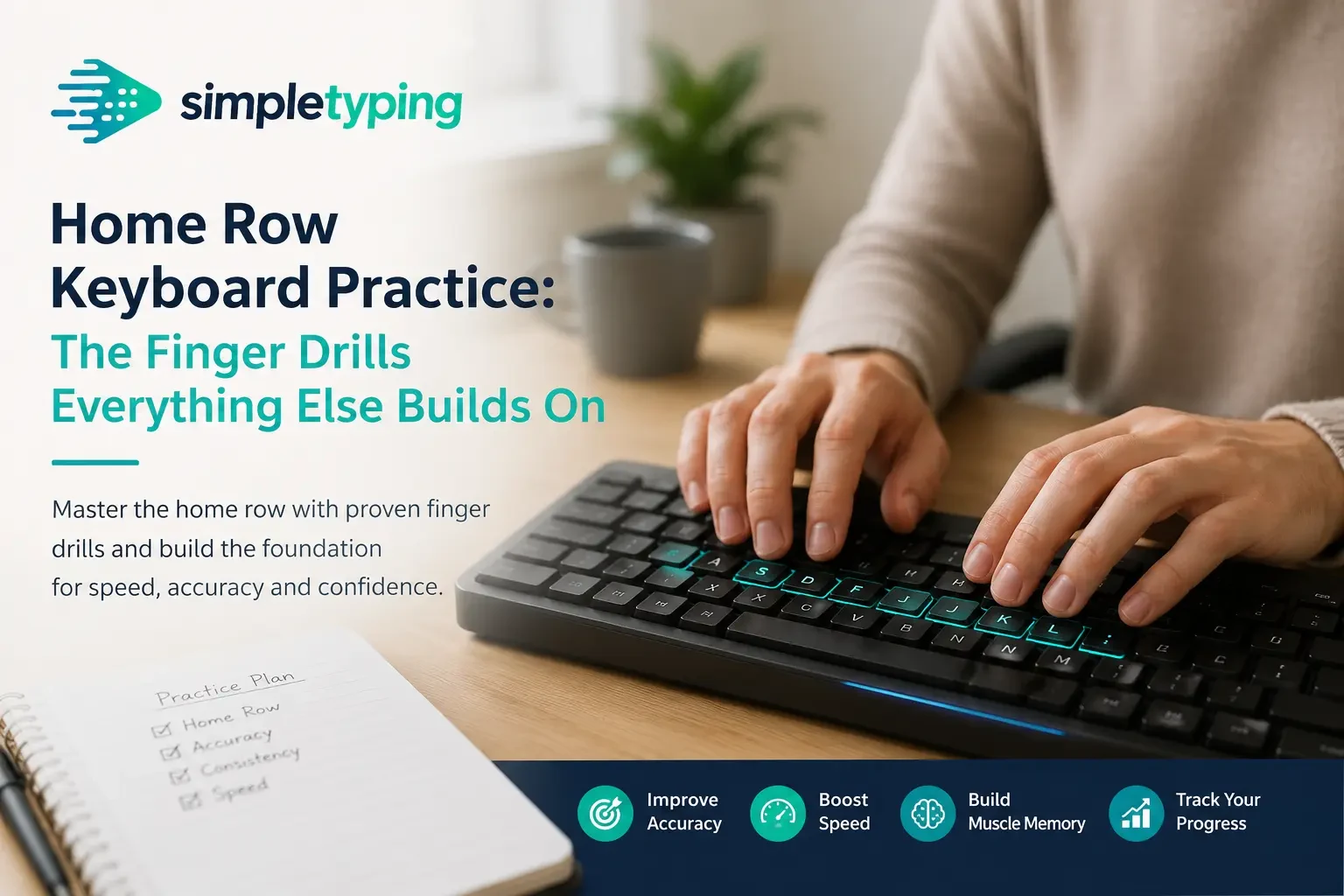
Structured lessons, not just random tests. A beginner who opens a random paragraph test on day one and starts hunting for letters is training exactly the habit they’re trying to break. What you actually need is a lesson path that starts on the home row (ASDF JKL;), adds a few keys at a time, and only introduces full sentences once your fingers know where the letters live without looking. A site built for English typing practice that jumps straight to a 60-word test paragraph on lesson one isn’t built for beginners, whatever the homepage says.
Real-time error highlighting. If a site only tells you your accuracy percentage after you finish, it's too late — you've already typed the wrong key twenty times and reinforced the mistake. You want the letter to turn red the instant you mistype it, right there under your cursor, so the correction happens in your fingers, not just in a report you read afterward.
Progress tracking that actually persists. Speed and accuracy numbers that vanish when you close the tab are close to useless. You want a dashboard that remembers your WPM from three weeks ago so you can see the line moving up, even slowly. This is one thing worth creating a free account for — it turns "I think I'm improving" into an actual number you can check.
No forced downloads. Beginners are frequently kids on a school Chromebook, adults on an office laptop with restricted admin rights, or someone on a shared family PC. A typing site that demands a desktop install, a browser extension, or Flash (yes, some old ones still try) is filtering out exactly the people it claims to serve. Everything should run in a plain browser tab.
Works on low-spec and locked-down machines. Government exam centres, school computer labs, and cyber cafes rarely run the latest hardware. If a site needs a high-end GPU to render a typing test smoothly, that's a design failure, not a feature.
How to test-drive any typing site in 10 minutes
You don't need to commit a week to find out if a site is worth your time. Run this ten-minute trial before you sign up for anything, save any bookmark, or tell a friend it's "the one":
- Minute 1–2: Open the site without logging in. Can you start typing within a few seconds, or does it push you through a signup wall first? A good site lets you try a free typing test before asking for your email.
- Minute 2–4: Look for a lesson menu. Does it start at the home row, or does lesson one throw a full paragraph at you? If there's no visible structure, that's a test site, not a learning site.
- Minute 4–6: Type a sentence and deliberately hit two or three wrong keys. Watch what happens on screen. Does the wrong letter get flagged immediately, or do you only find out at the end?
- Minute 6–7: Count the ads. One banner is normal for a free site paying its server bills. A pop-up mid-test, an auto-playing video, or an ad that shifts the text box down while you're typing is a dealbreaker.
- Minute 7–8: Check if it works for what you actually need — if you're preparing for a government exam, is there a mode that mimics the real exam typing test format and time limit? If you need Hindi, does Hindi typing actually work with a real keyboard layout, not just a gimmick?
- Minute 8–9: Try it on your phone or a slower device if that's what you'll actually practice on. A site that only works well on a fast laptop with a big monitor isn't realistic for most Indian users.
- Minute 9–10: Look for a way to save your result — a certificate, a score history, anything permanent. If every session evaporates the moment you close the tab, you have no way to prove or even see your own progress.
If a site fails more than one of these checks, move on. There are enough decent free options that you shouldn't have to settle.
Why the right site early saves you months
Picking well on day one isn't just about convenience — it changes your actual outcome. A beginner using scattered random-paragraph tests with no structure typically plateaus around 25–35 WPM within a month and then stalls, because they never built the finger-to-key muscle memory that structured lessons force. A beginner following a proper home-row-first curriculum with live error correction usually clears 40 WPM within three to four weeks of regular practice, because every session is reinforcing correct patterns instead of random ones.
There's also the exam angle. If you're a student aiming for SSC, a state-level clerical post, or any role with a typing eligibility bar, the site you train on should let you simulate that exact test format — same duration, same passage style, same scoring method used at the actual exam. Practicing on a generic test that scores differently from the real one gives you a false sense of where you stand, and that's a bad surprise to get on exam day.
And if you're picking a site for a child, the stakes are different again — a ten-year-old doesn't care about WPM charts, they care about whether it's frustrating or fun. A site with a proper typing course built for kids, shorter lesson bursts, and some game elements will keep a child practicing for weeks. A site built for adults, dropped in front of a child, usually gets abandoned in two sessions.
Must-have vs nice-to-have vs red-flag features
Here's the checklist in table form. Print it, screenshot it, whatever — use it on any site, not just this one.
| Category | Feature | Why it matters |
|---|---|---|
| Must-have | Structured, home-row-first lesson path | Builds correct finger habits instead of letting you guess-and-hunt from day one |
| Must-have | Real-time error highlighting | Corrects mistakes the moment they happen, not in a report after the fact |
| Must-have | No install, no browser plugin required | Works on school Chromebooks, office PCs, and shared computers with restricted access |
| Must-have | Free tier that doesn't require a card | Lets a genuine beginner try it properly before committing anything |
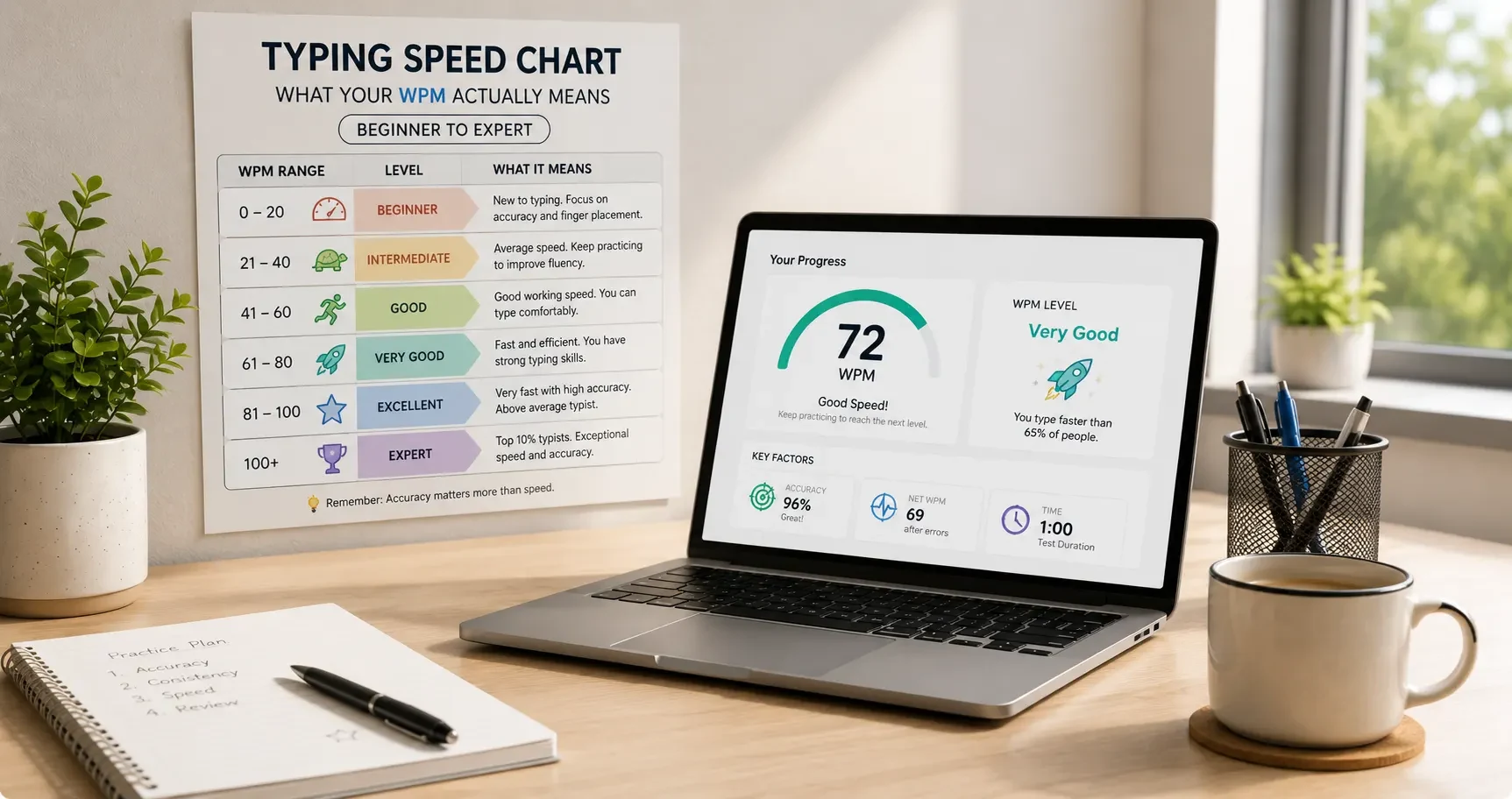
| Must-have | Accuracy and WPM shown together, not separately | Speed without accuracy is a meaningless number; the two have to be read together |
| Nice-to-have | Saved progress history / account dashboard | Useful for seeing improvement over weeks, though not essential to start learning |
| Nice-to-have | Downloadable or shareable certificate | Good for a resume line or school submission, but not what actually improves your speed |
| Nice-to-have | Typing games mixed into lessons | Helps with motivation, especially for kids, but shouldn't replace structured lessons entirely |
| Nice-to-have | Multiple language layouts (Hindi, regional) | Only matters if you actually need it — irrelevant if you only type in English |
| Nice-to-have | Exam-specific practice modes | Valuable if you're preparing for a government typing test, unnecessary otherwise |
| Red flag | Forced signup before you can type a single word | A confident site lets you try before you commit your email |
| Red flag | Ads inside or overlapping the typing area | Breaks your rhythm mid-test and is a sign the site prioritises ad revenue over your practice |
| Red flag | No visible lesson structure at all | Usually means it's a test-only site dressed up as a learning site |
| Red flag | Speed shown with no accuracy figure | Encourages reckless typing and hides the mistakes you're not fixing |
| Red flag | Vague or fake-looking testimonials on the homepage | A site selling itself on marketing rather than the actual practice experience |
A few things experienced typists wish they’d known
People who've actually gone from 20 WPM to 80+ WPM tend to say the same handful of things when you ask them what they'd do differently.
Accuracy first, speed later — always. A site that lets you race through a test at 90% accuracy and calls it a good score is teaching you to type carelessly. Aim for 97–98% accuracy before you even worry about your WPM number; speed comes on its own once the fingers know the layout cold.
Ten minutes daily beats ninety minutes on a Sunday. Muscle memory is built through repetition spread across days, not crammed into one long session. If the site you're using doesn't make it easy to do a short daily lesson, that's friction working against you.
Games are a supplement, not a curriculum. A round of a typing-based game is genuinely useful for reflexes and keeps things from getting boring, and browsing a few typing games once a week is a fine way to break the monotony. But if games are the entire lesson plan, you'll plateau because games rarely enforce correct finger placement the way structured drills do.
Test yourself under exam conditions occasionally, even if you're not sitting an exam. A timed, no-backspace-allowed test once a week tells you more about your real skill level than daily untimed practice does, because it removes the safety net of slowing down whenever you feel unsure.
Mistakes beginners make when choosing (and using) a typing site
Watching beginners struggle usually reveals the same five mistakes over and over.
- Picking the prettiest interface over the best lesson structure. A slick design with no home-row curriculum will teach you less than a plain-looking site with a proper lesson path.
- Ignoring accuracy scores because the WPM number feels more exciting. Chasing speed early just means unlearning bad habits later, which takes longer than building good ones from scratch.
- Switching sites every week. Every site tracks progress slightly differently, and jumping around resets your sense of improvement each time. Pick one, commit for a month, then reassess.
- Practicing only on a full keyboard at home and never on the smaller or different keyboard they'll actually use for an exam. If your target is a government typing test, occasionally practice on a similar setup to what the exam centre will have.
- Not tracking sessions at all. Without a saved history, you can't tell if you're actually improving or just imagining it. Even a basic account with saved scores solves this.
A real example: two beginners, two very different results
Two people, call them A and B, both start at roughly 18 WPM with heavy hunt-and-peck habits. A picks a random test site with no lesson structure and just repeats the same paragraph tests daily, watching the WPM number and ignoring accuracy, which sits around 85%. After a month, A has climbed to 28 WPM — but the accuracy hasn't moved, and A is still looking at the keyboard for half the letters.
B picks a site with a structured home-row-first path, uses the free tier for the first two weeks, and only moves to full-sentence tests once accuracy on shorter drills consistently hits 97%+. B tracks progress through a saved dashboard and does ten to fifteen minutes daily instead of one long weekend session. After the same month, B is at 34 WPM with 96% accuracy and has stopped looking at the keyboard almost entirely. The difference isn't talent or time invested — both practiced roughly the same total hours. It's that B's site enforced the right sequence and B's own instincts (track progress, prioritise accuracy) matched what the checklist above recommends.
Key takeaways
- Structure beats speed on day one — a home-row-first lesson path matters more than a flashy interface.
- Real-time error highlighting is what actually fixes bad habits; an end-of-test score alone won't do it.
- Accuracy above 97% should come before you chase a higher WPM number.
- Avoid sites that force signup before letting you type a single word, or that run ads inside the typing area.
- Progress tracking and a saved history matter more than they seem to — you need to see the line moving to stay motivated.
- Match the site to your actual goal: exam prep needs exam-format practice, kids need a kid-focused course, Hindi typists need a real Hindi layout, not a gimmick.
- Games are a nice supplement to keep practice from getting stale, not a replacement for structured lessons.
Frequently asked questions
What is the best online typing practice website for a complete beginner?
There's no single universal answer, but the checklist matters more than the brand name: look for structured home-row-first lessons, real-time error highlighting, no forced downloads, and a free tier you can try before committing. A site like SimpleTyping's English typing practice section is built around exactly that structure, but you should run the ten-minute trial above on whatever site you're considering, including this one.
Do I need to pay for typing practice, or is free enough for beginners?
Free is genuinely enough for the first several months, and often permanently. What you need as a beginner — structured lessons, tests, basic progress tracking — is standard on most free typing sites. Paid tiers usually add extras like detailed analytics or ad-free browsing, which are conveniences, not necessities.
How long does it take a beginner to reach 40 WPM?
With ten to fifteen minutes of focused daily practice on a structured site, most beginners starting from hunt-and-peck reach 35–40 WPM within three to five weeks. It varies with how much you were already typing before — someone who texts a lot on a physical keyboard will move faster than someone who's mostly used a phone.
Should I prioritise speed or accuracy when I'm just starting out?
Accuracy, without much debate. Type slowly enough to keep your accuracy at 97% or higher, and speed will follow naturally as your fingers memorise the layout. Chasing speed first just bakes in mistakes you'll have to spend extra weeks unlearning later.
Is it okay to learn typing through games instead of formal lessons?
Games are a good supplement but a poor substitute. They're great for keeping motivation up, especially for younger learners, and a session on a few typing games now and then doesn't hurt. But games rarely enforce correct finger placement the way a structured lesson does, so pair them with an actual course rather than relying on games alone.
Do typing certificates from online websites actually mean anything?
They're useful as a personal milestone and sometimes acceptable for school submissions or informal proof of skill, but they generally aren't a substitute for an official government or institutional typing test certificate if that's what a job or exam requires. Check what the certificate is used for on SimpleTyping's certificate page or the equivalent on any site before assuming it satisfies a formal requirement.
What typing speed do I need for government exams in India?
It varies by exam and post — SSC CGL data entry roles, for instance, typically require around 35 WPM in English or 30 WPM in Hindi, but requirements differ across SSC, state-level clerical exams, and stenography posts. Always check the specific notification for your exam, and practice on a site with a dedicated government exam typing practice mode that mirrors the real test format.
Can I practice Hindi typing on the same site as English typing?
Many sites offer both, but check that the Hindi layout is a real, standard one — Kruti Dev, Mangal (Unicode), or Remington — rather than a simplified demo version. A dedicated Hindi typing section that supports the layout your exam or job actually requires is worth checking before you invest weeks of practice in the wrong one.
Is it safe for kids to use typing practice websites unsupervised?
Mostly yes, as long as the site has no external ad networks tracking behaviour and doesn't require personal information beyond a basic account. Look for a site with a dedicated typing course for kids that keeps lessons short, avoids intrusive ads, and doesn't link out to unrelated content mid-lesson.
Does the typing site I use matter if I already know where the keys are?
Less than it does for a true beginner, but it still matters. Even typists who know the layout benefit from accuracy tracking and timed tests to identify weak fingers or specific letter combinations that slow them down. The main features that matter shift from "teach me the keyboard" to "show me exactly where I'm losing time."
What's a realistic red flag that a typing site isn't worth using?
If it interrupts your typing test with a pop-up ad, requires an email and password before you can type a single word, or shows a WPM score with no accuracy figure next to it, that's usually enough reason to look elsewhere. None of these are hard to spot in your first two minutes on the site.
How often should a beginner practice to see real improvement?
Daily, even if it's only ten minutes. Consistency across days builds the muscle memory that occasional long sessions don't, because typing skill is more about repetition frequency than total hours logged.
None of this checklist is complicated, which is sort of the point — picking a typing site shouldn't require research. Run the ten-minute trial, check the table against whatever you're considering, and prioritise accuracy over ego-boosting WPM numbers for the first month. If you want to start right now without opening another tab, try a free typing test on SimpleTyping, work through the structured lessons, and set up a free account so your progress and certificate are actually saved somewhere you can check back on.