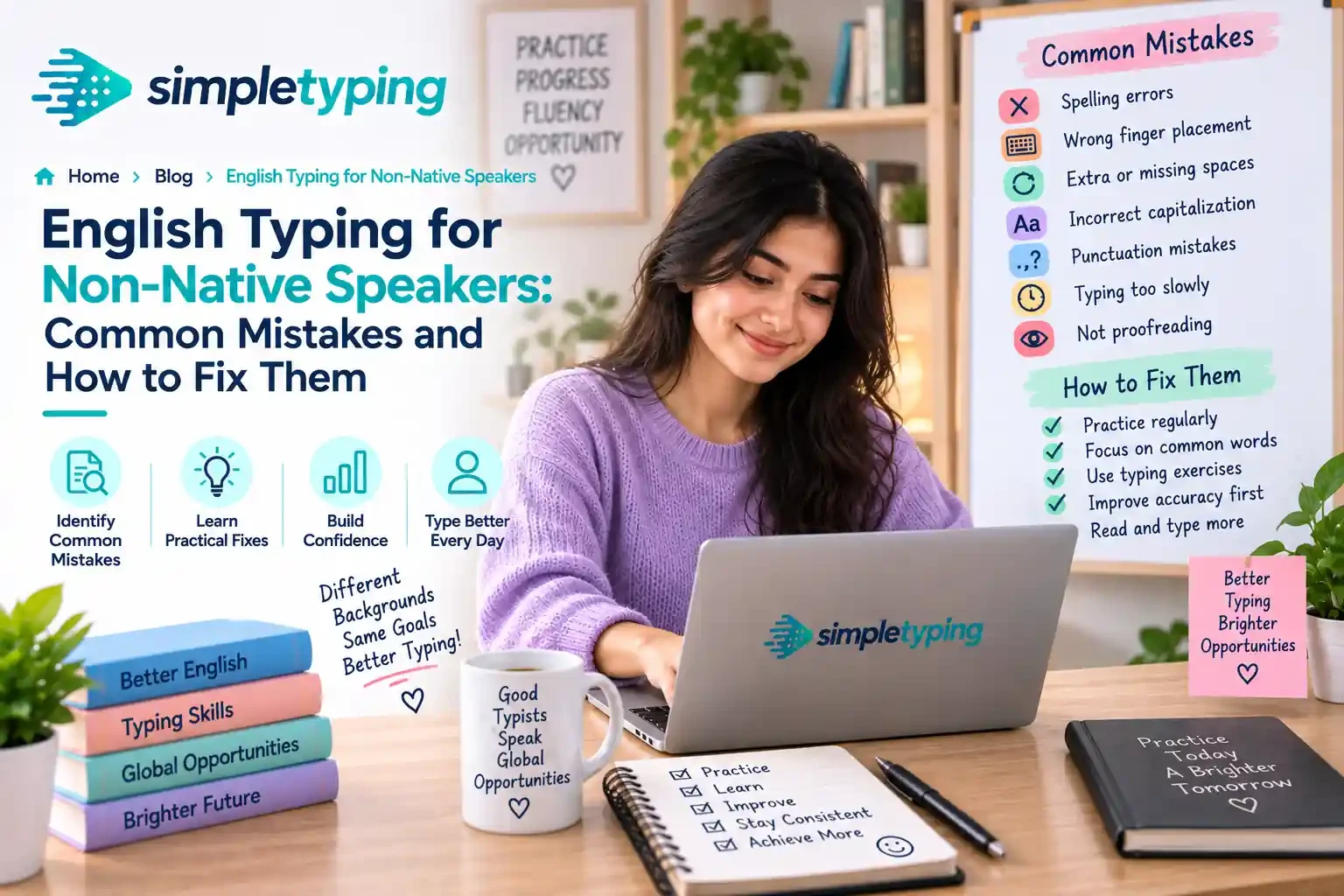
Here is a pattern we see constantly in our practice logs: a user types a Hindi or Marathi or Tamil sentence in their head fluently, but the moment they switch to an English paragraph, their words-per-minute drops by ten or fifteen points and their error rate quietly climbs. It is not a motor skill problem — their fingers know the keyboard fine. It is a language problem wearing a typing costume. If English is your second, third, or fourth language, the friction you feel while typing is real, it is specific, and most of it comes from five identifiable habits rather than some vague lack of “practice.” This article is about naming those habits and fixing them one at a time.
- Why English typing is a different skill when it is not your first language
- Spelling uncertainty: the hidden speed killer
- Unfamiliar word patterns and collocations
- The autocorrect trap: hiding errors instead of fixing them
- Punctuation and contractions that do not exist in your first language
- QWERTY unfamiliarity if you learned on a different script
- Real example: how Ravi cut his error rate in six weeks
- A practice routine built around these five mistakes
- Key takeaways
- Frequently asked questions
Why English typing is a different skill when it is not your first language
Touch typing courses are usually written for people who already know, without thinking, how every word they want to type is spelled and structured. That assumption quietly breaks down for a huge share of the typing-practice audience in India, where English is typically a second or third language learned formally in school rather than absorbed from birth. The keyboard is the same. The finger drills are the same. But the cognitive load is not the same at all — you are doing two jobs at once: composing correct English in your head, and then executing it on the keys. Native speakers only do the second job. That extra layer is where almost every non-native typing mistake actually originates, and it is why generic “type faster” advice so often misses the real problem.
Spelling uncertainty: the hidden speed killer
Watch a non-native typist closely and you will notice tiny hesitations before certain words — not because their fingers do not know where the letters are, but because their brain is not fully sure how the word is spelled until the moment it commits. Words like “necessary,” “occurred,” “definitely,” “government,” and “receive” are classic culprits because English spelling does not reliably match pronunciation, and that mismatch is far more disorienting if English was not the language your ear was trained on first.
This hesitation is invisible in a words-per-minute number but it shows up as inconsistent rhythm, which is often a bigger problem than raw speed. The fix is not memorizing a dictionary. It is building a personal list of your repeat offenders — words you consistently pause on or mistype — and drilling exactly those words in isolation before you meet them again in a paragraph. Most typists have a surprisingly short list, often under thirty words, that accounts for the majority of their hesitation.
- Keep a running note of any word that makes you pause or backspace more than once.
- Type that specific word ten times in a row, slowly and correctly, before returning to full sentences.
- Revisit the list weekly — words drop off it once they stop tripping you up.
Unfamiliar word patterns and collocations
Beyond individual spelling, English leans heavily on collocations — word pairs and phrases that native speakers produce as a single mental unit rather than word by word. “Make a decision,” “heavy rain,” “strong coffee,” “take a break.” If your first language builds these combinations differently, your brain has to consciously assemble the phrase instead of retrieving it whole, and that assembly time shows up as a stutter in your typing flow, particularly in longer paragraph practice.
This is exactly why practicing with real, connected English paragraphs matters more for non-native speakers than for anyone else — word-list drills never expose this gap because collocations only exist in context. Structured English typing practice that uses full sentences and paragraphs, rather than random word strings, gradually trains your brain to recognize and reproduce these common phrase patterns as chunks instead of rebuilding them from scratch every time.
The autocorrect trap: hiding errors instead of fixing them
If most of your daily English typing happens on a phone or in a word processor with autocorrect switched on, you have probably built a habit that works against you the moment you sit for a real typing test or a formal exam. Autocorrect silently repairs your spelling mistakes before you ever see them, which means you never get the feedback signal that would normally teach you to spell the word correctly yourself. Over months, this creates a strange gap: someone who writes flawless English messages every day but who, in an autocorrect-free typing test, reveals dozens of underlying spelling errors they did not know they had.
The fix is deliberately practicing in environments with autocorrect and predictive text turned off, so every mistake is genuinely yours to see and correct. A dedicated typing test does this by default, which is one reason typing platforms are useful for non-native speakers even beyond speed training — they surface exactly the errors your phone has been quietly hiding from you for years.
Punctuation and contractions that do not exist in your first language
English punctuation has quirks that simply are not present, or work differently, in many other languages. Contractions are the biggest one: “don’t,” “it’s,” “they’re,” “wouldn’t” all use an apostrophe placed at a specific point that has no logical shortcut if you did not grow up typing it thousands of times. Typists often either fumble the apostrophe key, place it wrong (“dont’t” or “does’nt”), or avoid contractions altogether by writing everything in full — which is technically correct but noticeably slows down natural sentence flow and reads stiffly in exam or workplace writing.
Comma placement around clauses, the difference between a hyphen and a dash, and when to capitalize after a colon are similar small landmines. None of these are hard once flagged explicitly, but they rarely get flagged explicitly in general typing lessons because course material assumes you already absorbed these rules through years of casual reading. Deliberately practicing sentences that are dense with contractions and mixed punctuation, rather than avoiding them, closes this gap faster than you would expect.
QWERTY unfamiliarity if you learned on a different script
For typists who first learned to type in Devanagari or another non-Latin script, there is an added layer that purely English-speaking beginners never face: the QWERTY layout itself needs to be learned as its own system, sometimes while unlearning muscle memory built for a completely different key mapping. Someone who is already a fast Hindi typing user on Kruti Dev or a phonetic layout does not automatically transfer that speed to English QWERTY — the finger-to-key associations are simply not the same keyboard logic, even though the physical keys are identical.
The mistake here is assuming existing typing speed in one script should carry over and getting frustrated when it does not. It will not, and treating English QWERTY as a fresh skill to build from home-row basics — rather than a shortcut off an existing skill — produces faster, less frustrating progress than trying to force old muscle memory onto a new layout.
| Common mistake | Why it happens | The fix |
|---|---|---|
| Hesitating on certain word spellings | English spelling does not match pronunciation reliably | Keep a personal repeat-offender list and drill those words alone |
| Slowing down on common phrases | Collocations do not transfer across languages | Practice full paragraphs, not isolated word lists |
| Hidden spelling errors in real tests | Daily typing relies on autocorrect to mask mistakes | Practice regularly with autocorrect and predictive text off |
| Wrong or missing apostrophes in contractions | No equivalent shortcut exists in the first language | Deliberately practice sentences dense with contractions |
| Slower speed despite being fast in another script | QWERTY finger mapping does not transfer from another layout | Relearn QWERTY from home-row basics instead of forcing old habits |
Real example: how Ravi cut his error rate in six weeks
Ravi, a bank clerk preparing for an SSC typing exam, could type Hindi comfortably at 35 WPM but struggled to break 22 WPM in English with an accuracy hovering around 88 percent. His first instinct was to just type more paragraphs and hope speed would follow. It did not move much for two weeks. What actually worked was diagnosis before repetition: he kept a notebook of every word he mistyped across five practice sessions and found that eleven words — mostly ones like “necessary,” “occasionally,” and “government” — accounted for nearly a third of his errors. He drilled those eleven words directly, turned off autocorrect on his phone for a month to stop hiding his real spelling gaps, and switched his daily paragraph practice to sentences loaded with contractions instead of avoiding them. Within six weeks his accuracy crossed 96 percent and his speed followed naturally, because he was no longer losing rhythm to the same handful of predictable stumbles.
A practice routine built around these five mistakes
You do not need a completely new practice system — you need your existing practice time pointed at the right targets. A simple weekly structure works well for most non-native typists:
- Start each session with two minutes reviewing your personal spelling repeat-offender list.
- Do your main paragraph practice with autocorrect and predictive text switched off, on a proper English typing test rather than a notes app.
- Once a week, deliberately choose a passage dense with contractions and mixed punctuation instead of avoiding it.
- If you are coming from a different script, keep a separate short QWERTY-only warm-up before switching to full sentences.
- Track accuracy trends, not just speed — a rising accuracy percentage over weeks is the real sign your language-level mistakes are resolving, and free registration on a typing platform makes it easy to see that trend rather than guessing from memory.
If your goal is a government exam rather than general fluency, the passage style and speed requirements differ enough that it is worth pairing this routine with dedicated government exam typing practice once your baseline accuracy is solid.
Key takeaways
- Typing hesitation in English is usually a language-confidence problem, not a finger-speed problem.
- A short personal list of repeat-offender words fixes more speed loss than generic drilling.
- Collocations and phrase patterns only get trained through full-sentence practice, not word lists.
- Autocorrect hides the exact errors you need to see to improve — turn it off during practice.
- Contractions and punctuation deserve deliberate practice, not avoidance.
- Speed from another script or layout does not automatically transfer to English QWERTY.
Frequently asked questions
Why is my English typing speed so much lower than my speed in my native language?
Because you are doing two tasks at once — composing correct English in your head and then executing it on the keyboard — while in your native language the composing step is nearly instant. The gap closes as English word patterns become automatic, not through faster finger movement alone.
Should I turn off autocorrect while practicing typing?
Yes. Autocorrect hides the real spelling mistakes you make, so you never learn from them. Practicing without it, especially on a dedicated typing test, shows you exactly where your language gaps are.
Is it normal to hesitate on certain English words even after years of using the language?
Yes, this is extremely common and usually limited to a small, specific set of words rather than the whole language. Identifying and drilling that specific set is far more effective than general practice.
Does knowing Hindi typing help with English typing speed?
Not directly. The finger-to-key mapping in Hindi layouts like Kruti Dev or phonetic typing is different from English QWERTY, so speed does not automatically transfer even though the physical keyboard is the same.
Why do I keep getting apostrophes wrong in words like don’t or it’s?
Contractions do not exist in the same form in many other languages, so the apostrophe placement has to be learned deliberately rather than absorbed naturally. Practicing sentences full of contractions instead of avoiding them fixes this fastest.
Should I avoid using contractions in typing tests if I am not confident with them?
No. Avoiding them slows your natural sentence flow and does not fix the underlying uncertainty. It is better to practice them directly until they stop causing hesitation.
How do I find out which words are actually slowing me down?
Review your mistyped words across several practice sessions and note any word that causes a pause, backspace, or repeated error. Most typists find a short, repeatable list of under thirty words responsible for most of their slowdown.
Is word-list practice or paragraph practice better for non-native English typists?
Paragraph practice is generally more useful because it exposes collocations and natural phrase patterns that word lists cannot replicate, which is where a lot of non-native hesitation actually comes from.
Can typing games help with these specific language-related mistakes?
They can help with reflexes and keyboard familiarity through casual play on a page like typing games, but they generally do not address spelling uncertainty or collocations the way structured paragraph practice does, since game text is often short and simplified.
How long does it typically take to fix these habits?
Many typists see a meaningful accuracy improvement within four to six weeks of targeted practice, as shown in the Ravi example above, provided the practice is aimed at their specific repeat mistakes rather than generic repetition.
Do I need a paid course to fix non-native English typing mistakes?
No. Most of the fixes described here — tracking your own mistakes, turning off autocorrect, practicing contraction-heavy sentences, and relearning QWERTY deliberately — can be done with free, regular practice and do not require paid coursework.
Will these mistakes affect my score in a government typing exam?
Yes, unresolved spelling uncertainty and punctuation errors directly reduce accuracy scores in exams like SSC and CPCT typing tests, which is why it is worth fixing them before switching focus to exam-specific speed requirements.
If any of these five mistakes sounded familiar, the fastest next step is simply to see them in your own numbers — run a few sessions on our English typing practice with autocorrect off and watch which specific words and patterns cause your slowdowns. Create a free account to track your accuracy trend over time, so you know for certain whether these fixes are actually working rather than guessing from how a session felt.