Sixty seconds. That’s all it takes to get a WPM number that a lot of people treat like a final verdict on how good a typist they are. It isn’t one — not fully, anyway. A free one minute typing speed test online is a genuinely useful tool, but it measures something narrower than most people assume, and if you lean on it the wrong way it can quietly distort your practice plan or tank your confidence over a fluke word.
This isn’t an argument against the one-minute format. It’s an honest look at what a 60-second reading is good for, why it wobbles more than longer tests, and how to actually use it so the number means something.
On this page
- What a One-Minute Typing Test Actually Measures
- Why the Numbers Jump Around: The Math of a Small Sample
- How to Use a One-Minute Test Well
- Where the One-Minute Format Actually Earns Its Keep
- One Minute vs Five Minutes vs Ten Minutes
- Tips From People Who Actually Track Their WPM
- Common Mistakes People Make With Short Tests
- A Quick Real-World Example
- Key Takeaways
- Frequently Asked Questions
What a One-Minute Typing Test Actually Measures
A one-minute typing test counts how many characters you type in sixty seconds, divides by five (the standard word length used in every typing test, including the ones on our English typing practice page), and subtracts a penalty for errors to get net WPM. That’s it. It doesn’t know if you’re warmed up, tired, distracted, or running on the adrenaline of trying to beat your last score.
What it actually captures is a snapshot of your peak short-burst speed under whatever mental state you were in during that particular minute. It’s closer to a sprint time than a marathon pace. Useful information, but only if you know which one you’re looking at.
Compare that to a real exam-style typing test — the kind used for SSC, state-level clerical posts, or court typist exams, which usually run 10 to 15 minutes on a full passage. Those tests are designed to catch what happens after the first burst wears off: hand fatigue, concentration drift, and the small errors that creep in around minute six or seven. A one-minute test structurally cannot show you any of that, because it ends before fatigue has a chance to show up.
Why the Numbers Jump Around: The Math of a Small Sample
Here’s the part most typing sites don’t bother explaining, and it’s the actual reason your one-minute score can swing from 42 to 51 and back to 44 across three attempts with nothing else changing.
Say you’re typing at a genuine pace of 40 WPM. In one minute, that’s roughly 40 words, or about 200 characters. Now suppose you fumble one extra word — a name, a number, an unfamiliar word — that you wouldn’t normally miss. Net WPM typically deducts one error per uncorrected mistake per minute. On a one-minute test, that single slip drops your net score from 40 to 39: a 2.5% swing from one word.
Now run the same slip during a five-minute test at the same pace. You’ve typed roughly 200 words over five minutes, and that one extra error is now divided across five minutes of typing time. Net WPM moves from 40 to 39.8 — a 0.5% swing. On a ten-minute test, the same single error barely moves the needle at all: about a 0.25% change. The impact of one mistake on your score scales down proportionally with test length. A 1-minute test is roughly five times as sensitive to a single error as a 5-minute test, and ten times as sensitive as a 10-minute one.
There’s a second layer of noise too, separate from errors: word-to-word speed variance. Even a smooth typist doesn’t type every word at identical speed — some words are short and familiar, others make you pause. Statistically, the more words you sample, the closer your average speed gets to your “true” pace, because the standard error of an average shrinks with the square root of the sample size. A one-minute test samples around 40 words; a ten-minute test at the same pace samples around 400 — ten times the data. That means the ten-minute score sits inside a confidence band roughly three times tighter than the one-minute score (√10 ≈ 3.16). In plain terms: a ten-minute test tells you your speed. A one-minute test tells you your speed, give or take a fair bit.
How to Use a One-Minute Test Well
None of this means the one-minute format is useless — it means it has a job, and the job isn’t “final assessment.” Here’s how to actually get value out of it.
- Use it as a warm-up, not a measurement. Run one or two throwaway one-minute rounds before a longer practice session on Free Typing Test just to get your fingers moving and your eyes off the keyboard. Don’t record these scores.
- Take three in a row and average them. A single 60-second reading is noisy; three back-to-back attempts, averaged, cancel out a lot of that randomness without eating fifteen minutes of your day.
- Log it daily instead of judging it daily. One test today means little. Thirty tests over a month, plotted as a trend line, mean quite a lot — the noise averages out across the sample.
- Use it as a same-conditions comparison tool. Test at the same time of day, same passage difficulty, same posture. Comparing a fresh-morning score to a post-lunch score isn’t a fair fight.
- Reserve the long-format test for real decisions. If you’re checking readiness for a government exam typing test or deciding whether you’re ready to sit a real speed exam, run the full 10-minute passage, not a minute-long guess.
Where the One-Minute Format Actually Earns Its Keep
Used the right way, a 60-second test does a few things genuinely well.
- Low friction, high frequency. A one-minute commitment is easy to repeat every day. A ten-minute one isn’t, and a habit you skip is worth nothing.
- Fast confidence check. Before a timed exam or an interview typing round, a quick test can settle nerves — or flag that you need another few minutes of warm-up first.
- Great for streaks. If you’re building a daily typing habit, a one-minute round is short enough that “no time today” stops being an excuse. Track it with a free account on SimpleTyping.in and you’ve got a running record without any extra effort.
- Trend detection. Individual scores are noisy, but a rolling average across many one-minute tests over weeks is actually a decent way to see whether your speed is genuinely improving or just fluctuating.
- Good for kids and absolute beginners. A one-minute test doesn’t demand much attention span, which makes it a reasonable entry point on typing for kids before moving to longer lessons.
One Minute vs Five Minutes vs Ten Minutes
| Test Length | Approx. Words Sampled (at 40 WPM) | Statistical Reliability | Shows Fatigue? | Best Used For |
|---|---|---|---|---|
| 1 minute | ~40 words | Low — one error can swing score 2–3% | No | Daily habit, warm-up, quick confidence check |
| 5 minutes | ~200 words | Moderate — roughly 5x steadier than 1 min | Partially | Weekly progress check, casual accuracy practice |
| 10 minutes | ~400 words | High — roughly 10x steadier than 1 min | Yes | Exam prep, certification-level readiness checks |
None of these lengths is “wrong.” They just answer different questions. The 1-minute test answers “how fast can I go right now, this second.” The 10-minute test answers “how fast can I sustain, under real conditions.” If you’re prepping for a real exam, only the second question matters on exam day.
Tips From People Who Actually Track Their WPM
- Don’t chase your best-ever score. That number was probably a fluke run with an easy passage and zero mistakes. Chase your median instead — it’s the honest number.
- Separate speed days from accuracy days. On a one-minute test it’s tempting to type recklessly for a bigger number. Occasionally run a slower, error-free minute on purpose — it trains a different muscle than raw speed.
- Watch the trend line, not the daily dot. If you want to see whether you’re actually improving, look at your weekly average, not today’s single result.
- Rotate passage type. A one-minute test on easy common words will always read faster than one on a passage with numbers, punctuation, or capitals. If every test uses the same easy text, your “improvement” might just be memorization.
- Mix in play. Short bursts of a typing game hit the same fast-feedback loop as a one-minute test but keep practice from feeling like a chore, which matters more for consistency than any single drill.
Common Mistakes People Make With Short Tests
- Treating one attempt as truth. A single 60-second score isn’t your typing speed — it’s one sample from a range. Take a few before believing the number.
- Comparing scores across different days without context. Tired, caffeinated, distracted — all of it shows up more in a short test than a long one, because there’s no time for the average to settle.
- Using it to gauge exam readiness. A 55 WPM one-minute score does not mean you’ll hold 55 WPM for ten straight minutes under exam pressure. Fatigue and nerves show up later, and a one-minute test never gets there.
- Ignoring accuracy in favor of the WPM number. A high WPM with a 90% accuracy rate is a worse result than a slightly lower WPM at 98%, especially for exams that disqualify you past an error threshold.
- Racing the clock instead of typing naturally. Knowing you only have sixty seconds tempts people into a rushed, sloppy style that doesn’t reflect how they’d actually type in a real document or exam.
A Quick Real-World Example
Rohit, prepping for an SSC CHSL typing round, ran a one-minute test every morning for two weeks and watched his score bounce between 32 and 41 WPM with no clear pattern. He assumed he was plateaued and got frustrated. When he switched to running the actual 10-minute passage format twice a week instead, his score settled at a consistent 35 WPM — steadier, and closer to what he’d actually need to sustain on exam day. The one-minute tests weren’t lying to him; they were just too short to average out the noise. Once he added longer sessions into his routine on English Typing practice, the picture got a lot clearer, and he kept the one-minute tests around purely as a daily habit-tracker rather than a scorecard.
Key Takeaways
- A one-minute test measures peak short-burst speed, not sustained, exam-condition speed.
- Because the sample is small (about 40 words), a single mistyped word can swing your score by 2–3%, roughly five to ten times more than the same mistake would move a 5- or 10-minute score.
- Adrenaline and the absence of fatigue both inflate the one-minute number compared to how you’d perform over a longer stretch.
- Use one-minute tests as a daily habit, warm-up, or streak tool — not as proof of exam readiness.
- For anything that matters — a real exam, a job typing test, an honest benchmark — run the longer format and trust the average over the outlier.
Frequently Asked Questions
Is a one-minute typing test accurate?
It’s accurate as a snapshot, not as a stable measurement. Because it only samples around 40 words, a single error or a lucky easy sentence can shift the score by a few WPM. Run it three times and average the results if you want something closer to a true reading.
What’s a good WPM score on a one-minute test?
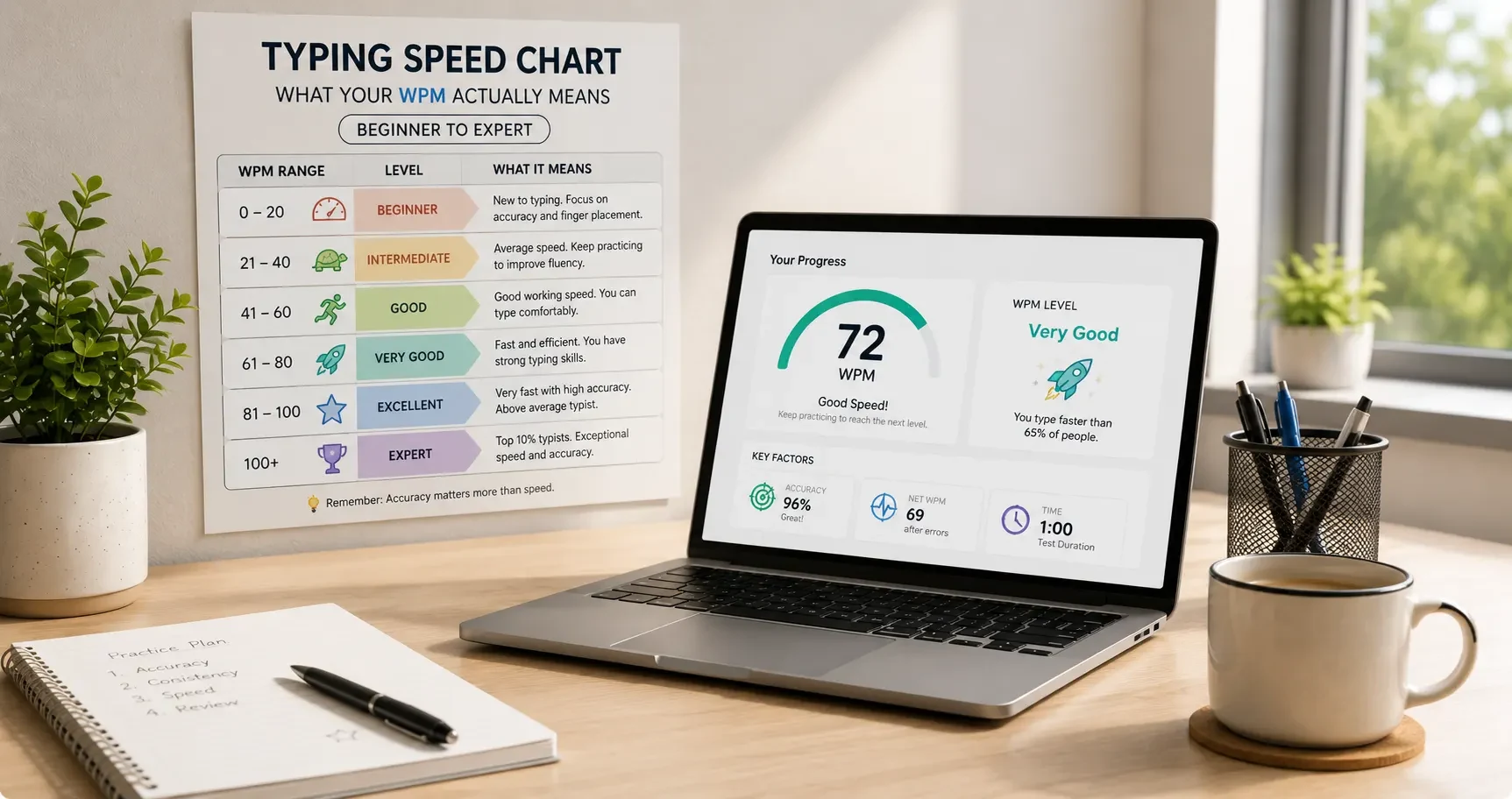
For most adults, 35–45 WPM is an average result, 50–65 WPM is solid, and anything above 70 WPM is genuinely fast. Government exam typing requirements are usually lower — often in the 30–35 WPM net range — but sustained over 10 minutes, which is a different bar entirely.
Why does my WPM change so much between one-minute tests?
Because the sample size is small. One mistyped word, one unfamiliar phrase, or a moment of distraction has an outsized effect on a 40-word sample compared to a 200- or 400-word one. This is normal statistical noise, not a sign you’re getting worse.
How many times should I take a one-minute typing test in a day?
Two or three back-to-back attempts, averaged, give a far more honest number than a single try. Beyond that, you’re better off switching to a longer session for real practice value.
Is a one-minute test enough to prepare for a government exam typing test?
No. Exam formats like SSC and state clerical typing tests run 10 minutes or more, and fatigue, concentration lapses, and cumulative errors only show up over that length. Use the one-minute format for daily warm-ups, but do your serious readiness checks with a full-length typing exam practice session.
Does a one-minute test measure accuracy the same way as speed?
It reports an accuracy percentage, but on a 40-word sample, one or two mistakes can swing that percentage by several points. Accuracy readings get meaningfully more reliable on longer passages simply because there’s more data to average over.
Should beginners use one-minute tests?
Yes, especially early on. Short tests keep the pressure low and the feedback loop fast, which suits beginners on English typing practice or kids working through typing for kids lessons. Just don’t treat any single score as a fixed judgment of ability.
How is WPM calculated in a one-minute test?
Every five characters typed — including spaces — count as one “word.” Total characters typed divided by five gives gross WPM. Net WPM subtracts a penalty for each uncorrected error, which is why accuracy and speed are always linked, never separate numbers.
Can I get a certificate from a one-minute typing test?
Most certificate-worthy typing tests use a longer passage — usually a minute isn’t enough to generate a credible score for a formal typing certificate. Create a free account on SimpleTyping.in to track your longer-format results and generate a typing certificate once your score is consistent.
What’s the difference between gross WPM and net WPM?
Gross WPM counts everything you typed, mistakes included. Net WPM subtracts a penalty for errors, so it reflects what you actually produced correctly. Net WPM is the number that matters for exams and job assessments.
Is it better to take a long test or many short tests?
Both, for different reasons. Many short tests build a daily habit and are easy to stick with over weeks. A long test is what actually tells you your sustainable, exam-ready speed. Use short tests to build the habit and long tests to check the truth.
Why does my speed look higher in a one-minute test than in a longer one?
Adrenaline and the absence of fatigue. In the first minute you’re fresh and often typing with extra focus knowing the clock is short. Over 5 or 10 minutes, concentration naturally dips and small errors creep in, which is exactly the effect a one-minute test is too short to catch.
A one-minute typing test isn’t broken and it isn’t lying to you — it’s just answering a smaller question than most people think it is. Use it the way it’s built to be used: a quick daily pulse-check, not a verdict. When you actually need to know your real, sustainable speed — for an exam, a job application, or just your own peace of mind — run the full-length version instead. Head over to Free Typing Test for the full-length English test, try the Hindi Typing lessons if that’s your track, and set up a free account at SimpleTyping.in to log your streak, watch your trend line instead of your daily noise, and earn a typing certificate once your numbers actually settle.