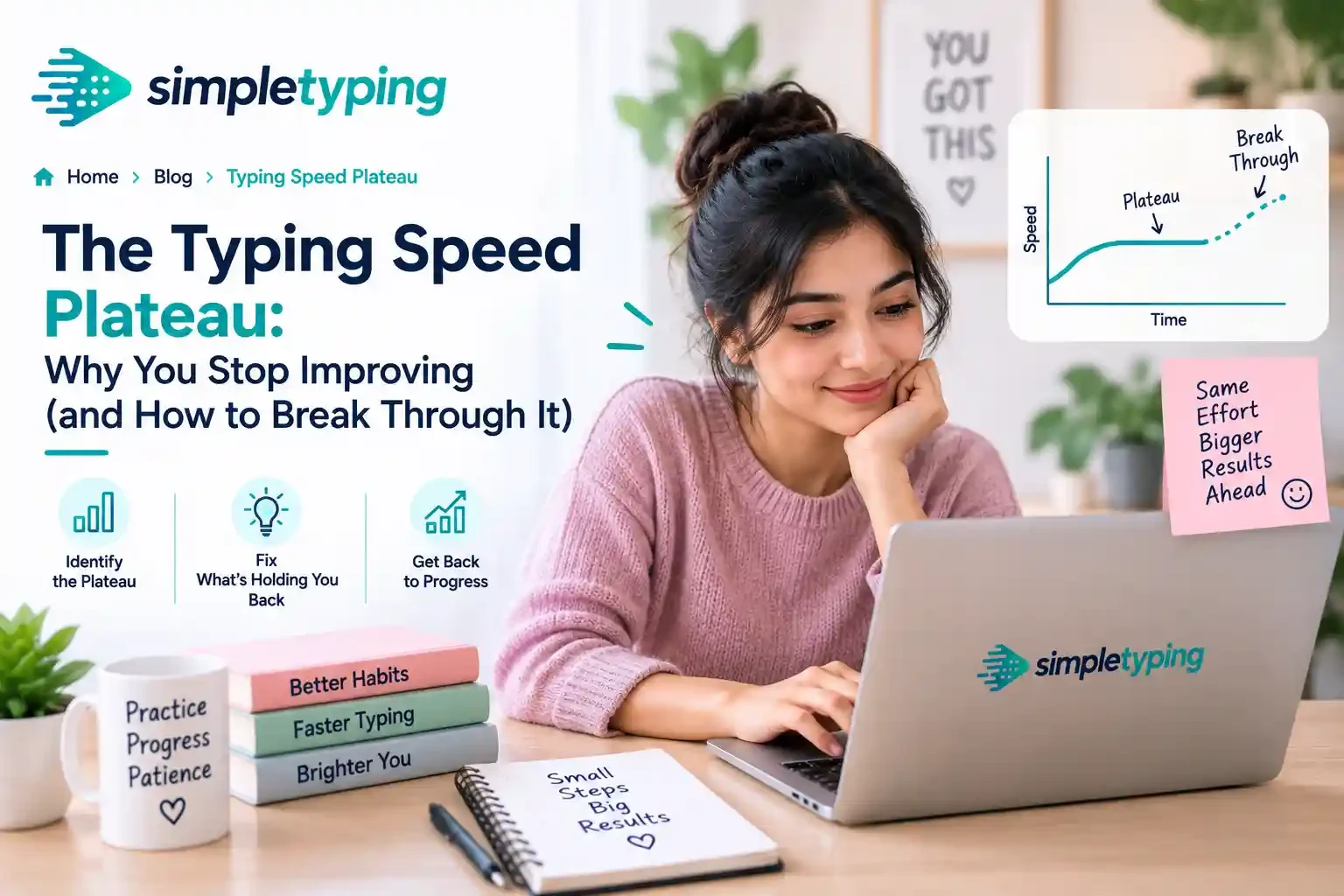
Type the same fifty common words for six weeks straight and something strange happens: your WPM climbs fast, then stalls, then refuses to budge no matter how many more rounds you throw at it. That plateau isn’t bad luck — it’s what happens when you train on word lists past the point they can teach you anything new. Real writing isn’t a list of disconnected words; it’s sentences with rhythm, punctuation that interrupts your flow, and word pairs your fingers need to learn as a unit. That’s exactly what paragraph practice trains, and it’s why most people who move from word drills to full paragraphs on an English typing test see their real-world speed jump even when their drill-only WPM had gone flat.
On this page
- Why word lists stop working after a while
- What actually makes a practice paragraph good
- How to structure paragraph practice as you level up
- What paragraph practice actually trains
- Word drills vs. paragraph practice, side by side
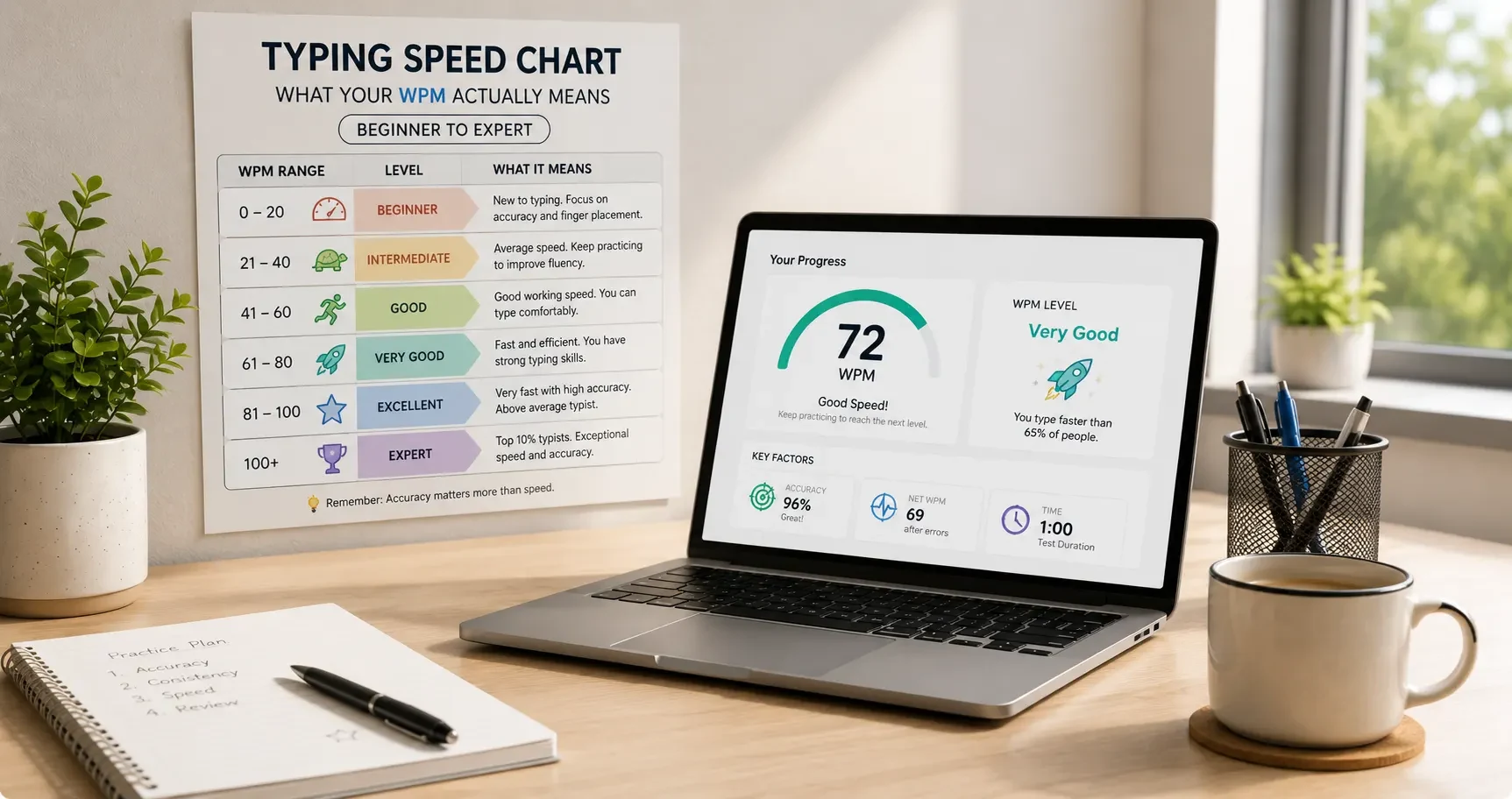
- How to read your results beyond the WPM number
- Common mistakes people make with paragraph practice
- A real example: 38 WPM to 61 WPM in six weeks
- Key takeaways
- Frequently asked questions
Why Word Lists Stop Working After a While
Word-list drills are great for exactly one thing: teaching your fingers where the keys are. In your first week or two of touch typing, that’s all you need. But a list of isolated words — even a smart one built from the most frequent words in English — strips out everything that makes real typing hard. There’s no punctuation to react to mid-sentence. There’s no capital letter appearing three words after a period. There’s no comma forcing a tiny pause, no semicolon, no closing quotation mark you have to remember you opened four words ago. Your brain also gets a free pass between words — a beat of dead time it doesn’t get in a paragraph, where one word flows straight into the next with only a space between them.
Paragraphs force your fingers and your eyes to work the way they will when you’re actually typing an email, a report, or an answer sheet in a government exam. That’s the whole point of switching from drills to running text once the basics are locked in — and it’s a step a lot of people skip because word lists feel like they’re "working" simply because the WPM number keeps ticking up early on.
What Actually Makes a Practice Paragraph Good
Not every block of text is useful practice. A paragraph built entirely from short, repeated common words ("the cat sat on the mat, the cat sat on the mat") is barely better than a word list wearing a disguise. A genuinely useful practice paragraph has a few specific traits:
- Sentence length variety. A good paragraph mixes short punchy sentences with longer ones that run 20-30 words, because real writing does the same, and your rhythm needs to adjust on the fly rather than settle into one comfortable tempo.
- Natural punctuation. Commas, periods, question marks, the occasional colon or set of quotation marks — not crammed in artificially, but placed the way a person actually writes.
- A believable vocabulary spread. Some common words, some less common ones, the odd number or capitalized proper noun. If every sentence uses the same twenty words, you’re not training reading-ahead, you’re just training memorization of that specific paragraph.
- A subject you can actually follow. Nonsense text (lorem-ipsum style filler) removes meaning, and meaning is what lets your eyes skip ahead and predict the next word before you’ve finished typing the current one.
Good online typing tests generate or curate paragraphs with these traits on purpose. If you’re practicing on text that’s just repeated high-frequency words strung together, you’re not getting paragraph-level training even though it looks like one on screen.
How to Structure Paragraph Practice as You Level Up
Paragraph practice isn’t one-size-fits-all. What you should be typing at 20 WPM is different from what you should be typing at 70 WPM. Here’s a rough progression that works for most learners moving through an English typing practice routine:
- Absolute beginner (0-20 WPM): Spend most of your time on finger-placement drills and short word lists. You genuinely need repetition on individual keys and common letter combinations before paragraphs will teach you much — jumping straight to full sentences here just means a lot of stopping and hunting.
- Early beginner (20-30 WPM): Start mixing in short, simple paragraphs — maybe three sentences, familiar vocabulary — for about a third of your practice time, keeping the rest on word lists and key drills.
- Intermediate (30-50 WPM): Flip the ratio. Paragraphs should now make up most of your practice, maybe 70-80%, with word drills reserved for specific weak spots like a particular letter combination or number row accuracy.
- Advanced beginner heading toward fluency (50-65 WPM): Practice almost entirely with paragraphs, and start choosing ones with denser punctuation — dialogue with quotation marks, semicolons, parenthetical asides.
- Advanced (65+ WPM): Bring in harder material on purpose — technical vocabulary, longer unfamiliar words, formal writing with more complex punctuation. This is also the stage where practicing for a specific goal, like a government exam typing test with a strict accuracy cutoff, actually starts to matter more than chasing a higher WPM.
- Ongoing maintenance: Once you’re comfortable, rotate paragraph topics and difficulty every session so you don’t quietly memorize a small set of passages and inflate your own numbers without realizing it.
What Paragraph Practice Actually Trains
The benefit isn’t just "more realistic practice" in the abstract. Paragraph practice specifically builds a handful of skills that word lists structurally cannot:
- Rhythm. Typing a sentence at a steady pace, without the tiny reset that happens between isolated words, is a different motor skill than typing words one at a time.
- Reading ahead. Fluent typists read three or four words ahead of what their fingers are doing. Word lists give your eyes nothing to look ahead to — there’s no next word until the current one resolves.
- Punctuation reflexes. Hitting shift for a capital letter mid-sentence, reaching for a comma without breaking stride, closing a quotation mark you opened two clauses ago — none of this exists in a word list.
- Common word-pair memory. Phrases like "as well as," "in order to," or "on the other hand" get typed as near-single units by fluent typists. That only develops from seeing them together, repeatedly, in context.
- Stamina and consistency. A two-minute paragraph test reveals whether your speed holds steady or falls apart by the last line — something a ten-word drill can never show you.
Word Drills vs. Paragraph Practice, Side by Side
| Skill Being Trained | Word-List Drills | Paragraph Practice |
|---|---|---|
| Raw key/finger placement | Excellent for beginners | Decent, but not focused |
| Punctuation handling | Poor to none | Strong — the main advantage |
| Reading-ahead / eye-hand lag | Doesn’t apply | Directly trained |
| Typing rhythm and flow | Choppy, stop-start | Continuous, realistic |
| Common word-pair memory | Weak | Strong |
| Endurance over 2-5 minutes | Not really tested | Directly tested |
| Transfer to real-world typing (emails, forms, exams) | Limited | High |
How to Read Your Results Beyond the WPM Number
Most people finish a paragraph typing test, glance at the WPM number, feel a flicker of pride or disappointment, and close the tab. That’s leaving most of the useful information on the table. A single test result usually gives you accuracy percentage, error count, and sometimes a breakdown of where errors clustered — and each of those tells you something the headline number doesn’t.
- Check accuracy before speed. 70 WPM at 88% accuracy means you’re re-typing roughly one in every eight words in real use. A steady 55 WPM at 98% will out-produce that typist on any real task with a deadline.
- Look at where errors happened, not just how many. Errors clustered near punctuation marks point to a specific fixable habit. Errors scattered evenly across the whole paragraph usually point to fatigue or rushing.
- Compare speed in the first half vs. the second half. If you consistently slow down in the last 30 seconds of a test, that’s a stamina problem, not a speed problem, and it needs longer paragraphs, not faster ones.
- Track trends over a week, not a single session. One test result is noise. Ten results over ten days is a trend. Creating a free account and running the typing certificate tracking on SimpleTyping lets you actually see that trend instead of guessing from memory.
Common Mistakes People Make With Paragraph Practice
- Retyping the same one or two paragraphs over and over. After a few repeats you’re typing from memory, not from reading, and your WPM stops reflecting anything real.
- Chasing WPM and ignoring accuracy entirely. A high number built on sloppy typing doesn’t transfer to actual work, where every mistake costs you time to fix.
- Skipping word drills too early. Jumping into paragraphs before you know the keyboard layout just means constant hunting mid-sentence, which trains bad habits rather than good rhythm.
- Never increasing difficulty. Sticking with easy, familiar paragraphs long after they stop being a challenge is comfortable, but it’s also why plateaus happen.
- Treating every practice session like a graded exam. Constant pressure to beat your last score leads to tense shoulders, rushed fingers, and worse accuracy — some sessions should just be relaxed reps, especially if you’re prepping for something like an exam typing test weeks out.
- Ignoring punctuation-heavy or technical paragraphs once comfortable. Advanced typists who only ever practice easy conversational text plateau just as hard as beginners who only use word lists.
A Real Example: 38 WPM to 61 WPM in Six Weeks
A friend prepping for a state-level clerical exam started at 38 WPM with 91% accuracy, almost entirely from years of casual, hunt-and-peck-adjacent typing. For the first ten days she stuck to short word drills and finger-placement exercises to fix her hand position, which by itself pushed her to 44 WPM. Then she switched to paragraph practice almost exclusively — short paragraphs at first, then longer ones with more punctuation as her comfort grew. She also started checking her per-session error breakdown instead of just the WPM at the end.
What she found was that nearly 40% of her errors were happening around commas and capital letters right after a period — not random mistakes, a specific habit. She spent about a week doing paragraph practice with heavier punctuation on purpose, deliberately slowing down through those spots. Six weeks after starting, she was at 61 WPM with 97% accuracy, comfortably clearing the speed requirement for her exam with room to spare. The word drills got her fingers moving; the paragraphs are what actually got her exam-ready.
Key Takeaways
- Word lists are good for absolute beginners learning finger placement, but they stop teaching you much once you’re past roughly 25-30 WPM.
- Paragraphs train rhythm, punctuation reflexes, reading-ahead, and common word-pair memory — none of which isolated words can teach.
- A good practice paragraph has varied sentence length, natural punctuation, and a real vocabulary spread — not just repeated easy words.
- Shift your practice ratio gradually: mostly word drills as a beginner, mostly paragraphs once you’re intermediate and beyond.
- Accuracy and error location matter more than the raw WPM number once you’re past the early stages.
- Rotate your practice paragraphs and increase difficulty deliberately, or you’ll plateau on comfortable, memorized text.
Frequently Asked Questions
Is paragraph typing practice better than word list practice?
It depends on your level. For absolute beginners, word lists are actually more useful because they isolate finger placement without the added complexity of punctuation and sentence flow. Once you’re past roughly 25-30 WPM, paragraph practice becomes more valuable because it trains rhythm, punctuation handling, and reading-ahead — things word lists simply don’t include.
How many paragraphs should I type per practice session?
Three to five paragraphs of two to three minutes each is a solid daily session for most learners — enough to warm up, hit a working rhythm, and still track meaningful results without burning out your focus. Longer sessions are fine occasionally, but consistency day to day matters more than session length.
What’s a good WPM for paragraph typing as a beginner?
Most beginners land between 15 and 25 WPM on paragraph text in their first few weeks, which is normal and expected — paragraphs are naturally a bit slower than word lists because of the added punctuation and sentence-level thinking. By three to four months of regular practice, 35-45 WPM is a realistic and common target.
Should I prioritize speed or accuracy when typing paragraphs?
Accuracy first, almost always. Speed built on a shaky accuracy foundation collapses the moment the material gets slightly harder, while accuracy built first tends to carry speed up naturally behind it. A good rule of thumb is not to push for higher WPM until you’re consistently above 95% accuracy at your current speed.
Why do I type faster on word lists than on paragraphs?
Word lists let your fingers rest for a fraction of a second between words, and there’s no punctuation, capitalization, or sentence-level reading to slow you down. That gap is completely normal — it usually shrinks as you get more comfortable with paragraph structure, but it rarely disappears entirely, because paragraphs are simply doing more work.
Can paragraph practice help with government exam typing tests?
Yes, and arguably more than word drills at that stage, since exam typing tests are almost always graded on full passages with real punctuation, not isolated words. Practicing with paragraphs that resemble exam-style content, through a dedicated typing exam practice section, gets you much closer to the actual test conditions than generic word drills do.
How long does it take to see improvement from paragraph practice?
Most people notice a difference within two to three weeks of consistent daily practice, and a clearer jump — often 10-15 WPM — within six to eight weeks. The exact timeline depends heavily on how much of that time is spent on properly varied paragraphs versus repeating the same few passages.
Are typing games a substitute for paragraph practice?
Not a full substitute, but a useful supplement. A well-designed typing game can keep motivation up and reinforce speed under light pressure, but most games use short bursts of text rather than full paragraphs, so they don’t train sentence-level rhythm and punctuation the same way dedicated paragraph practice does.
Does paragraph practice work for Hindi typing too?
The same principle applies. Whether you’re practicing Hindi typing in Kruti Dev, Mangal, or Remington layout, moving from isolated words to full sentences once you know the keyboard layout builds the same rhythm and reading-ahead benefits as it does in English.
What kind of paragraphs should advanced typists practice with?
Once you’re comfortably past 60-65 WPM, plain conversational paragraphs stop challenging you much. Look for text with denser punctuation — dialogue, semicolons, parenthetical clauses — and some technical or formal vocabulary, since that combination is closer to what you’ll actually type in professional or academic settings.
Is it okay for kids to start with paragraphs instead of word lists?
Generally no, especially for younger learners. Children typically do better starting with short, simple word and key drills to build basic finger placement and confidence before moving into full sentences. A structured typing for kids path that introduces paragraphs gradually tends to hold attention and build accuracy far better than throwing a full paragraph at a child on day one.
How do I track my progress with paragraph typing over time?
The most reliable way is to test regularly under similar conditions and log the results rather than relying on memory of "feeling faster." Creating a free account lets you keep a running history of your sessions and eventually earn a typing certificate once you hit a consistent speed and accuracy benchmark, which gives you an actual record rather than a vague impression.
Word lists get your fingers on the right keys, but paragraphs are what turn that into typing you can actually use — for exams, for work, for anything longer than a single sentence. If you’ve been stuck at the same WPM for a few weeks, that plateau is often just a sign it’s time to switch most of your practice over to full paragraphs. Head over to the free typing test to try a paragraph-based test right now, and if you want to see your progress mapped out over weeks instead of guessing from memory, create a free account and work toward your first typing certificate.