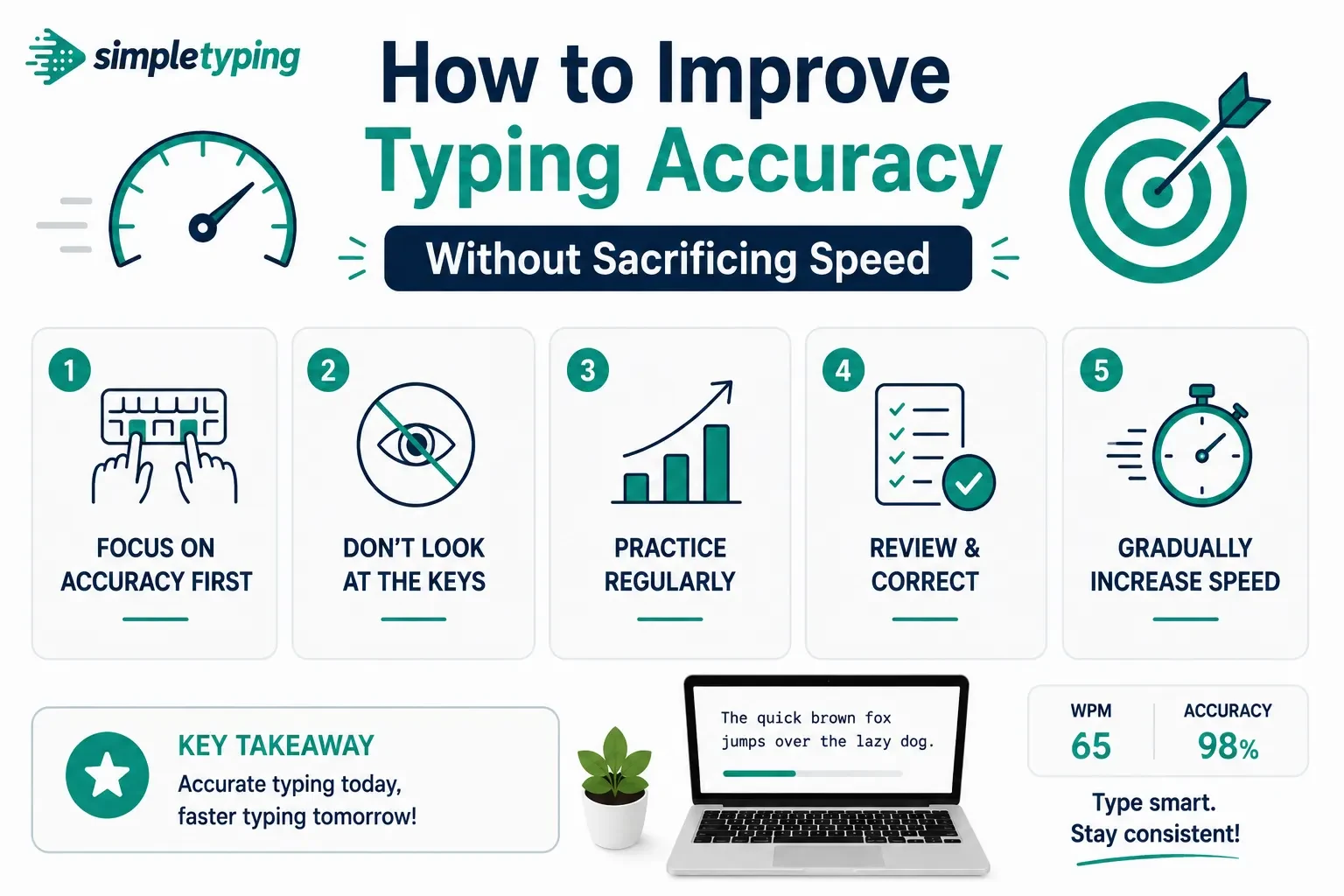
It is tempting to treat speed and accuracy as a trade-off, but past a certain point they are not in tension at all — sloppy typing actively slows you down once you count the time spent correcting mistakes.
Slow down on purpose, briefly
Spend a few sessions typing at roughly 70% of your usual speed with a goal of zero errors. This retrains muscle memory around correctness instead of raw velocity.
Notice which keys you actually miss
Most typists have two or three specific letter pairs or symbols responsible for the majority of their errors. Review your result history and drill those specific patterns instead of practicing generically.
Stop looking at the keyboard to ???double check???
Glancing down to confirm a keystroke is usually where an accurate touch typist becomes an inaccurate one — trust your finger memory and keep your eyes on the passage.
Do not rush the last line
A lot of avoidable errors happen in the final few seconds of a timed test as typists rush to finish. Keep your pace steady through the whole passage rather than sprinting at the end.
Use accuracy-focused practice modes
Our English Typing practice highlights mistakes in real time as you type, which builds the kind of instant feedback loop that speeds up error correction long-term.