{ "@context": "https://schema.org", "@type": "BreadcrumbList", "itemListElement": [ { "@type": "ListItem", "position": 1, "name": "Home", "item": "https://simpletyping.in/" }, { "@type": "ListItem", "position": 2, "name": "Blog", "item": "https://simpletyping.in/blog/" }, { "@type": "ListItem", "position": 3, "name": "Structured Typing Lessons vs Random Practice: Which One Actually Builds Skill Faster?", "item": "https://simpletyping.in/blog/structured-typing-lessons-vs-random-practice/" } ] }
Two people can practice typing for the exact same number of hours and end up with completely different skill ceilings, depending on whether they followed structured typing lessons or just jumped into random word tests from day one. This is not a minor stylistic difference — it changes which fingers hit which keys, how fast bad habits get locked in, and how long it takes before your WPM score actually means something. Most typing sites, including this one, offer both a lesson-based track and free-form random practice, but almost nobody explains when to use which. This article compares the two approaches head-to-head across the dimensions that actually matter, walks through two real outcomes, and lays out a weekly split for people who want the benefits of both without wasting months on the wrong one first.
- What "structured lessons" and "random practice" actually mean
- How structured typing lessons build skill
- How random practice builds skill
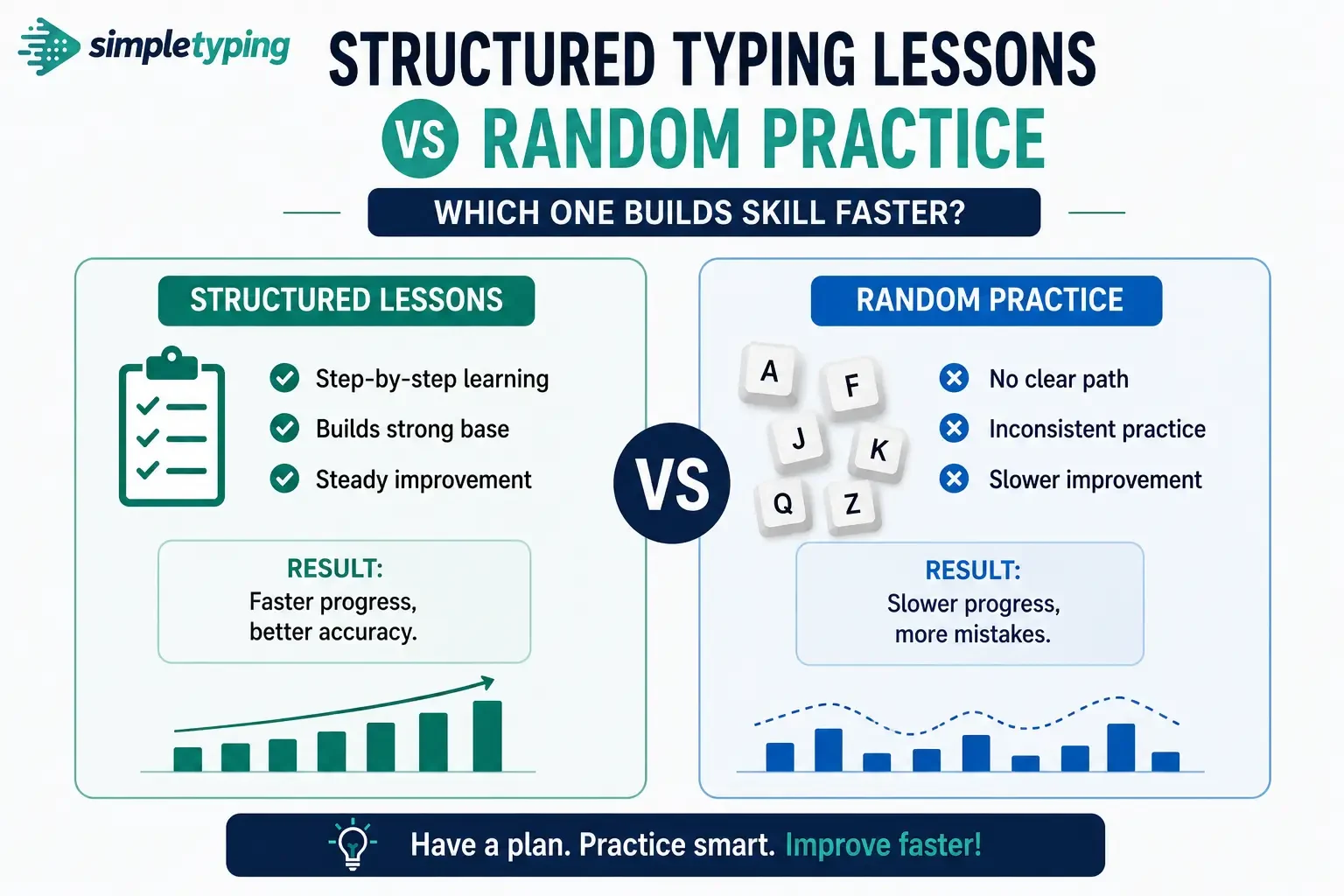
- Head-to-head comparison
- Two typists, two paths: what actually happened
- Who should combine both, and how
- Common mistakes with each approach
- Key takeaways
- Frequently asked questions
What "structured lessons" and "random practice" actually mean
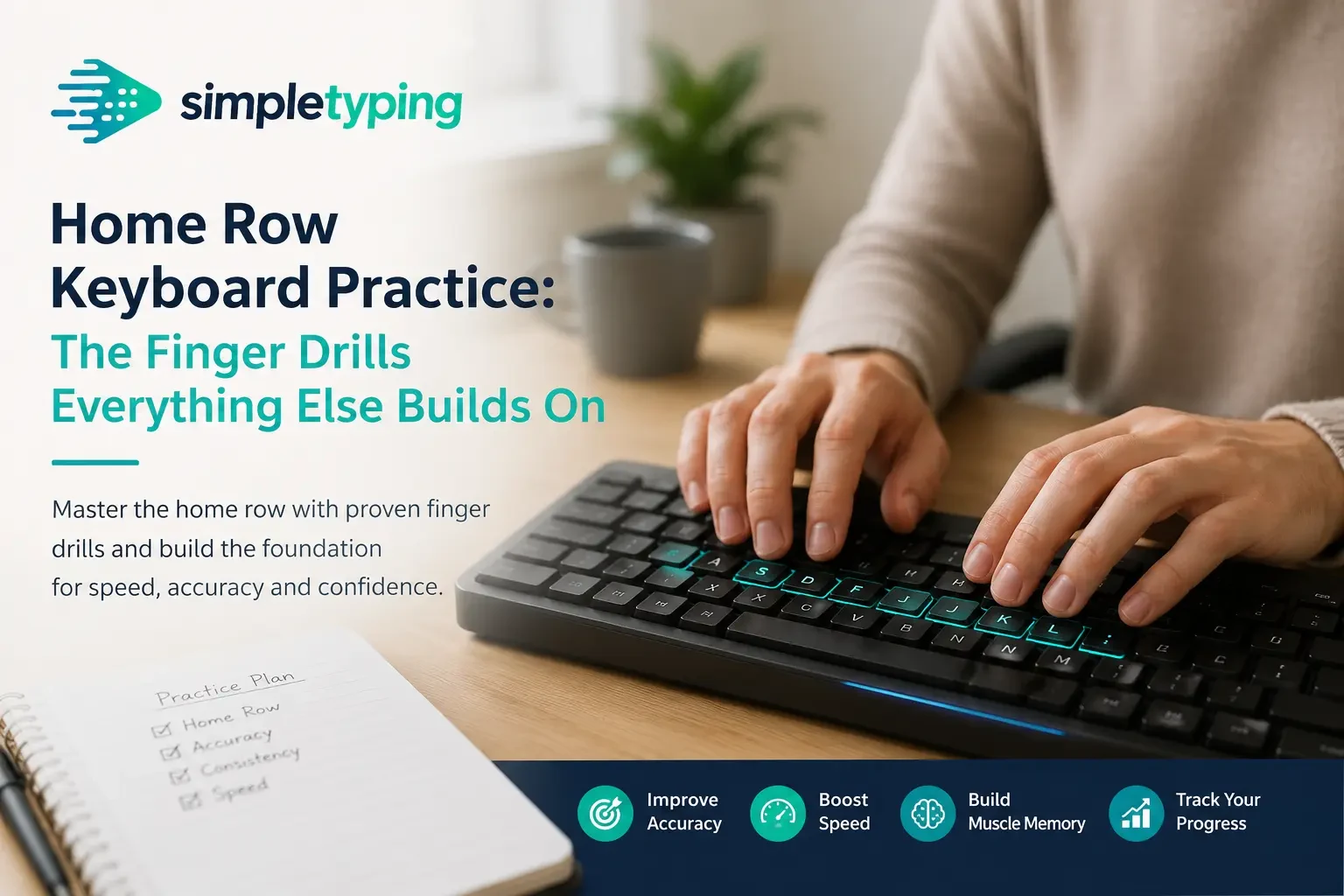
Structured typing lessons follow a fixed sequence: you start on the home row (asdf jkl;), add the top row, then the bottom row, then numbers and symbols, with each lesson assuming you have mastered the one before it. The goal is not speed — it is correct finger-to-key mapping, built one row at a time so no bad habit ever gets a chance to form. Random practice skips all of that. You open a timed test or a random paragraph generator and just type whatever appears, using whatever fingers already feel natural, with speed (WPM) and accuracy as the only feedback you get.
Both exist for a reason. SimpleTyping’s English typing section and Hindi typing section both offer lesson-style progressions alongside free random tests, precisely because different typists at different stages need different tools. The confusion is not that one method is "correct" — it is that people pick whichever one is more fun on day one, without knowing that choice quietly decides how their typing looks a year later.
How structured typing lessons build skill
Structured lessons work by isolating variables. When you are only asked to type "fff jjj fff jjj" for five minutes, your brain is not distracted by unfamiliar words, punctuation, or speed pressure — it is purely encoding which finger owns which key. This is why touch-typing courses insist on starting with the home row before anything else: it gives your fingers a "base" they can always return to, which is the entire mechanical foundation touch typing depends on.
The tradeoff is pace. Lessons are deliberately slow and repetitive, and your WPM number barely moves for the first one to two weeks because you are not being tested on speed yet — you are being tested on whether the correct finger reaches for the correct key without looking. For someone who has never touch-typed, this phase is not optional. Skipping it does not save time; it just moves the problem downstream, where it is far harder to fix because the incorrect movement has already become automatic. The real payoff of structured lessons shows up in weeks four through eight, when accuracy and speed both start climbing together because there is no bad habit fighting against the improvement.
How random practice builds skill
Random practice — jumping straight into a one-minute or five-minute timed test with unpredictable words — works through a completely different mechanism: pattern exposure under time pressure. Real writing is not "fff jjj fff jjj"; it is common letter clusters like "tion," "the," "ing," and "and" appearing constantly, along with punctuation, capital letters, and the occasional awkward word. Random practice forces your hands to adapt to that unpredictability immediately, which is exactly what a lesson track, by design, delays.
For someone who already has a rough idea of the keyboard layout — even an inconsistent one from years of self-taught typing — random practice can produce visible WPM gains within the first week, because the brain is already pattern-matching against real vocabulary instead of drilling isolated keys. The catch is that random practice has no mechanism for correcting *how* you get to a fast result. If two fingers are doing the work of four, random practice will happily let your WPM climb anyway, right up until it hits a ceiling that no amount of additional random practice can push past, because the actual bottleneck was never speed — it was finger allocation.
Head-to-head comparison
Laid side by side, the two methods are strong in almost exactly the places the other is weak, which is precisely why the "which one is better" debate rarely has a single answer.
| Dimension | Structured Lessons | Random Practice |
|---|---|---|
| Best for skill stage | Absolute beginners with no touch-typing habits yet | Intermediate typists refining real-world speed |
| Engagement / boredom risk | Higher — repetitive drills can feel slow and dry | Lower — feels like "real" typing from the first minute |
| Measurable progress | Clear lesson-by-lesson completion, but WPM moves slowly | WPM and accuracy change every session, though the numbers are noisy |
| Time to see results | Slower in week one, compounds strongly after week four | Fast initial jump, then a hard plateau |
| Risk of reinforcing bad habits | Low, as long as lessons are followed in order | High, especially for people who never learned proper finger placement |
Two typists, two paths: what actually happened
Ananya, 24, is a fresh graduate preparing for a bank clerk exam who had never touch-typed before. She started on SimpleTyping’s structured lesson track and refused to touch a timed test until she had finished the home row, top row, and bottom row modules — a little over three weeks. Her early numbers were unimpressive: barely 18 WPM after two weeks, all on drills, no real tests. But her finger placement was correct from day one. By week six she crossed 38 WPM at 96% accuracy, and both numbers have kept climbing steadily since, because she never had to unlearn anything.
Vikram, 38, is an experienced computer user who already roughly knew where most keys were after years of self-taught, semi-hunt-and-peck typing. He skipped lessons entirely and went straight into daily one-minute random word tests. His WPM jumped fast at first — 32 WPM in the very first week — because he already had rough key familiarity to build on. But his accuracy plateaued around 88% for months, because random practice never corrected which fingers he was actually using. Two years later, he still glances down at the keyboard occasionally and has never broken 45 WPM, despite logging far more total practice hours than Ananya ever needed.
Who should combine both, and how
Almost everyone benefits from combining the two eventually — the real question is sequencing. A practical split for someone starting from zero: spend the first two to four weeks doing 4 days of structured lessons plus 1 day of light random practice (just to see how it feels, not to chase a score), with 2 rest days. Once the core lesson track is finished, flip the ratio: 2 days of lesson review focused on your weakest fingers, 3 days of random practice or timed tests to build real speed, 1 day of typing games for variety, and 1 rest day.
For someone who already type-tested their way to an intermediate speed without ever learning proper form — Vikram’s situation — the fix is to temporarily reverse the usual order: go back to structured lessons focused specifically on the fingers and keys causing the most errors, even though it feels like a step backward, before returning to random practice. It is uncomfortable because WPM often dips for a week or two during the correction, but it is the only way past a habit-driven plateau. The English typing practice and typing games sections both work well as the "day 5" variety slot in this schedule, since games keep random practice from feeling like a chore.
Common mistakes with each approach
The most common lesson-track mistake is treating lessons as a checkbox exercise — rushing through home row in one sitting to "get to the real typing," which defeats the purpose since the whole point is repetition until the movement is automatic, not until the lesson is technically complete. A close second is quitting lessons the moment WPM feels low, without realizing low WPM is expected and temporary at that stage.
The most common random-practice mistake is optimizing purely for the WPM number while ignoring accuracy, which produces exactly the kind of fast-but-sloppy typing that is hardest to fix later. A second common mistake is assuming random practice alone will "eventually" fix bad finger habits through sheer repetition — it will not, because random tests have no mechanism for flagging which finger did the work, only whether the letter appeared correctly on screen.
Key takeaways
- Structured typing lessons are better for true beginners because they prevent bad habits before they form.
- Random practice produces faster early WPM gains but can lock in incorrect finger habits if used too soon.
- Lesson-based progress looks slow at first, then compounds strongly after four to six weeks.
- Random-practice-only typists often plateau in accuracy regardless of total hours practiced.
- Combining both — lessons first, then a mixed weekly split — consistently outperforms either method alone.
- If you already type fast but inaccurately, going back to targeted lessons is usually the fastest fix, not more random practice.
Frequently asked questions
Are structured typing lessons better than random practice for absolute beginners?
Yes. Absolute beginners have no existing finger habits to protect, so lessons can establish correct technique from the very first session, which is far easier than correcting bad habits later.
Can I skip lessons and go straight to typing tests?
You can, and many people do, but skipping lessons usually means whatever finger habits you already have — good or bad — get reinforced immediately, which can cap your accuracy and speed later.
How long does it take to finish a full structured typing lesson track?
Most learners complete a full home-row-to-symbols lesson track in three to six weeks with daily short sessions, though the exact pace depends on how much time is spent per day.
Will random practice alone improve my typing speed?
Yes, especially early on, because it exposes you to real word patterns quickly. However, gains often plateau once poor finger habits become the limiting factor instead of unfamiliarity with words.
What is the biggest risk of only doing random practice?
The biggest risk is reinforcing incorrect finger placement, since random tests measure only speed and accuracy on screen, not which finger pressed which key.
What is the biggest risk of only doing structured lessons?
The biggest risk is losing motivation, since lesson-based drills are repetitive and WPM improvement is slow to show up in the first two to three weeks.
How do I know when to move from lessons to random practice?
Once you can complete each lesson module without looking at the keyboard and with consistently high accuracy, you are ready to shift toward random practice and timed tests.
Do typing games count as structured or random practice?
Most typing games count as random practice, since the words or targets that appear are unpredictable, even though the game format makes the repetition feel less like a drill.
Is it possible to combine lessons and random practice in the same week?
Yes, and for most typists past the absolute-beginner stage, a weekly mix of lesson review and random practice produces better results than sticking to only one method.
Does SimpleTyping.in offer both structured lessons and random practice?
Yes, both the English and Hindi typing sections include lesson-based progressions as well as free random word and paragraph tests, so you can move between both without switching sites.
Should children learn typing through lessons or games and random practice?
Children generally benefit from short structured lessons to establish finger placement, mixed with typing games for engagement, since pure drills tend to lose a child’s attention quickly.
How do I measure whether lessons or random practice is working for me?
Track both WPM and accuracy together over several weeks rather than looking at either number alone; steady gains in both suggest your current method is working, while rising speed with flat or falling accuracy is a warning sign.
{ "@context": "https://schema.org", "@type": "FAQPage", "mainEntity": [ { "@type": "Question", "name": "Are structured typing lessons better than random practice for absolute beginners?", "acceptedAnswer": { "@type": "Answer", "text": "Yes. Absolute beginners have no existing finger habits to protect, so lessons can establish correct technique from the very first session, which is far easier than correcting bad habits later." } }, { "@type": "Question", "name": "Can I skip lessons and go straight to typing tests?", "acceptedAnswer": { "@type": "Answer", "text": "You can, and many people do, but skipping lessons usually means whatever finger habits you already have - good or bad - get reinforced immediately, which can cap your accuracy and speed later." } }, { "@type": "Question", "name": "How long does it take to finish a full structured typing lesson track?", "acceptedAnswer": { "@type": "Answer", "text": "Most learners complete a full home-row-to-symbols lesson track in three to six weeks with daily short sessions, though the exact pace depends on how much time is spent per day." } }, { "@type": "Question", "name": "Will random practice alone improve my typing speed?", "acceptedAnswer": { "@type": "Answer", "text": "Yes, especially early on, because it exposes you to real word patterns quickly. However, gains often plateau once poor finger habits become the limiting factor instead of unfamiliarity with words." } }, { "@type": "Question", "name": "What is the biggest risk of only doing random practice?", "acceptedAnswer": { "@type": "Answer", "text": "The biggest risk is reinforcing incorrect finger placement, since random tests measure only speed and accuracy on screen, not which finger pressed which key." } }, { "@type": "Question", "name": "What is the biggest risk of only doing structured lessons?", "acceptedAnswer": { "@type": "Answer", "text": "The biggest risk is losing motivation, since lesson-based drills are repetitive and WPM improvement is slow to show up in the first two to three weeks." } }, { "@type": "Question", "name": "How do I know when to move from lessons to random practice?", "acceptedAnswer": { "@type": "Answer", "text": "Once you can complete each lesson module without looking at the keyboard and with consistently high accuracy, you are ready to shift toward random practice and timed tests." } }, { "@type": "Question", "name": "Do typing games count as structured or random practice?", "acceptedAnswer": { "@type": "Answer", "text": "Most typing games count as random practice, since the words or targets that appear are unpredictable, even though the game format makes the repetition feel less like a drill." } }, { "@type": "Question", "name": "Is it possible to combine lessons and random practice in the same week?", "acceptedAnswer": { "@type": "Answer", "text": "Yes, and for most typists past the absolute-beginner stage, a weekly mix of lesson review and random practice produces better results than sticking to only one method." } }, { "@type": "Question", "name": "Does SimpleTyping.in offer both structured lessons and random practice?", "acceptedAnswer": { "@type": "Answer", "text": "Yes, both the English and Hindi typing sections include lesson-based progressions as well as free random word and paragraph tests, so you can move between both without switching sites." } }, { "@type": "Question", "name": "Should children learn typing through lessons or games and random practice?", "acceptedAnswer": { "@type": "Answer", "text": "Children generally benefit from short structured lessons to establish finger placement, mixed with typing games for engagement, since pure drills tend to lose a child's attention quickly." } }, { "@type": "Question", "name": "How do I measure whether lessons or random practice is working for me?", "acceptedAnswer": { "@type": "Answer", "text": "Track both WPM and accuracy together over several weeks rather than looking at either number alone; steady gains in both suggest your current method is working, while rising speed with flat or falling accuracy is a warning sign." } } ] }
Whether you are starting from zero or trying to break past a stubborn plateau, the fastest path is rarely "pick one and stick with it forever." Start with the structured English typing lessons if you are new to touch typing, mix in typing games once the basics feel automatic, and create a free account to track your WPM and accuracy over time so you can see which method is actually moving the needle for you.