You’re at a cyber café twenty minutes before an SSC form deadline, or you’re on your cousin’s laptop and just want to know your WPM before you commit to anything. The last thing you want is a signup form asking for your email, a password with a capital letter and a symbol, and an OTP that takes four minutes to arrive. This is the exact itch a no-login typing test scratches — and it’s a genuinely useful feature, not just a “skip for now” button hiding a paywall.
But guest mode isn’t free of trade-offs. You lose the paper trail. No history, no trend line showing you went from 32 WPM to 48 WPM over six weeks, and no certificate to attach to a job application. This article is about knowing exactly when skipping login is the smart move, and when those thirty seconds of signup are actually worth spending.
On this page
- Who actually needs a no-login typing test
- How to get the most out of guest mode
- The real benefits of skipping registration
- Guest mode vs a free account: what you gain and lose
- A few things most people don’t think to check
- Common mistakes people make with this decision
- A real scenario, with numbers
- Key takeaways
- FAQ
Who actually needs a no-login typing test
Not everyone wants an account, and it’s not laziness — it’s context. A few groups where guest access is the obviously correct choice:
Shared and public computers. Cyber cafés, school computer labs, district libraries, and typing institutes running twenty machines for walk-in students. Nobody wants to log into a personal account on a machine forty other people will use that day, and nobody running the lab wants to manage forty student logins for a five-minute check.
People who just want a number, right now. Maybe you’re curious whether you type faster than your coworker. Maybe you’re deciding whether to even bother practicing before an exam typing test. A quick, no-friction check answers that in under two minutes, with no commitment attached.
The privacy-conscious. Some people are simply tired of handing out their email to every site that asks, because every email eventually turns into a newsletter, then a “we miss you” email, then a password reset request eight months later for an account they forgot existed. A guest typing test asks for nothing and remembers nothing.
First-time visitors sizing up a site. Before you trust a website with your name and email, it’s reasonable to want to try the actual product first. Running a free typing test without registering lets you judge the test quality, the passage variety, and the accuracy reporting before deciding the site is worth an account.
Kids and casual learners. A parent letting a child try typing practice for kids for the first time usually doesn’t want to create an account before knowing whether the child will even stick with it past day one.
How to get the most out of guest mode
Guest testing works best when you treat it deliberately rather than just mashing the start button. Here’s the sequence that gets you the most useful result in the least time:
- Pick the right test length first. If you need a quick gut-check, a one-minute test is enough. If you’re actually trying to gauge exam readiness, run a longer passage — a one-minute number is noisy and can overstate your real speed by 10–15 WPM because fatigue hasn’t set in yet.
- Choose the correct language and layout before you start. If you’re prepping for a government exam that expects Hindi typing in Kruti Dev or Mangal, don’t practice on an English typing test and assume the skills transfer — they mostly don’t. Go straight to Hindi typing practice instead.
- Sit the way you would during the real thing. Guest mode removes account friction, not physical friction. Same posture, same keyboard distance, same lighting you’d have during an actual exam.
- Take a screenshot of your result. Since nothing is saved server-side, a screenshot is your only record. Note the date next to it if you plan to compare later.
- Run it two or three times in the same sitting. A single attempt tells you almost nothing reliable; your first run is often 5–8 WPM slower than your third simply from warming up. Three attempts gives you a truer baseline.
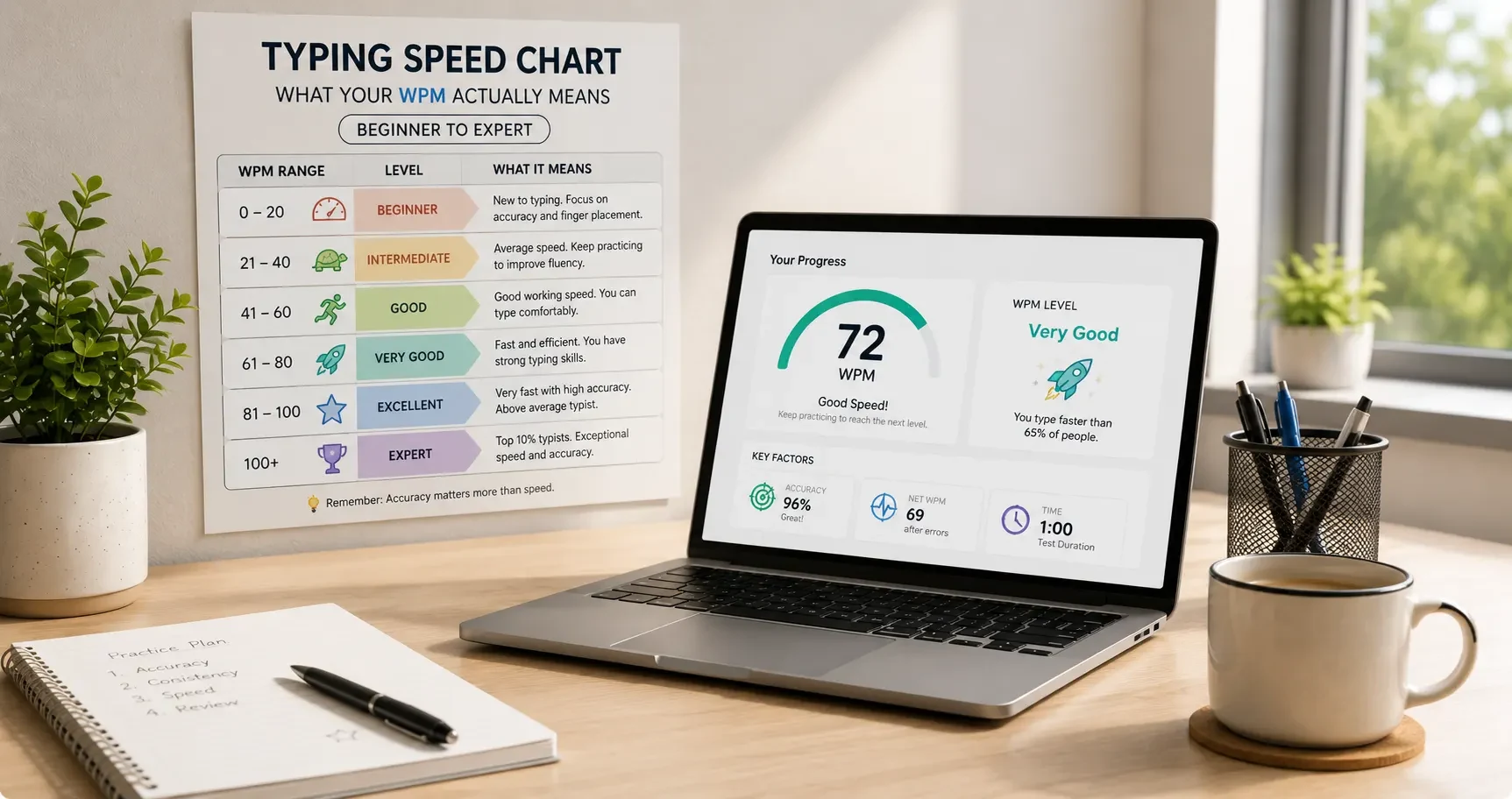
- Read the accuracy breakdown, not just the WPM. A 55 WPM run at 88% accuracy is worse than a 45 WPM run at 98% accuracy for almost every practical purpose, exams included.
- Decide afterward whether you need to come back. If the number matches what you expected and you’re done, guest mode did its job. If you’re now motivated to improve it, that’s your cue to consider a free account.
The real benefits of skipping registration
Beyond the obvious “no form to fill,” there are a few concrete advantages worth naming directly.
Speed to result. A guest test on SimpleTyping.in takes you from landing on the page to seeing your WPM in well under a minute. Compare that to any site requiring email verification before you can even start — you’ve lost five minutes before you’ve typed a single word.
Zero inbox risk. No account means no marketing emails, no data sitting in a database somewhere, nothing to delete later if you change your mind about the site.
Works for shared devices without cross-contamination. On a lab machine, an account-based test risks the next student seeing your saved results or, worse, typing under your login by accident. Guest mode sidesteps that entirely.
No pressure to perform. Oddly, some typists genuinely type faster when they know nothing is being permanently recorded. It’s the same reason practice matches feel looser than league matches.
Good for comparison shopping. If you’re trying two or three typing sites to see which passages and interface you prefer, guest access on each lets you compare fairly without creating three accounts you’ll never use again.
Guest mode vs a free account: what you gain and lose
Here’s the trade-off laid out plainly, because most articles either oversell accounts or oversell anonymity, and neither is honest.
| Feature | Guest mode (no login) | Free account |
|---|---|---|
| Time to start typing | Under 30 seconds | 1–2 minutes for signup |
| Progress history / trend graph | Not available | Saved automatically after every test |
| Downloadable typing certificate | Not available | Generated and stored on your profile |
| Works well on shared/public computers | Yes — nothing left behind | Risky unless you remember to log out |
| Good for exam prep tracked over weeks | Poor — no continuity between sessions | Strong — shows real improvement over time |
| Email required | No | Yes, once |
| Access to saved custom practice sets | No | Yes |
| Best for | One-off checks, curiosity, quick comparisons | Structured practice toward an exam or job requirement |
The honest framework: if you’ll take this test once and move on with your day, guest mode is not a compromise — it’s the correct tool. If you’re building toward something over multiple weeks, like an exam typing requirement that expects a documented 35+ WPM at a specific accuracy threshold, a free account pays for itself the first time you need to prove your improvement or print a certificate.
A few things most people don’t think to check
Most guides stop at “guest mode is fast, accounts save your data.” A few less obvious points worth knowing:
Your browser can fake a memory for you. Even without an account, most modern browsers will remember your last test settings (language, duration) via local storage on that specific device. That’s not the same as real history, and it disappears the moment you clear cookies or switch devices, but it does mean guest mode isn’t always a total blank slate on your own laptop.
Certificates matter for very specific reasons, not vague ones. If an employer or exam board is asking for documented proof of typing speed, a screenshot of a guest test is rarely accepted — they want a certificate tied to an account, often with a timestamp and reference number. Know which situation you’re in before you decide login is unnecessary.
Guest mode is the better teaching tool for absolute beginners. Someone brand new to touch typing, including a child trying typing lessons for kids for the first time, benefits more from low-pressure repetition than from watching a graph. Accounts and progress charts are more useful once basic finger placement is already comfortable.
Typing games rarely need an account either. If the goal is just building finger memory through play rather than tracking a formal score, jump straight into a typing game without worrying about signup at all.
Common mistakes people make around this decision
A few patterns show up again and again:
Practicing anonymously for weeks, then needing proof. Someone preps for an SSC or state-level exam entirely as a guest, gets comfortable at 40 WPM, and only realizes at the last moment that the application wants an official typing certificate. Now they’re creating an account and starting the documented history from zero, days before a deadline.
Assuming a guest score is directly comparable to a friend’s account-based score. Test conditions, passage difficulty, and even the specific test duration can shift results by several WPM. Comparing a 30-second guest run to someone’s 10-minute logged-in test isn’t apples to apples.
Creating an account just out of habit, on a public machine. Signing into a personal account on a shared cyber café computer and forgetting to log out afterward is a small but real privacy slip. If you’re on a machine you don’t control, guest mode is usually the safer default, not just the faster one.
Never upgrading even after outgrowing guest mode. The flip side — someone genuinely working toward a job requirement, still testing anonymously every day, wondering why they “can’t tell” if they’re actually improving. Without saved history, week-to-week comparison is just guesswork.
A real scenario, with numbers
Say a data entry job listing asks for 35 WPM with 95% accuracy, verified. A candidate finds this out two weeks before applying. Day one, as a guest, they run a quick English typing test and score 29 WPM at 91% accuracy — below the bar on both counts, but now they know exactly where they stand, without having handed over an email address just to find that out.
That first check is exactly what guest mode is for: a fast, low-stakes diagnostic. But once the candidate decides they’re actually going to close that gap over the next two weeks, continuing as a guest stops making sense. They create a free account, and from day two onward every test is logged: 31 WPM on day 3, 33 on day 7, 36 on day 11, 38 on day 14 — all at climbing accuracy, ending at 96%. That trend line is what eventually goes into their application, alongside a generated certificate. The guest test got them started for free in thirty seconds; the account is what turned three weeks of practice into documented proof.
Key takeaways
- Guest mode is the right call for one-off checks, shared or public computers, and anyone who doesn’t want another inbox subscription.
- You lose two specific things without an account: a saved progress history and a downloadable certificate — nothing else is missing.
- If you’re practicing toward a documented exam or job requirement over multiple weeks, a free account earns back its thirty-second signup cost quickly.
- Run two or three attempts in a guest session rather than trusting a single result — the first run is almost always your slowest.
- Match the test to your actual goal: Hindi layout practice for exams that require it, longer passages when you need a realistic number, games when the goal is just building comfort.
- On any computer you don’t personally control, guest mode is also the more private choice, not just the quicker one.
Frequently Asked Questions
Do I need to sign up to take a typing test on SimpleTyping.in?
No. You can run a full typing test as a guest with no email, password, or verification step. Signing up is only necessary if you want your results saved or want to generate a certificate.
Is a typing test without login accurate?
Yes — the WPM and accuracy calculation is identical whether you’re logged in or not. The only difference is what happens to the result afterward: logged-in results are stored, guest results simply aren’t.
Can I get a certificate without creating an account?
No, certificates require an account because they’re tied to a saved, verifiable result with a timestamp. If you need proof of your typing speed for a job or exam application, it’s worth registering before you start your official attempt.
Will my guest test results be saved anywhere?
No. Once you close the page or refresh, a guest result isn’t stored anywhere on the site. If you need a record, take a screenshot before navigating away.
Is it safe to use guest mode on a public computer?
Generally, yes — and it’s often the safer option compared to logging into a personal account on a machine you don’t control, since there’s no session left behind for the next user to see.
Can I practice Hindi typing without logging in too?
Yes, Hindi typing practice works the same way as English — no login required to attempt tests in Kruti Dev, Mangal, or Remington layouts.
How many times can I take a guest typing test?
As many times as you like. There’s no attempt limit for guest testing, though without an account you won’t have a way to compare attempts side by side afterward beyond what you note down yourself.
Should students preparing for a government exam use guest mode?
For early exploration, sure. But if the exam has a documented speed requirement, it’s worth switching to a free account fairly early so your improvement over weeks is actually recorded, not just remembered.
Does creating an account cost anything?
No, account creation on SimpleTyping.in is free. The only cost is the thirty seconds or so it takes to sign up.
Can kids use the typing test without an account?
Yes, and for a first try, that’s often the better approach — letting a child get comfortable with typing before introducing accounts or tracked progress.
What happens if I start as a guest and later decide I want my history tracked?
You simply create an account whenever you’re ready — your prior guest attempts won’t retroactively appear, but every test from that point forward will be saved.
Is guest mode slower or missing features compared to logging in?
The typing test itself — passage, timer, WPM and accuracy calculation — is exactly the same. The only things missing are the account-only features: history, trend tracking, and certificates.
Guest mode isn’t a lesser version of the real product — it’s the right tool for a specific job, the same way a free sample is the right choice before you commit to the full jar. Run a quick, no-strings-attached free typing test right now if all you need is a number. But if you’re actually building toward an exam, a job requirement, or just want to watch your WPM climb week over week with proof to show for it, spend the thirty seconds on a free account and start collecting a real typing certificate instead of screenshots.