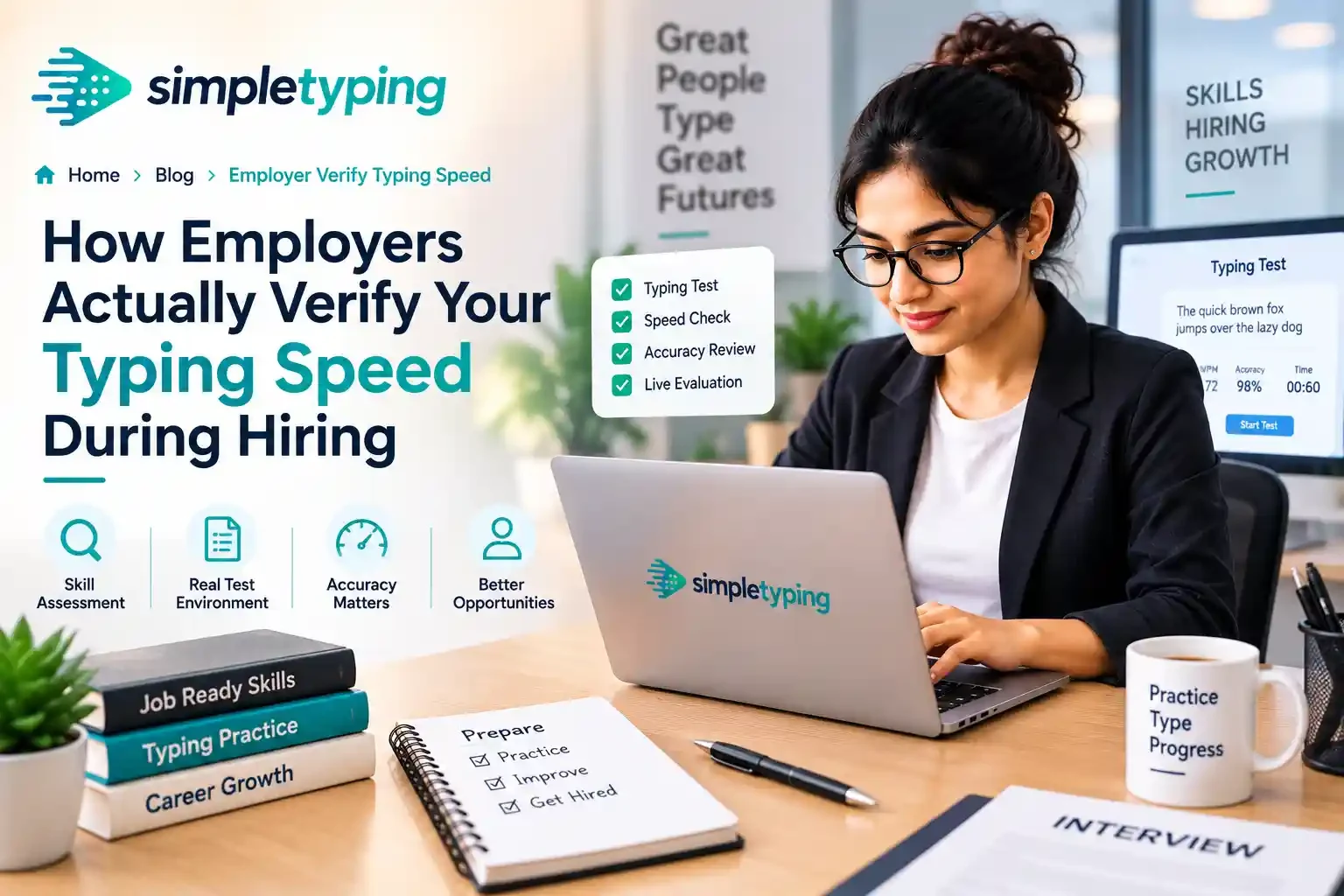
Land a remote job today and there is a good chance you will type before you ever talk to anyone. Virtual assistant listings ask for a five-minute WPM screenshot attached to the application. Data entry postings require a platform-verified score above a hard cutoff before you can even bid. Transcription services run their own timed test before they show you a single paid job in the queue. None of this is the relaxed classroom typing drill you might remember - it is a gate, and if you do not clear it, your application often never reaches a human being. This guide breaks down what score actually counts as competitive for different remote roles, how these hiring tests are usually built, where applicants quietly lose points without realizing it, and how to prepare specifically for a test that is part of a hiring decision rather than a personal practice session.
- Why Remote Employers Test Your Typing at All
- How Freelance Platform and Employer Typing Tests Actually Work
- What Score Counts as Competitive, By Job Type
- Data Entry and Transcription: Why Accuracy Outweighs Speed
- Virtual Assistant and Customer Support: Speed Meets Judgment
- Common Mistakes Applicants Make on Hiring Typing Tests
- How to Prepare for a Job-Application Test
- A Freelancer's Real Test-Day Experience
- Key Takeaways
Why Remote Employers Test Your Typing at All
Remote hiring is high-volume and low-trust by default. A manager posting a virtual assistant role on a freelance marketplace might get two hundred applications in a single day, most from people they will never meet, verify a degree for, or watch work at a desk. A typing test is one of the few objective, hard-to-fake signals available at that scale. It also predicts something real: a large share of remote work is typing-bound - answering support tickets, updating spreadsheets, transcribing calls, drafting client emails - so a slow or error-prone typist genuinely produces less billable output per hour, and that shows up fast once the contract starts.
Unlike an office interview where typing is one small skill buried among many visible cues, a remote screening test is often the only hard data point an employer has before extending an offer. That is why platforms build it into the application flow instead of leaving it to self-reporting. A resume line that says "80 WPM" is worth nothing without a verified score attached to it, and employers who have been burned by that gap now simply will not consider applicants who skip the test.
How Freelance Platform and Employer Typing Tests Actually Work
Most hiring typing tests share a similar shape, even though the branding differs from platform to platform. A short passage - usually somewhere between one and five minutes - is either randomly generated or pulled from a fixed pool, and you type it as accurately and quickly as you can within the time limit. Some systems score net WPM, which subtracts errors from your raw speed, while others report gross WPM alongside a separate accuracy percentage and let the employer weigh both. A growing number of platforms now run the test inside their own interface and issue a verified badge or certificate, rather than trusting a screenshot you uploaded yourself.
A few details trip people up because they assume the test works like the practice tools they are used to:
- Many hiring tests give you only one or two attempts before locking the result to your profile for a set period.
- Some disable backspace entirely or count every correction as a strike against accuracy, which changes your strategy completely.
- Higher-paying transcription and data-entry gigs sometimes add webcam or screen-recording verification to prevent someone else from taking the test for you.
- The score is almost always a pass/fail filter, not a ranking. Once you clear the minimum, the deciding factor shifts to your portfolio, references, and interview - so clearing the bar comfortably matters more than beating it by a huge margin.
What Score Counts as Competitive, By Job Type
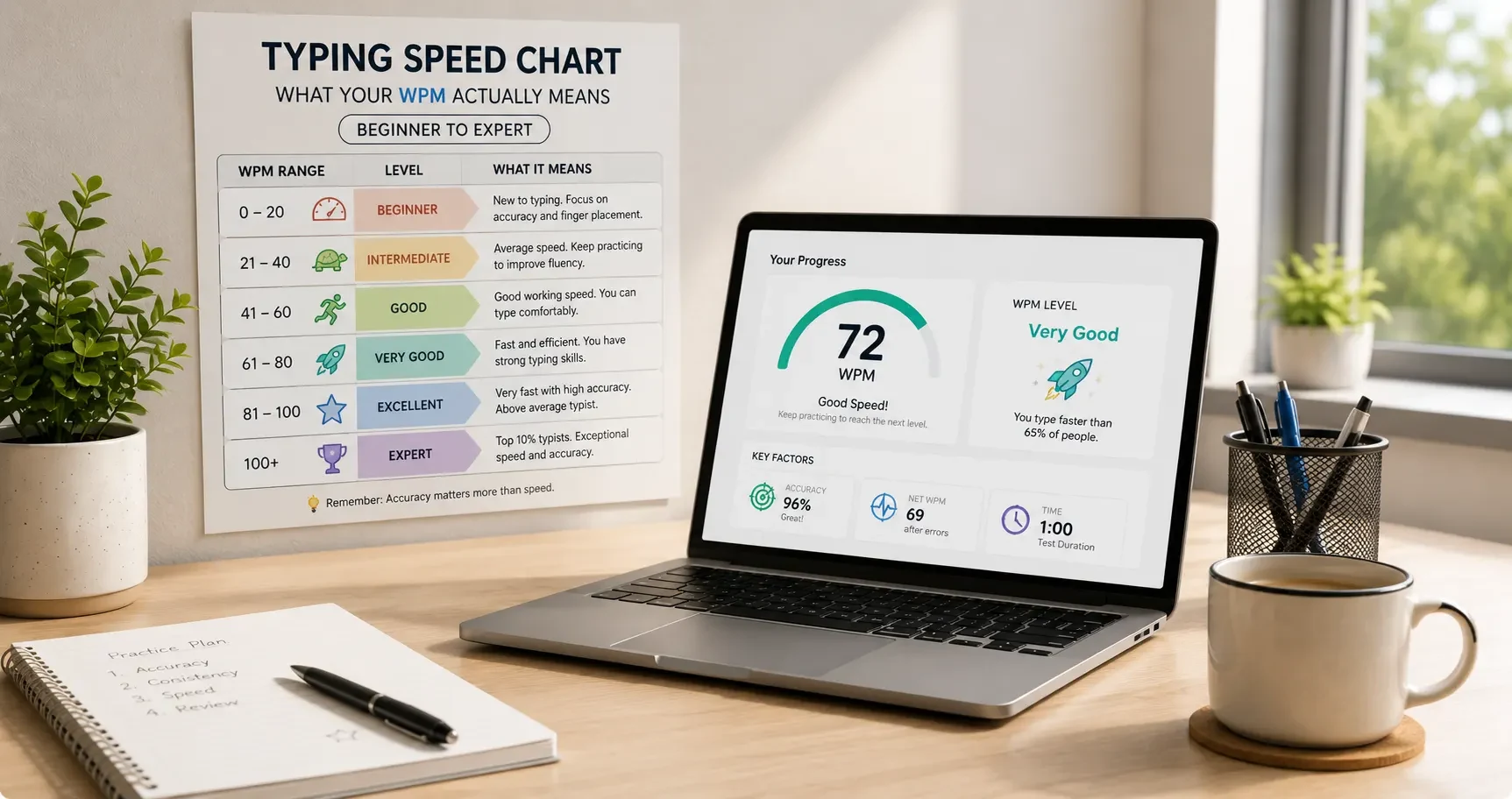
There is no single "good" score for remote work - the bar shifts with what the role actually asks you to type, and how much a mistake costs once it ships. The table below reflects typical ranges seen across freelance marketplaces, remote job boards, and employer-run screening tests for common typing-heavy roles.
| Role Type | Typical Minimum WPM | Accuracy Usually Expected | What Actually Gets Checked |
|---|---|---|---|
| Freelance Data Entry | 40-50 WPM | 97-99% | Numeric fields and record-matching, since a single misplaced digit can corrupt a whole row |
| Transcription | 50-65 WPM (sustained) | 98%+ | Ability to type continuously while listening, not just a burst on a static passage |
| Virtual Assistant | 45-55 WPM | 95-97% | Speed combined with a short writing or comprehension section |
| Customer Support / Live Chat | 40-50 WPM | 95%+ | Speed held steady across a full shift, not a five-minute peak |
Notice that none of these cutoffs are extreme. Most remote employers are not hunting for elite 100 WPM typists - they are filtering out applicants who would visibly slow down a workflow or introduce costly errors. Clearing 50 WPM with accuracy above 96% puts you in a competitive position for nearly every role on this list.
Data Entry and Transcription: Why Accuracy Outweighs Speed
In data entry, errors compound. A typo in a single customer record might seem trivial, but multiply that across thousands of rows processed in a week, and a typist running at 60 WPM with 92% accuracy is often less valuable than one running at 45 WPM with 99% accuracy - the second person needs far less correction time downstream, and correction time is what actually costs the client money. This is why data entry screening tests weight accuracy heavily, sometimes disqualifying applicants outright below a 97% threshold regardless of speed.
Transcription works a little differently because the test itself is often not a plain typed passage - it is a short audio clip you must transcribe within a time limit, sometimes with required timestamps or speaker labels. Your "typing speed" there is really a measure of how well your fingers keep pace with natural spoken language, including pauses, filler words, and accents. Practicing on generic text paragraphs helps your raw keystroke speed, but it does not fully prepare you for typing while listening, which is a distinct skill worth practicing separately if transcription is your target.
Virtual Assistant and Customer Support: Speed Meets Judgment
Virtual assistant and customer support roles rarely test typing in isolation. A VA screening often pairs a WPM test with a short writing sample - answering a mock client email, summarizing a paragraph, or drafting a professional reply - because the employer wants to see that you can type quickly and communicate clearly at the same time. Speed without clarity does not help a client whose inbox needs managing.
Customer support and live chat roles add a different pressure: sustained output. A five-minute burst test tells an employer little about whether you can hold 45 WPM for four straight hours while also reading customer messages, checking a knowledge base, and staying polite under pressure. Some employers run longer simulated-chat exercises for this exact reason, or ask you to handle three overlapping conversations at once during a trial shift. If you are aiming for support work, practice typing while reading and thinking, not just typing a passage you already know is coming.
Common Mistakes Applicants Make on Hiring Typing Tests
Most people who fail these tests are not bad typists - they are unprepared for the specific format in front of them. The same mistakes show up again and again:
- Practicing only in relaxed, untimed sessions, then freezing under an actual countdown timer on the real test.
- Chasing raw speed while ignoring accuracy, not realizing many tests apply a harsh penalty per error or disqualify below a set percentage.
- Not reading the instructions carefully - some tests disable backspace, others count a correction as two strikes, and assuming your usual habits will transfer is a costly guess.
- Taking the test on an unfamiliar device, a laggy trackpad-based laptop, or a keyboard layout different from what they normally use.
- Submitting an old certificate or screenshot when the employer specifically asked for a live, verified test result.
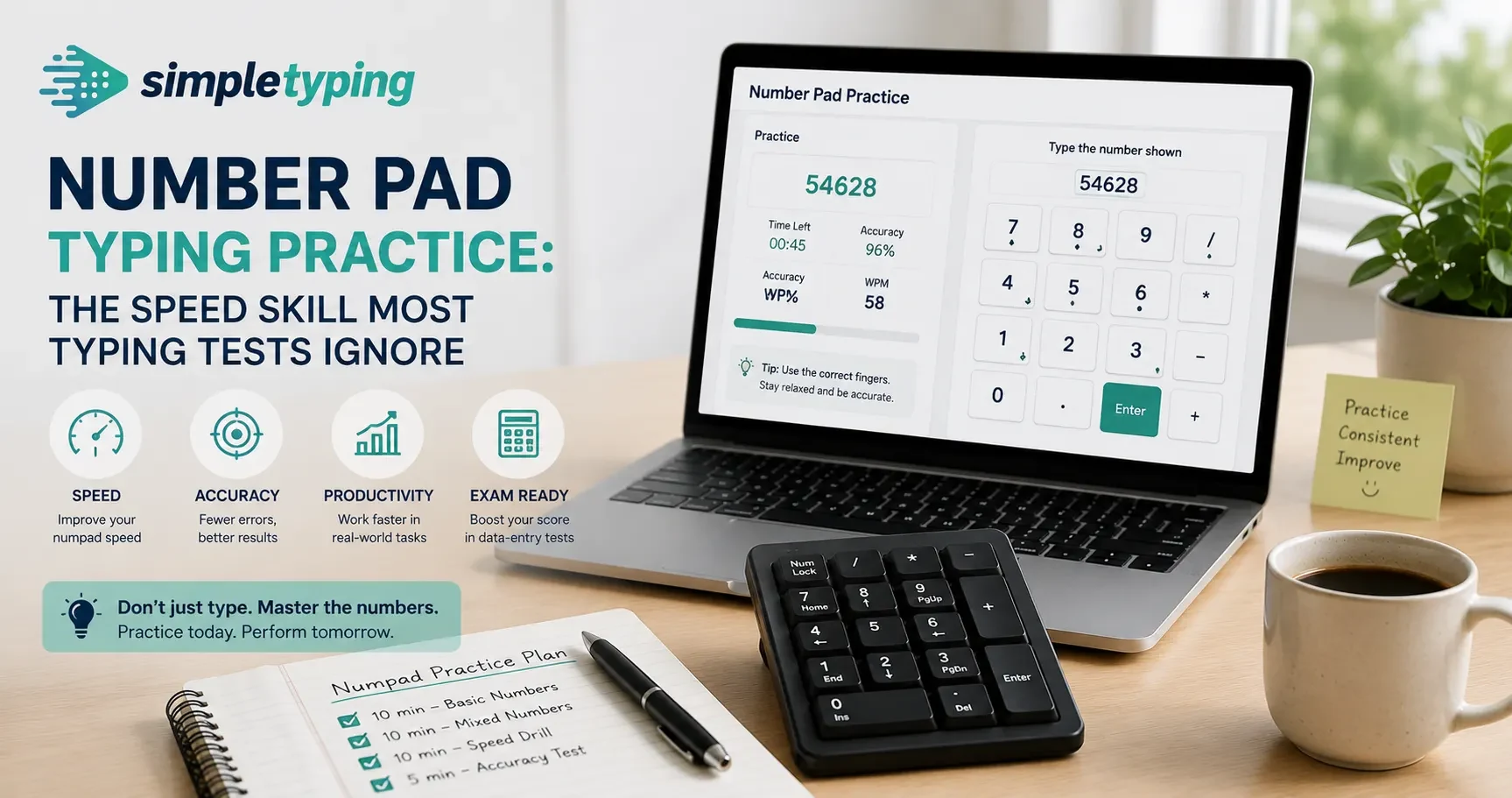
- Rushing numeric or punctuation-heavy sections because most practice was done on plain word lists that never included numbers or symbols.
- Ignoring the environment - a spotty connection, background noise during a transcription test, or a cramped workspace all quietly drag the score down.
How to Prepare for a Job-Application Test
Preparing for a hiring test is a different exercise from casual daily practice, and treating it the same way is the biggest reason capable typists underperform. Practice for a job test with intent, close to the actual conditions you will face:
- Run full, timed sessions at the exact duration the test will use - one minute, three minutes, or five - instead of open-ended practice you can stop whenever you like.
- Deliberately include numbers, punctuation, and mixed-case text in your drills, since real hiring passages rarely look like clean lowercase word lists.
- Research the specific platform's test format ahead of time where possible - some communities and forums share what to expect, including whether backspace is allowed.
- Build your accuracy ceiling first, then let speed rise naturally. A rushed typist who fixes mistakes constantly usually scores lower than a controlled one who barely needs to correct at all.
- Test on the actual device and keyboard you plan to use for the real thing, at the time of day you are most alert.
- Do a handful of full-length dress rehearsals in the days before you apply, not just short bursts, so the real test does not feel like the first time you have typed for that long under pressure.
A Freelancer's Real Test-Day Experience
Daniel had spent two years typing casually - college notes, the occasional email - and assumed his speed was "fine" when he decided to apply for virtual assistant roles on a global freelance marketplace. His first attempt at the platform's built-in test came back at 38 WPM with 91% accuracy, well under the 45 WPM and 95% accuracy most listings asked for. The test used unfamiliar punctuation-heavy business text, not the casual sentences he was used to, and he had been correcting every small mistake instead of pushing through.
Over the next ten days he ran short, timed passages every morning using text that mixed numbers, dashes, and parentheses - closer to what real client instructions look like - and stopped chasing top speed in favor of finishing each passage clean. By his second official attempt, he hit 51 WPM at 97% accuracy, cleared every listing's minimum, and landed his first contract within two weeks. The gap was never raw talent - it was that his practice had never matched the actual test conditions.
Key Takeaways
- Most remote and freelance typing tests set the bar between 40 and 55 WPM with accuracy above 95%, not an elite speed threshold.
- Accuracy matters more than raw speed for data entry and transcription, where errors compound across large volumes of records.
- Virtual assistant and support roles often blend typing speed with writing quality or sustained output, not a single burst score.
- These tests are usually pass/fail gates - clearing the minimum comfortably matters more than maximizing your number.
- Casual daily practice does not automatically prepare you for a timed hiring test; simulate the real format, duration, and content beforehand.
- Small habits - reading instructions, testing on your real device, including numbers and punctuation in practice - fix most of the mistakes that cause applicants to fail.
If your last real practice session was months ago, do not walk into a job-application typing test cold. Run a few timed, full-length sessions this week so you know exactly where your speed and accuracy stand before an employer's cutoff decides it for you.