Someone tells you they type 70 WPM and you immediately feel either smug or inadequate, depending on your own number. Neither reaction is fair, because “good” typing speed isn’t one number — it’s a moving target that depends on how old you are, what you actually do for a living, and how long you’ve been typing at all. A 13-year-old hitting 35 WPM is doing great. A professional data entry operator hitting 35 WPM has a problem. Same number, completely different meaning. This piece breaks down what typing speed actually looks like across age groups and professions, using the ranges typing platforms and workplace assessments commonly observe, so you can figure out where your own number actually sits instead of comparing it to a random screenshot someone posted online.
- What counts as a “good” typing speed anyway
- Average typing speed by age group
- Average typing speed by profession and context
- Where most casual typists actually land
- A real example: Ravi checks his number
- Why your number might not match these benchmarks
- How to find out exactly where you stand
- Key takeaways
- Frequently asked questions
What counts as a “good” typing speed anyway
Words per minute is a blunt instrument. It counts every five characters (including spaces) as one “word” and divides by the time taken, then usually subtracts a penalty for errors. That’s it. It says nothing about whether you understood what you typed, whether you can sustain that speed for an hour, or whether you can type technical vocabulary as fast as common words. So when people ask “is 40 WPM good?” the honest answer is: good compared to what?
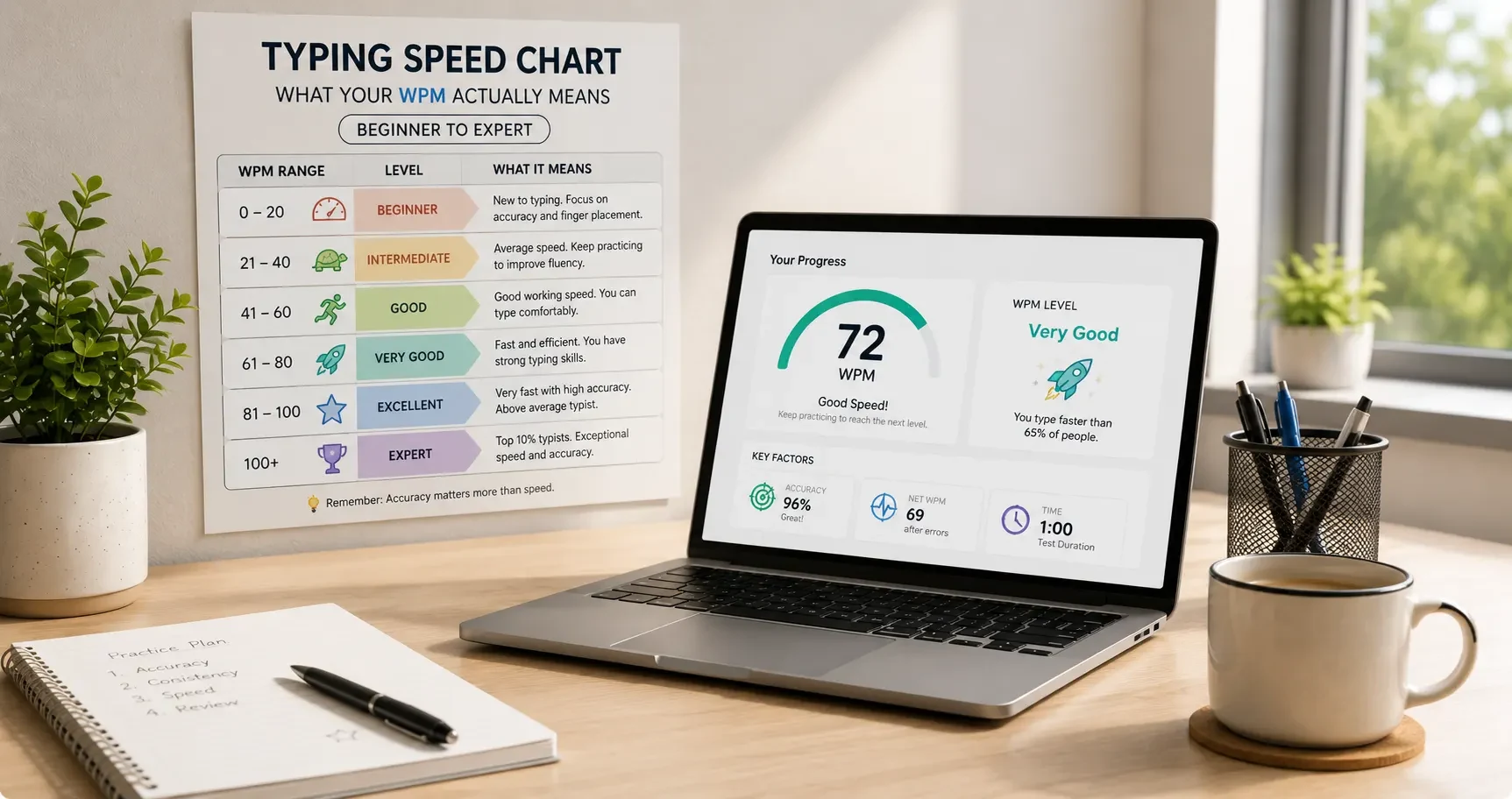
The useful way to think about it is in three tiers that roughly hold across most contexts:
- Below 25 WPM — still building muscle memory, usually looking at the keyboard at least some of the time.
- 25–45 WPM — functional touch typing. This covers the vast majority of adults who type daily but were never specifically trained.
- 45–70+ WPM — trained or heavily practiced typing, typical of roles where speed is part of the job description.
Everything below breaks that out further by who you actually are, because “average” hides more than it reveals.
Average typing speed by age group
Age matters less because of biology and more because of exposure — how many cumulative hours a person has spent on a keyboard, and whether that time was structured practice or just hunting for the right keys while messaging friends. Here’s the general pattern typing platforms observe across large numbers of test-takers:
| Age group | Typical average WPM | What’s going on |
|---|---|---|
| Kids, 7–10 years | 10–20 WPM | Still learning key positions; accuracy matters far more than speed at this stage |
| Tweens/teens, 11–17 | 25–45 WPM | Fast improvement window if they get structured practice, not just chat typing |
| Young adults, 18–29 | 40–55 WPM | Peak exposure to keyboards through school, college, and early jobs |
| Adults, 30–59 | 35–50 WPM | Wide range — depends heavily on whether typing is part of daily work |
| Seniors, 60+ | 20–35 WPM | Often accurate but slower; less lifetime keyboard exposure for many in this group |
Notice the teens and young adults bracket sits highest. That’s not really an age effect — it’s an exposure effect. Someone who grew up typing school assignments, messaging apps, and eventually work documents on a QWERTY keyboard has simply logged more hours than someone whose keyboard use started later in life. If you’re a parent wondering where your child should be, a structured typing practice track for kids that focuses on correct finger placement early tends to produce faster, more accurate typists by their teens than kids who just pick it up by osmosis.
Average typing speed by profession and context
This is the more useful lens for adults, because your job dictates how much deliberate typing practice you’ve accumulated, whether you like it or not.
- Casual/occasional user (emails, browsing, light messaging): roughly 25–35 WPM. Typing isn’t the bottleneck in their day, so it never gets pushed higher.
- Student: roughly 30–45 WPM, climbing through school years as assignment volume increases.
- Government exam candidate (SSC, CPCT, and similar): most exams set a qualifying bar around 30–35 WPM in English or roughly 25–30 WPM in Hindi, but competitive candidates usually train well past the minimum, often into the 40–45 WPM range, because the qualifying speed and a comfortable, error-free speed are not the same thing.
- Content writer/editor: roughly 45–65 WPM. Long-form writing rewards fluency, but composing sentences (not just transcribing) caps raw speed below what pure transcription work reaches.
- Data entry operator: roughly 50–70 WPM, sometimes higher on numeric-only entry, because this is a role where speed is directly measured and compensated.
- Programmer: this one surprises people — raw WPM on prose often sits in the 50–70 WPM range, similar to other trained typists, but effective coding speed is throttled by thinking time, syntax, and tooling, not finger speed. A programmer’s prose WPM and their actual code output have almost no relationship.
- Stenographer/court reporter/professional transcriptionist: 80–120+ WPM, representing the far end of what sustained, accurate typing looks like after years of specialized training.
The pattern across all of these: speed tracks how directly a job rewards typing speed, not how “smart” or tech-savvy the person is. A brilliant analyst who spends most of the day thinking, not typing, can easily type slower than a call-center agent who logs tickets all day.
Where most casual typists actually land
If you’ve never done formal touch-typing training and you’re not in a typing-heavy job, you are very likely sitting somewhere between 30 and 40 WPM, and that is genuinely normal — not a red flag, not something to be embarrassed about. The distribution of untrained adult typists is heavily clustered in that band. What throws people off is that online typing-speed screenshots and viral posts skew toward people who are unusually fast, because slow results don’t get shared. You’re not comparing yourself to the average; you’re comparing yourself to a self-selected highlight reel.
The more useful question isn’t “am I average” but “is my current speed costing me anything.” For most casual use, 30–40 WPM is fine. If you’re preparing for a specific target — a government exam cutoff, a data entry job, a certificate you need for a job application — that’s when the gap between your speed and the requirement actually matters, and it’s worth closing deliberately rather than assuming it’ll fix itself.
A real example: Ravi checks his number
Ravi is 26, works in customer support, and took a typing test on a whim after a coworker bragged about hitting 80 WPM. Ravi scored 38 WPM and felt discouraged for about five minutes. Then he actually looked at what 38 WPM means: it’s squarely in the normal range for a casual adult typist who spends most of the day talking to customers on calls, not typing documents. His coworker, it turned out, had spent two years doing freelance transcription work before this job — a completely different typing history. Once Ravi compared himself against the right benchmark (casual adult user, not professional transcriptionist), 38 WPM stopped looking like a problem. He still wanted to improve it because his company was rolling out a chat-support channel where response speed would matter, so he set a realistic target of 50 WPM over six weeks using short daily sessions on English typing practice rather than chasing his coworker’s number cold.
Why your number might not match these benchmarks
A handful of factors push individual results away from the group averages above, and it’s worth ruling them out before you conclude you’re unusually slow or fast:
- Test length. A 15-second burst almost always scores higher than a 5-minute passage, because fatigue and error-correction haven’t kicked in yet.
- Content difficulty. Common-word passages score higher than technical or numeric-heavy content. Comparing a words-only score to a data-entry number is comparing two different skills.
- Language and script. Hindi typing speeds, especially on Kruti Dev or Remington layouts, are typically measured lower than English QWERTY speeds for the same person, simply because of keystroke density per word. If you’re benchmarking Hindi typing results, don’t compare them directly to English WPM.
- Keyboard familiarity. A laptop keyboard you use eight hours a day will always beat an unfamiliar keyboard at a test center or a friend’s desk.
- Warm-up. Cold-starting a test first thing in the morning tends to score a few WPM lower than after five minutes of warm-up typing.
None of these mean the benchmark tables are wrong — they mean a single test result is a snapshot, not a verdict.
How to find out exactly where you stand
Benchmarks are only useful once you have your own number to compare against them, measured under conditions that actually match what you’re being compared to. A few practical steps:
- Run at least three tests on different days, not one lucky attempt, and average the results — a single score is noisy.
- Match the test format to your goal: if you’re prepping for a government exam typing requirement, practice on passage-style content at the exam’s actual duration, not a 30-second sprint.
- Separate your accuracy from your raw speed. A high WPM with 85% accuracy is not actually faster than a moderate WPM with 98% accuracy once you account for the corrections a real job would require.
- If you want a record you can point to later (for a resume, a certificate, or just to track progress over months), a free account lets you keep a consistent history instead of screenshotting one-off results.
Key takeaways
- There is no single “good” typing speed — it depends entirely on your age group and how typing-heavy your daily context is.
- Casual adult typists cluster around 30–40 WPM, and that’s genuinely normal, not a problem to fix by default.
- Kids should be judged against 10–20 WPM (early) or 25–45 WPM (teens), not adult benchmarks.
- Profession matters more than age for adults — data entry, stenography, and transcription push speeds well above what casual use requires.
- Government exam cutoffs (often 30–35 WPM) are minimums, not comfortable targets — competitive candidates train past them.
- A single test result is noisy; compare an average of several tests, run under conditions matching your actual goal.
Frequently asked questions
What is a good typing speed for a 12-year-old?
Somewhere between 20 and 35 WPM is a solid, achievable range for most 12-year-olds who’ve had at least some structured practice. Kids who are still visually hunting for keys will score lower, and that’s expected at this age — accuracy and correct finger placement matter more right now than raw speed.
What is a good typing speed for adults?
For casual daily use, 35–45 WPM is considered solidly good. For roles where typing is a core job function — data entry, transcription, customer support chat — 55 WPM and above is a more realistic professional target.
Is 40 WPM a good typing speed?
Yes, for a casual adult typist, 40 WPM sits right in the normal-to-good range. It would be considered below target for a dedicated data entry role, but it’s well above the minimum most government exam typing tests require.
Is 60 WPM considered fast?
60 WPM is faster than the vast majority of casual typists and comfortably above most professional minimums. It’s a realistic, achievable target with consistent practice rather than an exceptional or rare number.
What typing speed do government exams like SSC require?
Most SSC and state-level exams set a qualifying speed around 30–35 WPM in English, with Hindi requirements typically slightly lower due to higher keystroke density per word. Check the specific notification for your exam, since exact figures vary by post and by year.
Do programmers need to type fast?
Not as much as people assume. A programmer’s prose typing speed often looks similar to any other trained typist, but actual coding output is limited far more by thinking time, debugging, and reading code than by finger speed. Fast typing helps, but it isn’t the bottleneck it seems.
Why is my Hindi typing speed lower than my English typing speed?
Hindi typing layouts like Kruti Dev or Remington typically require more keystrokes per word than English QWERTY, so a lower raw WPM in Hindi doesn’t mean you’re a slower typist — it reflects the script, not your skill.
Does age itself slow down typing speed?
Age by itself has a smaller effect than people expect. What drives the seniors group lower in most data is typically cumulative keyboard exposure, not age-related slowdown — seniors who’ve typed daily for decades often type as fast as younger adults.
How many WPM does a professional data entry job usually require?
Most data entry roles look for somewhere between 50 and 70 WPM, with accuracy requirements often set above 95–98%, since errors in data entry work are typically more costly than in general typing.
Can I actually get to 80 or 100 WPM?
It’s achievable, but it takes sustained, deliberate practice over months, not weeks — it’s the range typically reached by people who type for a living, like stenographers or professional transcriptionists, rather than a casual milestone most people hit by accident.
Is it fair to compare my typing speed to a viral social media post?
Not really. Results people share online skew toward unusually fast scores because slow results rarely get posted. Compare yourself to your own age group and profession benchmarks, not to a self-selected highlight reel.
How should I check my current typing speed accurately?
Run several tests across different days rather than relying on one attempt, use content that matches your actual goal (exam passages, general prose, or numeric data), and track both speed and accuracy together rather than speed alone.
Whatever bracket you land in, the number only matters relative to what you actually need it for. If you want to see your real, current speed rather than guess from memory, run a quick English typing test or, if Hindi is your target script, try the Hindi typing practice section instead — then create a free account to track whether your number is actually moving over the next few weeks.