Type “typing test” into Google and you will land on five completely different products wearing the same name. One gives you a timer and a paragraph and nothing else. Another wants your email before it will show you a WPM number. A third is trying to simulate an SSC CHSL exam screen down to the font. If you have ever taken a test, gotten a score, and then wondered what that score was actually for, the problem usually is not your typing — it is that you took the wrong kind of test for the question you were asking. There are, broadly, five categories of online typing test in circulation, and they measure different things, serve different purposes, and in a couple of cases actively work against each other if you mix them up. This article sorts them out so you can pick the right one on the first try instead of the third.
- Why the test type actually matters
- Timed speed tests (1, 3, 5, 10 minutes)
- Certificate-generating tests
- Untimed practice tests
- Exam-format tests for government jobs
- Accuracy-focused tests
- Side-by-side comparison
- A real scenario: picking the right test
- Key takeaways
- Frequently asked questions
Why the test type actually matters
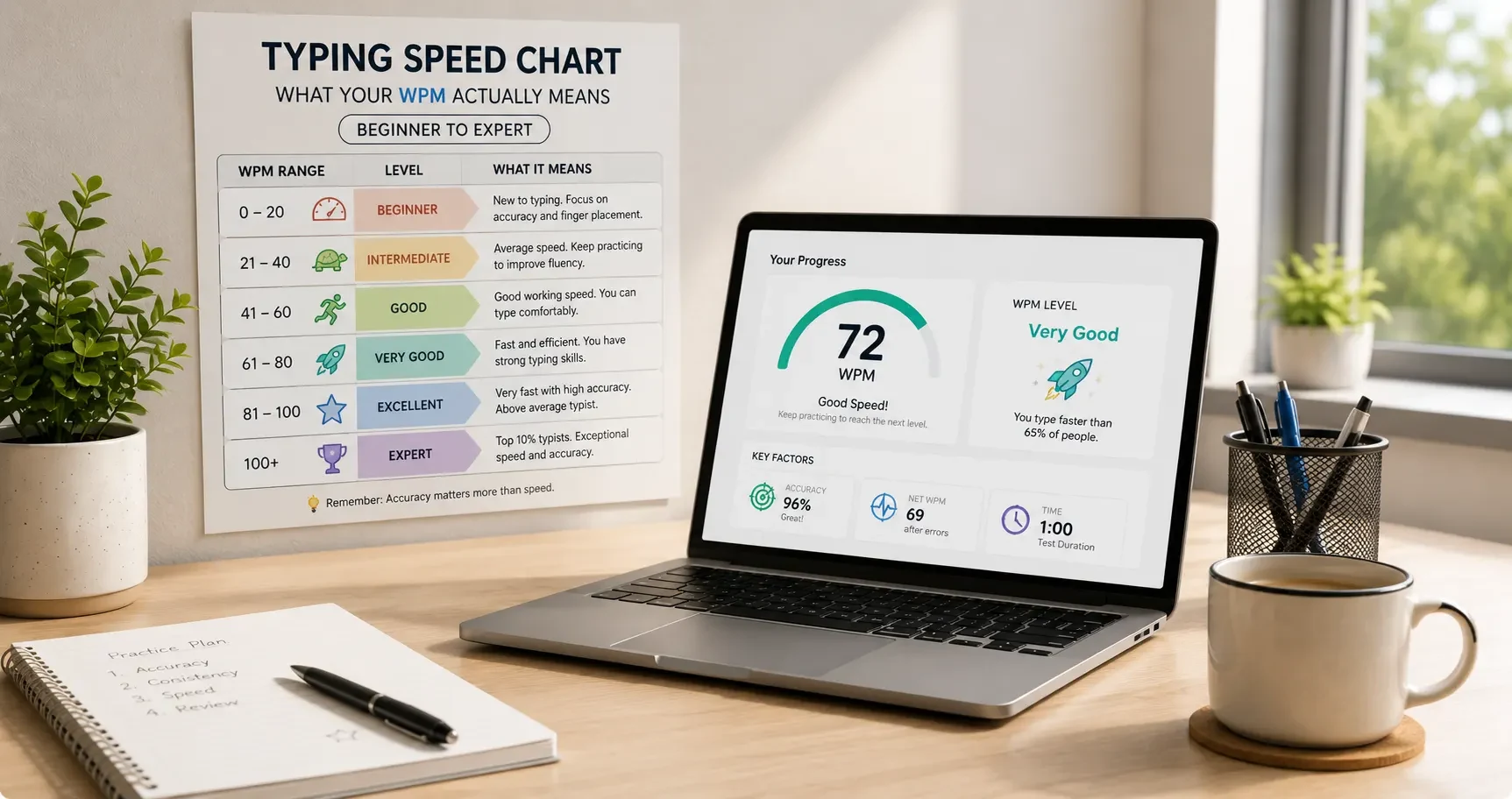
Every typing test does the same three things under the hood: it shows you text, it records what you type against a clock, and it computes words per minute and an accuracy percentage. The differences that matter are what happens around that core loop — how long the clock runs, whether the result gets saved anywhere, whether the passage resembles anything you will type in real life, and whether the test is trying to reward speed or punish mistakes. Two people can both score “42 WPM” on tests that measured almost nothing in common. One took a 1-minute burst on common English words with no penalty for backspacing; the other took a 10-minute exam-format test on a dense government circular with a hard accuracy cutoff. Treating those as the same number is where most of the confusion about typing tests online starts.
So before you open any test, it helps to know what question you are actually trying to answer: How fast am I, roughly? Can I prove a number to someone else? Am I improving? Will I pass a specific exam? Am I accurate enough, regardless of speed? Each of those maps to a different test type, covered below.
Timed speed tests (1, 3, 5, 10 minutes)
This is the default typing test most people picture: a countdown clock, a passage or word stream, and a WPM/accuracy score the moment the timer hits zero. The variable that changes everything here is duration. A 1-minute test rewards a fast, clean burst and is forgiving of the fact that nobody can sustain their peak speed — it is a snapshot, not a stamina check. A 5-minute test starts to expose whether your speed holds up once your fingers tire and your attention drifts. A 10-minute test is closer to what a real data-entry shift or exam actually demands, and scores on it are typically a few WPM lower than the same person’s 1-minute number, simply because fatigue is real.
None of these durations is “more correct” than another — they answer different questions. If you want a quick pulse check before a practice session, a 1-minute test is fine. If you want a number you would actually trust before walking into an exam, use the duration closest to that exam’s real time limit. We have separate breakdowns of what a one-minute test tells you versus a five-minute or ten-minute run, if you want the mechanics of each duration in more depth.
Certificate-generating tests
A certificate test is a timed test with one extra feature bolted on: at the end, it produces a downloadable or shareable document with your name, WPM, accuracy, and a date on it. The typing mechanics underneath are usually identical to an ordinary timed test — the certificate is a presentation layer, not a different measurement method. What actually varies between sites is whether that certificate means anything to anyone other than you. Some employers and colleges will accept a printed certificate as informal proof of typing ability for an application; most formal government recruitment processes will not, and require you to sit their own supervised exam-format test regardless of what certificate you already hold.
So a certificate test is worth taking when you want a shareable artifact — for a resume, a freelance profile, or just personal proof — not when you need to satisfy an official eligibility requirement. If you want the honest version of what these documents are and are not worth, it is covered in more depth on the site, and you can create a free account if you want your results and certificates saved to a profile instead of generated as a one-off.
Untimed practice tests
Untimed or self-paced practice mode strips the clock out entirely, or lets you run it in the background without ending the session when it hits zero. The point is not to measure you — it is to let you build muscle memory without the psychological pressure of a countdown, which is exactly the pressure that causes beginners to freeze up, glance at the keyboard, or panic-type errors they would not otherwise make. Practice tests are also where drilling on specific content actually happens: Hindi typing layouts, punctuation-heavy passages, number rows, or whatever your weak spot happens to be.
The mistake people make is judging themselves by practice-mode numbers, or worse, judging timed-test numbers by practice-mode standards. They are not comparable. A practice session where you stopped twice to correct a habit is doing its job even if the resulting WPM would look terrible on a real test. Use practice tests to build the skill, and timed tests to check where the skill currently stands.
Exam-format tests for government exams
This is the most specific and most misunderstood category. Exams like SSC CHSL, CGL (Data Entry Operator posts), and various state-level CPCT and typing eligibility tests do not just check whether you can hit a WPM number — they run on a fixed time limit (commonly 10 minutes), a fixed error tolerance (often a hard cutoff around 4-5% depending on the exam), and sometimes exam-specific software or a proctored environment. A score that would look excellent on a generic 1-minute test can still fail an exam-format test if your error rate creeps past the allowed threshold, because these exams are graded on net speed after accuracy penalties, not raw gross WPM.
If your actual goal is a government job, practicing on generic tests only gets you partway there. You need the specific combination of duration, passage style, and error tolerance your target exam uses. Our government exam typing practice section is built around exactly this, and we have a dedicated comparison of how SSC and CPCT requirements differ if you are choosing between exams or unsure which cutoff applies to you.
Accuracy-focused tests
An accuracy-focused test flips the usual incentive. Instead of a clock pushing you to go faster, the interface is built to slow you down and highlight every mistake as it happens — often with the test refusing to advance past an error, or scoring accuracy as the headline number instead of WPM. These exist because speed and accuracy are not the same skill, and improving one does not automatically improve the other. Plenty of typists plateau not because they are slow but because a 6-8% error rate is quietly capping their real-world usable speed once corrections are factored in.
Accuracy tests are worth running periodically even if your main goal is speed, because they surface which specific keys, finger transitions, or word patterns you consistently botch. Fixing those tends to raise your net speed on timed tests more reliably than just typing faster ever does.
Side-by-side comparison
| Test type | Primary metric | Typical duration | Best used for |
|---|---|---|---|
| Timed speed test | Gross WPM | 1–10 minutes | Quick, general speed benchmarking |
| Certificate test | WPM + accuracy on a document | 1–5 minutes | Resumes, portfolios, informal proof |
| Untimed practice | None (self-paced) | No limit | Building technique without pressure |
| Exam-format test | Net WPM after error penalty | 10 minutes (varies by exam) | SSC, CPCT and similar official eligibility |
| Accuracy-focused test | Error rate / accuracy % | Varies | Diagnosing and fixing specific mistakes |
A real scenario: picking the right test
Priya is preparing for an SSC CHSL data-entry post. In her first week she ran a 1-minute test daily and watched her score climb from 28 to 41 WPM, which felt great — until she sat a mock exam-format test under the real 10-minute, 4%-error-tolerance rules and scored a net 26 WPM, well under what her daily test suggested. The gap was not fake progress; it was the wrong test type. Her 1-minute number measured a clean sprint. The exam measures sustained accuracy under a strict penalty over ten times the duration. Once she switched her main practice to exam-format sessions and kept the 1-minute test only as a quick daily warm-up, her exam-format score caught up within three weeks, because she was finally training the thing that would actually be graded.
Key takeaways
- Timed tests answer “how fast, roughly” — the duration changes the answer, so match it to your purpose.
- Certificate tests are the same mechanics as a timed test with a shareable document attached; they are informal proof, not official eligibility.
- Untimed practice tests build technique without clock pressure and should never be compared directly to timed scores.
- Exam-format tests use net WPM with an error-rate cutoff and are the only type that reliably predicts government exam performance.
- Accuracy-focused tests diagnose specific mistakes that quietly cap your real-world speed.
- A single WPM number means little without knowing which test type produced it.
Frequently asked questions
What is the difference between a typing test and a typing exam?
A typing test is any self-guided check of your speed and accuracy, usually informal. A typing exam (like SSC CHSL) is a formal, proctored assessment with fixed rules — duration, passage type, and an error tolerance — that determines eligibility for a job or course.
Which type of typing test should I take first if I am a beginner?
Start with an untimed practice test to build correct finger placement, then move to a 1-minute timed test once you are comfortable, so early mistakes do not get baked in under time pressure.
Is a certificate from a free online typing test valid for government jobs?
No. Government recruitment bodies require you to pass their own proctored exam-format test. A certificate from a general typing website is useful for resumes and personal proof, not for official eligibility.
Why is my score lower on a 10-minute test than a 1-minute test?
Fatigue and sustained accuracy both affect longer tests more. Most typists lose a few WPM once concentration and finger speed dip past the first couple of minutes, which is normal and expected.
What does "net WPM" mean on exam-format tests?
Net WPM is your gross typing speed minus a penalty for errors, calculated according to the specific exam’s formula. It is almost always lower than the gross WPM shown on a generic timed test.
Can I practice for SSC or CPCT using a regular typing test?
You can use regular tests for general speed building, but you should also practice on exam-format tests that match the real duration and error tolerance, since regular tests do not apply the same accuracy penalties.
Do accuracy-focused tests slow down my typing speed over time?
Not permanently. They temporarily prioritize correctness over pace, which feels slower in the moment, but the habits you fix usually raise your net speed on timed tests afterward.
How often should I take a timed test versus a practice test?
A common approach is daily untimed or light practice with a timed test once or twice a week to track real progress, rather than timing every single session, which can add unnecessary pressure.
Is a higher WPM always better regardless of test type?
No. A high WPM on a lenient test type does not transfer automatically to a stricter one. What matters is your WPM on the test type that matches your actual goal.
Do typing tests for Hindi work the same way as English ones?
The underlying mechanics (timer, WPM, accuracy) are the same, but Hindi tests also depend heavily on which keyboard layout — Kruti Dev, Mangal, or Remington — you are using, which affects both speed and how errors are counted.
Can kids use the same typing tests as adults?
Kids generally benefit more from untimed, game-style practice tests that build accuracy and comfort with the keyboard before introducing timed pressure, rather than starting straight on exam-format or strict accuracy tests.
Do I need to register an account to take a typing test?
No, most tests including certificate tests can be taken as a guest. Registering just lets you save your history and certificates to a profile instead of losing them after the session.
If you now know which test you actually need, do not overthink it any further — go run it. Try a straightforward English typing test for a general benchmark, or head to the government exam typing practice section if a specific SSC or CPCT cutoff is what you are actually preparing for. Either way, a free account keeps your results in one place instead of scattered across a dozen tabs.