Most people who never get past 35 WPM don’t fail because they lack talent or a good typing tutor. They fail because they sit down for a punishing ninety-minute session on a Sunday, feel accomplished, and then don’t touch a keyboard with any intent until the following weekend. Typing speed is a motor skill, and motor skills are built the way muscle is built — through small, frequent, recoverable effort, not occasional heroics. This article is about the mechanism behind that: why five honest minutes a day beats an hour once a week, and how to build a practice habit that survives an actual busy, imperfect life instead of collapsing after ten days.
On this page
- Why Daily Practice Beats Occasional Marathon Sessions
- How to Build a Daily Typing Habit That Actually Sticks
- What Consistency Gives You That Intensity Can’t
- Daily 10 Minutes vs. Weekly 70 Minutes
- Expert Tips for Making Practice Automatic
- Common Mistakes That Kill the Habit
- A Real Example: 45 Days, 28 to 62 WPM
- Key Takeaways
- FAQs
Why Daily Practice Beats Occasional Marathon Sessions
Your fingers don’t learn a keyboard layout the way your brain learns a fact. Typing is procedural memory — the same system that lets you ride a bicycle or play a scale on a piano without thinking about each individual motion. Procedural memory consolidates during rest, particularly during sleep, when the brain replays and strengthens the neural pathways used earlier that day. That’s not a metaphor; it’s why a short practice session followed by a night’s sleep often produces a noticeable jump in accuracy the next morning, even though you didn’t practice in between.
This is also why cramming backfires. A ninety-minute Sunday session gives your hands one long exposure and then six days of silence, so the pathways barely get reinforced before they start to fade. Ten minutes a day gives your brain seven separate consolidation windows in the same week. Spaced repetition — the same principle language apps use for vocabulary — applies just as strongly to finger movement. Skip one day and you lose almost nothing; the pathway is still fresh. Skip a full week and you’re partly relearning hand position, key distances, and rhythm, which is why so many people feel like they’re starting over every time they return to a typing test after a long gap.
How to Build a Daily Typing Habit That Actually Sticks
- Attach it to something you already do without thinking. Habit stacking works because you’re borrowing an existing trigger instead of relying on willpower. If you make coffee every morning, practice for five minutes while it brews. If you check email first thing at work, do two minutes of warm-up typing right before you open your inbox.
- Define your minimum viable session before you need it. Decide in advance that five minutes counts as a full day — not a consolation prize, a genuine win. On the days you only have five minutes, you do five minutes and close the laptop with the streak intact. Perfect is the enemy of consistent here; a rule that only accepts thirty-minute sessions is a rule you’ll break within two weeks.
- Pick one anchor tool and stop shopping around. Bounce between five different typing sites and you spend half your session re-learning the interface. Settle on a single typing practice tool, or a Hindi typing one if that’s your target script, and return to the same place daily.
- Track the streak somewhere you’ll actually see it. A visible counter changes behaviour more than most people expect — nobody wants to be the person who breaks a 19-day streak over a lazy Tuesday. A free account that logs your sessions and issues a typing certificate once you hit a speed milestone gives you both the tracking and a concrete reward to work toward.
- Build in a soft-landing day instead of an all-or-nothing rule. Life will occasionally eat your ten minutes. Decide now that one missed day doesn’t reset anything — you simply pick the streak back up tomorrow. Reserve genuine concern for missing three or more days in a row, not one.
- Lower the friction to zero. Bookmark the practice page, keep it pinned in a browser tab, or open it before you even decide whether you feel like practicing. The fewer clicks between intention and action, the more likely the habit survives a tired day.
- Rotate in something playful once or twice a week. A quick round of a typing game keeps the habit from turning into a chore, and it still reinforces key placement and rhythm even though it doesn’t feel like formal drilling.
What Consistency Gives You That Intensity Can’t
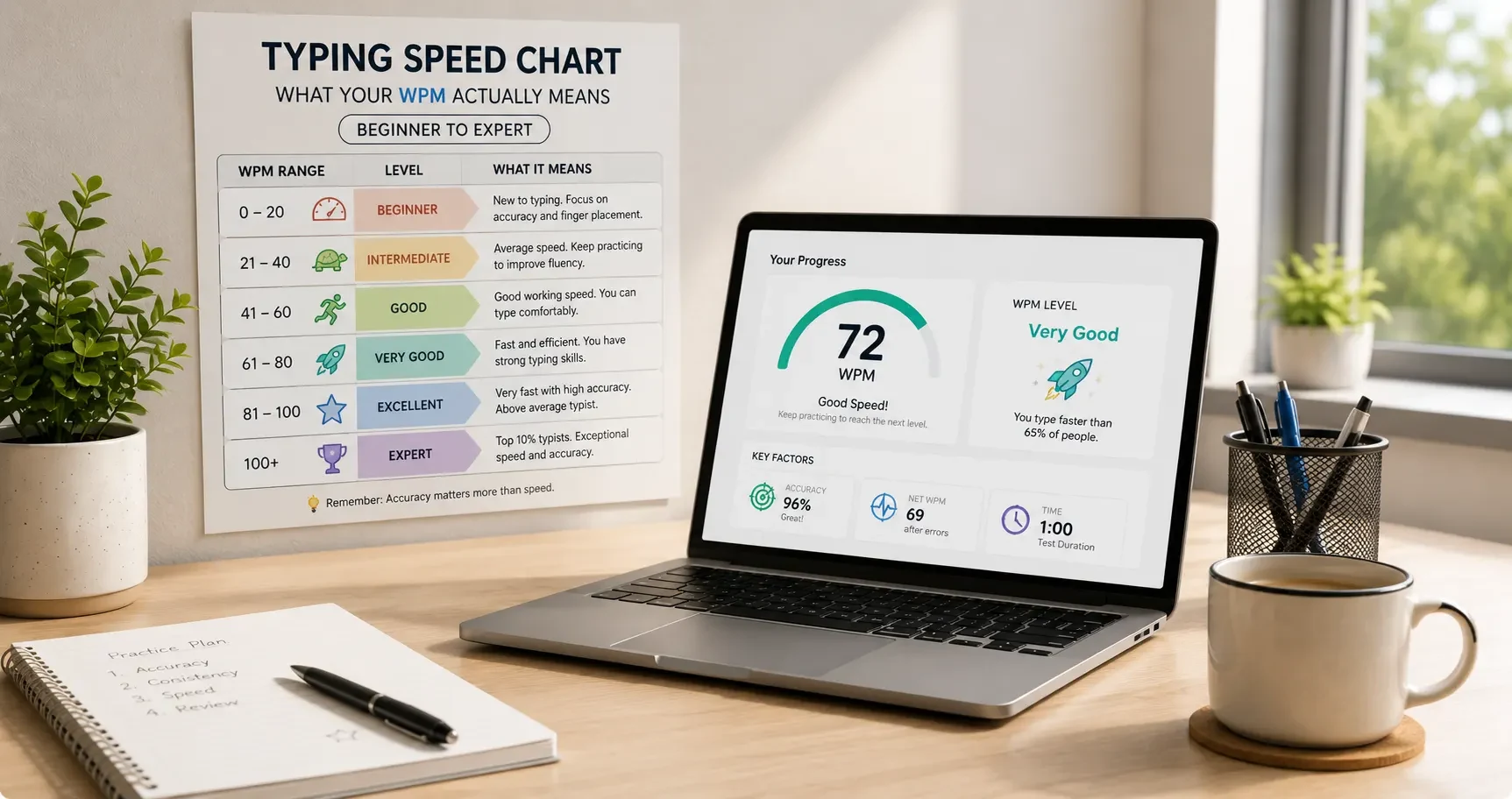
Intensity gives you a good story about one great session. Consistency gives you a different baseline. When you type daily, your resting hand position, your instinct for which finger owns which key, and your recovery from a mistyped letter all become automatic rather than effortful. That’s the difference between a hunt-and-peck typist who plateaus around 25–40 WPM because two fingers do all the work, and a touch typist cruising past 60–90 WPM because the motion has become reflexive.
Consistency also compounds in a way single sessions don’t. A student preparing for a government exam typing test who practices twelve minutes daily for two months accumulates roughly 12 hours of deliberate practice, spread across 60 separate consolidation windows. Someone who does one two-hour session every Saturday for the same two months accumulates 16 hours — more total time, fewer results — because the pathways never get the nightly reinforcement that spaced-out sessions provide. More hours logged doesn’t automatically mean more skill gained; when those hours land matters as much as how many there are.
Daily 10 Minutes vs. Weekly 70 Minutes
Same weekly time investment, very different outcomes. Here’s how the two approaches typically compare over an eight-week stretch:
| Factor | Daily 10-Minute Sessions | Weekly 70-Minute Session |
|---|---|---|
| Consolidation windows (sleep cycles between practice) | ~56 over 8 weeks | ~8 over 8 weeks |
| Typical WPM gain after 8 weeks | 15–25 WPM | 5–10 WPM |
| Accuracy trend | Steady, compounding improvement | Improves during the session, decays before the next one |
| Risk of quitting | Low — each session is small and easy to resume | High — each session requires a big time block and motivation spike |
| Muscle memory retention | Strong, becomes near-automatic | Weak, partial relearning needed each session |
| Fatigue and errors within a session | Minimal — short bursts stay fresh | Rises after 20–30 minutes as focus drops |
Expert Tips for Making Practice Automatic
- Practice at the same time of day where possible. Your brain responds well to routine timing, not just routine duration.
- Warm up on a short passage before jumping into a timed typing test — cold fingers make more errors in the first sixty seconds regardless of skill level.
- Measure accuracy alongside speed. Chasing WPM alone without watching your error rate trains bad habits just as effectively as it trains good ones.
- Alternate scripts if you need both. A few minutes of Hindi typing practice on top of English keeps both keyboard layouts active in memory instead of one decaying while you focus on the other.
- Review your slowest keys once a week instead of always practicing the same comfortable passage — comfort is often a sign you’re avoiding your weak fingers.
- Don’t practice fatigued at 1 a.m. just to save the streak. A five-minute session done properly beats a rushed one done badly; protect the quality floor, not just the calendar mark.
Common Mistakes That Kill the Habit
- Setting the bar too high on day one. Committing to 45 minutes daily sounds ambitious but rarely survives a busy work week — the habit needs to be easy before it can be impressive.
- Treating a missed day as a failure instead of a data point. One skipped session is normal life. Reacting to it by abandoning the whole habit is the actual mistake.
- Practicing without any measurement. Typing randomly with no timer or accuracy report means you can’t tell if you’re actually improving or just repeating the same errors daily.
- Switching tools and passages constantly. Novelty feels productive but resets your sense of progress every time, since you’re comparing results across inconsistent tests.
- Only practicing on weekends. This is the marathon-session trap in disguise — two long sessions a week still leave five days of pathway decay in between.
- Ignoring posture and finger placement to chase speed early. Bad form baked in during the first two weeks is far harder to unlearn later than it is to fix now.
A Real Example: 45 Days, 28 to 62 WPM
A reader preparing for a clerical exam started at 28 WPM with 88% accuracy — enough to pass a basic screening but not enough for a competitive exam cutoff. Instead of blocking out weekend hours, she committed to twelve minutes every morning right after making tea, using a five-minute minimum on days when work ran long. She tracked her sessions through a free account so she could see the streak and her WPM trend line rather than guessing at progress.
By day 15 she was at 38 WPM. By day 30, 51 WPM. By day 45, 62 WPM at 96% accuracy — a jump most people assume needs months of dedicated practice, achieved in under nine total hours of actual typing time spread across 45 short sessions. She missed four days across the entire stretch, none of them consecutive, and the streak survived each time because the rule was never all-or-nothing.
Key Takeaways
- Typing is a motor skill; it consolidates during rest between sessions, which is why daily short practice beats occasional long practice.
- Five minutes done daily counts as a real session — define your minimum viable session in advance so a busy day doesn’t break the habit.
- Attach practice to an existing routine (habit stacking) instead of relying on remembering or motivation.
- Missing one day costs almost nothing; missing a full week forces partial relearning of hand position and rhythm.
- Track your streak and your numbers somewhere visible — what gets measured gets repeated.
- Build in a forgiving reset rule so one skipped day doesn’t spiral into abandoning the habit entirely.
Frequently Asked Questions
How many minutes of daily typing practice actually improve speed?
Ten to fifteen minutes a day is enough to produce a measurable WPM increase within a few weeks, provided you’re practicing with intent — watching your accuracy, not just racing the clock. Even a five-minute minimum session on hectic days keeps the habit and the muscle memory alive.
Is daily practice really better than one long weekly session, given the same total time?
Yes, for typing specifically. The same weekly time spread across seven short sessions gives your brain far more consolidation windows than one long block, which is why daily practitioners typically see two to three times the WPM gain over eight weeks compared to weekly marathon sessions.
What happens if I skip a single day of practice?
Almost nothing. The neural pathways built the previous days stay largely intact overnight, and picking back up the next day feels nearly seamless. It's skipping a full week or more that causes noticeable regression.
What happens if I skip a whole week?
You'll likely feel rusty — slightly slower reaction time, a few more typos in the first couple of minutes, and a sense of relearning hand position. It's not a full reset, but it's enough that most people need two or three sessions to get back to where they left off.
What is habit stacking and how does it apply to typing practice?
Habit stacking means attaching a new habit to an existing one that already happens automatically, like making coffee or checking your phone in the morning. Doing a short typing session right before or after an established routine borrows that routine's consistency instead of relying on willpower alone.
Should I focus on speed or accuracy during daily sessions?
Accuracy first, always. Speed built on sloppy accuracy just means you're reinforcing errors faster. A steady 96%+ accuracy with gradually increasing WPM produces more durable long-term speed than chasing a high WPM number with frequent mistakes.
Can I build this habit without registering an account?
Yes, you can practice and take a typing test without logging in at all. A free account simply adds streak tracking, saved progress, and a certificate once you hit a speed milestone, which many people find useful for staying motivated.
Is daily practice necessary for kids learning to type?
It helps even more for kids, since shorter attention spans respond better to brief daily sessions than long infrequent ones. A structured typing for kids routine of ten minutes a day tends to build comfort with the keyboard faster than occasional hour-long sessions ever manage.
How long until daily practice shows a noticeable WPM increase?
Most beginners notice a real jump within two to three weeks of consistent daily practice, and a more dramatic shift — often 20 to 30 WPM higher — by the six to eight week mark, depending on starting point and session length.
Does practicing typing games count as real practice?
Partially. A typing game reinforces key placement and rhythm in a lower-pressure format, which is useful once or twice a week to keep the habit enjoyable, but it shouldn't fully replace focused paragraph or passage practice where you're also tracking accuracy.
What's the best time of day to practice?
Whatever time you can protect consistently. Morning sessions tend to have an edge because they happen before the day's fatigue and distractions pile up, but a habit stacked onto an evening routine works just as well if that's what you'll actually stick to.
How do I recover a streak after falling off for a week or two?
Restart with your minimum viable session, not a punishing catch-up session. Trying to make up for lost time with an extra-long practice block usually backfires and makes the habit feel like a burden again. Five minutes today, resumed tomorrow, rebuilds the streak faster than one heroic hour.
Speed isn’t something you win in a single sitting — it’s something you accumulate, five or ten minutes at a time, on the days you don’t feel like it as much as the days you do. Start small enough that skipping feels harder than showing up. Take a free typing speed test right now to see your current baseline, then create a free account to track your daily streak and earn a certificate once the consistency starts paying off.