A 14-year-old preparing for a school computer exam and a 34-year-old data-entry executive typing invoices for eight hours a day have almost nothing in common — except that both of them typed “free typing tutor” into Google last week. They’ll land on the same search results, and most of those results will hand them the same generic 30-day course. That’s the problem. A student needs structure and motivation; a professional needs speed, accuracy under pressure, and a wrist that doesn’t ache by 4 pm. Treating them identically wastes the student’s patience and the professional’s time.
- How students and professionals actually differ
- A step-by-step routine for students
- A step-by-step routine for professionals
- Why matching practice to your goal matters
- Student needs vs professional needs
- Expert tips for each group
- Common mistakes each group makes
- Real numbers from real routines
- Key takeaways
- FAQ
How students and professionals actually differ
A student opening a typing tutor for the first time usually has zero muscle memory. They don’t know where the F and J keys are, let alone the home row. What they need is sequence — lessons that build from single fingers to full sentences, ideally tied to something they can show a teacher: a certificate, a progress chart, a completed course. Gamification isn’t a nice-to-have for this group; it’s the difference between practicing for ten minutes and practicing for zero minutes. Kids and teenagers get bored of drills fast, which is exactly why typing games exist alongside structured lessons in the first place.
A working professional is a completely different animal. They already type — the question is whether they type well. Most professionals coming to a typing tutor already sit somewhere between 30 and 55 WPM using four or five fingers, and what they actually want is a diagnosis: where exactly are the errors coming from, which keys slow them down, and how much faster could they realistically get in two weeks. They don’t want a 40-lesson course. They want a 5-minute test that tells them the truth, followed by targeted drilling on their specific weak spots — numbers, symbols, or whatever vocabulary fills their inbox all day.
A step-by-step routine for students
If you’re a student — whether you’re prepping for a school computer class, a college assignment, or a government exam like SSC or CPCT — this is the order that actually works:
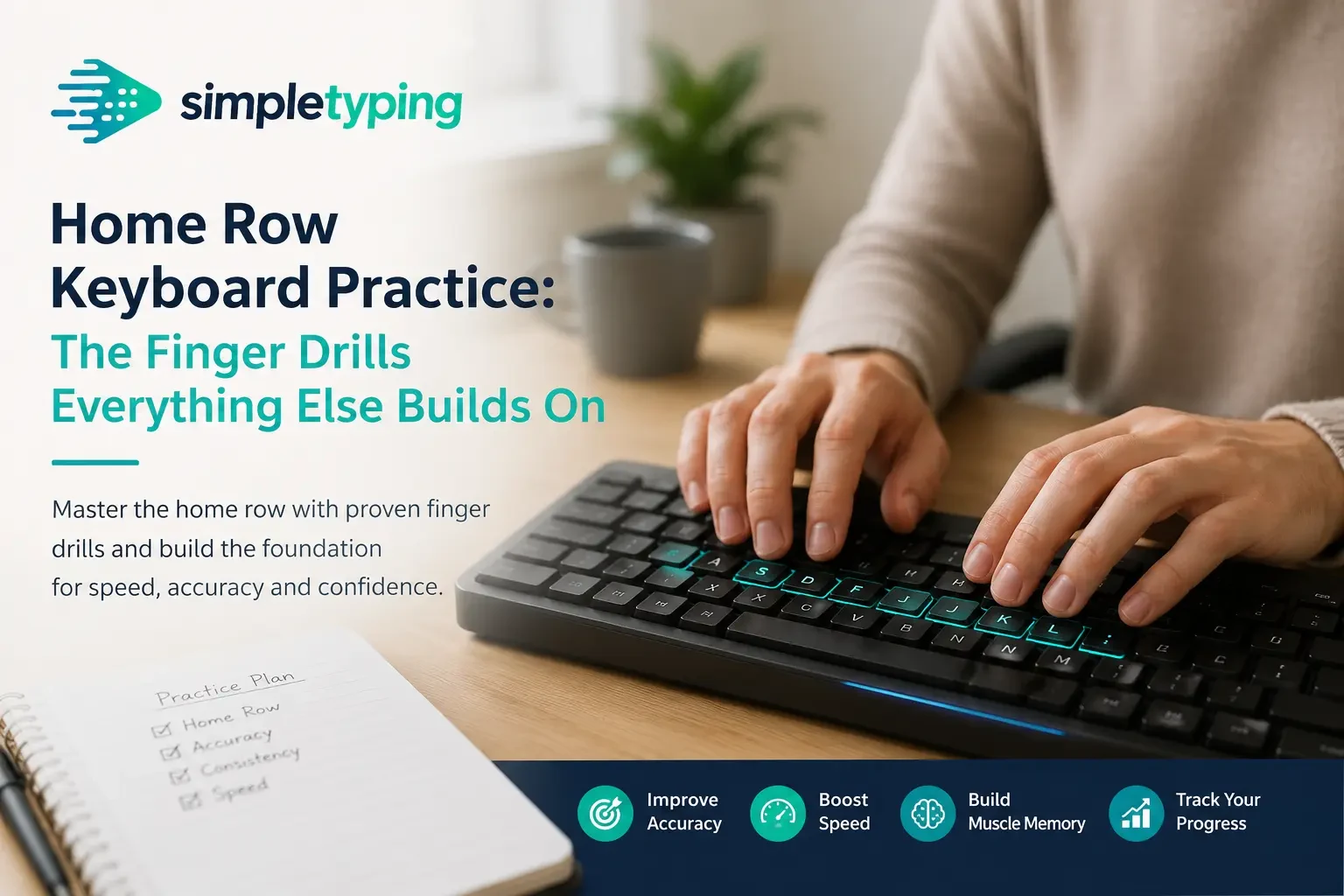
- Start with home row placement. Don’t skip to full words. Spend your first two or three sessions purely on finger position using structured English typing practice that locks each finger to its own keys.
- Move to short words, then full sentences. Once your fingers know their lanes, progress to common three- and four-letter words before attempting paragraphs. Rushing this step is the single biggest reason students plateau at 15 WPM for months.
- Practice in the script your exam actually uses. If you’re preparing for a government exam that tests Hindi typing in Kruti Dev or Mangal, don’t wait until the last month to start — begin Hindi typing practice early, because switching keyboard layouts mid-preparation resets your muscle memory.
- Simulate the real exam format. Government exams and school tests have specific time limits and passing WPM thresholds. Use exam-focused typing practice that mirrors the actual test structure instead of generic paragraphs.
- Track progress weekly, not daily. Daily fluctuations are normal and discouraging. A free account that logs your WPM and accuracy over weeks shows the trend line that actually matters.
- Mix in games to stay consistent. Fifteen minutes of a typing game twice a week keeps a 12-year-old coming back in a way that a plain drill never will — check out the typing games section if lessons feel like a chore.
- Collect a certificate for submission. Once you cross your target speed, generate a typing certificate you can actually attach to a school assignment or exam application.
A step-by-step routine for professionals
If you’re already earning a living at a keyboard, your routine should look almost nothing like the one above:
- Take a short diagnostic first. Run a one-minute or five-minute typing speed test before you commit to any practice plan. There’s no point drilling skills you already have.
- Identify your actual bottleneck. Most professionals aren’t slow because of letters — they’re slow because of numbers, punctuation, or specific key combinations they hit constantly, like em-dashes in reports or the @ symbol in emails all day.
- Drill domain vocabulary, not generic text. A data-entry operator typing invoice numbers all day benefits far more from numeric-pattern drills than from a paragraph about the solar system. Practice on text that resembles your actual workload.
- Set a weekly speed target, not a course completion goal. Aim to move from, say, 48 WPM to 55 WPM over three weeks rather than “finish the course.” Re-test with a quick typing test every few days to check progress.
- Build in ergonomics from day one. If you’re typing 6+ hours daily, correct wrist posture and scheduled breaks matter more than raw speed. Ignore this and you’ll trade a faster WPM for a wrist that hurts by Thursday.
- Re-test monthly, not weekly. Once you’re past 60 WPM, gains slow down naturally. A monthly check-in is enough to catch regression without turning practice into an obsession.
Why matching practice to your goal matters
Give a student a professional-style five-minute diagnostic test and they’ll walk away with a low number and no idea what to do next — there’s no lesson structure telling them how to fix it. Give a professional a 40-lesson beginner course and they’ll quit by lesson three because they’re already past that stage; nothing is more demoralizing to someone typing 50 WPM than being told to practice the letter F for ten minutes. Matching the approach to the actual goal means students stay motivated long enough to build the habit, and professionals get measurable improvement without wasting hours they don’t have. It also changes what “success” looks like: for a student it’s a certificate and a passed exam threshold; for a professional it’s fewer corrections per hour and less strain by the end of a shift.
Student needs vs professional needs
| Factor | Students | Professionals |
|---|---|---|
| Starting point | Often zero typing experience | Already typing at 30–55 WPM |
| Main goal | Build correct habits + pass an exam | Increase speed/accuracy on real work |
| Preferred format | Structured multi-week lessons | Short diagnostic tests, targeted drills |
| Content focus | Home row, common words, exam-format paragraphs | Numbers, symbols, domain-specific vocabulary |
| Motivation driver | Games, badges, visible progress | Measurable WPM/accuracy gains |
| Proof needed | Certificate for school/exam submission | Consistent performance, not paperwork |
| Session length | 15–30 minutes, several times a week | 10–15 minutes, fit around work |
| Physical concern | Minimal — short daily exposure | High — 6+ hours daily, injury risk |
Expert tips for each group
For students: don’t chase speed before accuracy. An exam that requires 30 WPM with 90% accuracy will reject a fast, sloppy typist faster than a slower, cleaner one. Practice the exact exam format — if your target exam uses Hindi typing, don’t train exclusively in English and switch at the last minute. And use a typing course built for younger learners if you’re under 13; the pacing and vocabulary in adult-focused lessons often move too fast.
For professionals: stop retaking the same full-length test over and over expecting a different number. Instead isolate the actual weak point — if it’s numeric keys, drill numeric keys specifically for a week. Also, invest ten minutes once in learning proper hand posture; it pays back every single day you’re at the keyboard. And if your job involves both English and regional-language data entry, keep both skill sets warm with brief Hindi typing sessions rather than letting one atrophy.
Common mistakes each group makes
Students commonly skip the home-row stage entirely and jump straight into full paragraphs, which locks in hunt-and-peck habits that are painful to unlearn later. They also practice generic text when their actual exam has a fixed format and vocabulary — if you’re prepping for a specific government exam, generic paragraphs won’t simulate the real conditions the way dedicated exam typing practice will.
Professionals tend to over-focus on raw WPM and ignore accuracy, not realizing that every correction costs more time than typing slightly slower would have. The other common mistake is ignoring posture until pain shows up — by the time your wrist hurts, you’re already dealing with repetitive strain, not preventing it. A five-minute stretch every hour is cheaper than a physiotherapy bill.
Real numbers from real routines
Student example: Priya, a Class 10 student in Lucknow, started at 8 WPM with heavy hunt-and-peck habits three months before her school computer exam, which required 20 WPM at 85% accuracy. She followed a structured lesson path for 20 minutes a day, four days a week, mixing in a typing game on the fifth day to stay interested. By week 6 she hit 18 WPM at 88% accuracy; by week 10 she cleared 24 WPM and downloaded her certificate to submit with her exam application.
Professional example: Rohit, a data-entry executive in Pune, was already typing at 46 WPM but making frequent errors on numeric fields, which slowed his actual invoice processing more than his raw speed suggested. Instead of a full course, he ran a quick diagnostic test, identified numeric-key errors as the bottleneck, and drilled number-heavy text for 10 minutes daily for two weeks. His accuracy on numeric fields went from 82% to 96%, and his effective processing speed — accounting for corrections — improved more in those two weeks than it had in the previous six months of just “typing more.”
Key takeaways
- Students need structure, exam-format practice, and a certificate to show for it; professionals need a fast diagnosis and targeted drilling.
- Gamification keeps students consistent; it’s mostly irrelevant to professionals who just want measurable gains.
- Professionals should prioritize ergonomics from the start — injury prevention matters more the longer you sit at a keyboard.
- Students should never chase speed before accuracy, especially with a fixed exam threshold to hit.
- Both groups benefit from testing on the actual format they’ll use — exam paragraphs for students, domain vocabulary for professionals.
- A one-size-fits-all typing course usually under-serves both groups at once.
Frequently asked questions
Is a free typing tutor actually good enough, or do I need a paid one?
For the vast majority of students and professionals, a free typing tutor covers everything needed — structured lessons, speed tests, accuracy tracking, and certificates. Paid tools mostly add extras like advanced analytics, which most learners never actually use.
How is a typing tutor for students different from one for professionals?
A student-focused tutor builds skills from zero with sequential lessons and exam-format practice, while a professional-focused approach starts with a diagnostic test and drills specific weak points like numbers, symbols, or domain vocabulary.
How long should a student practice typing each day?
Fifteen to thirty minutes, four to five times a week, works better than one long weekend session. Consistency builds muscle memory; cramming doesn’t.
How long should a working professional practice?
Ten to fifteen minutes a day is usually enough once you already know how to type — the goal is targeted improvement, not building a skill from scratch.
What WPM should a student aim for before a government exam?
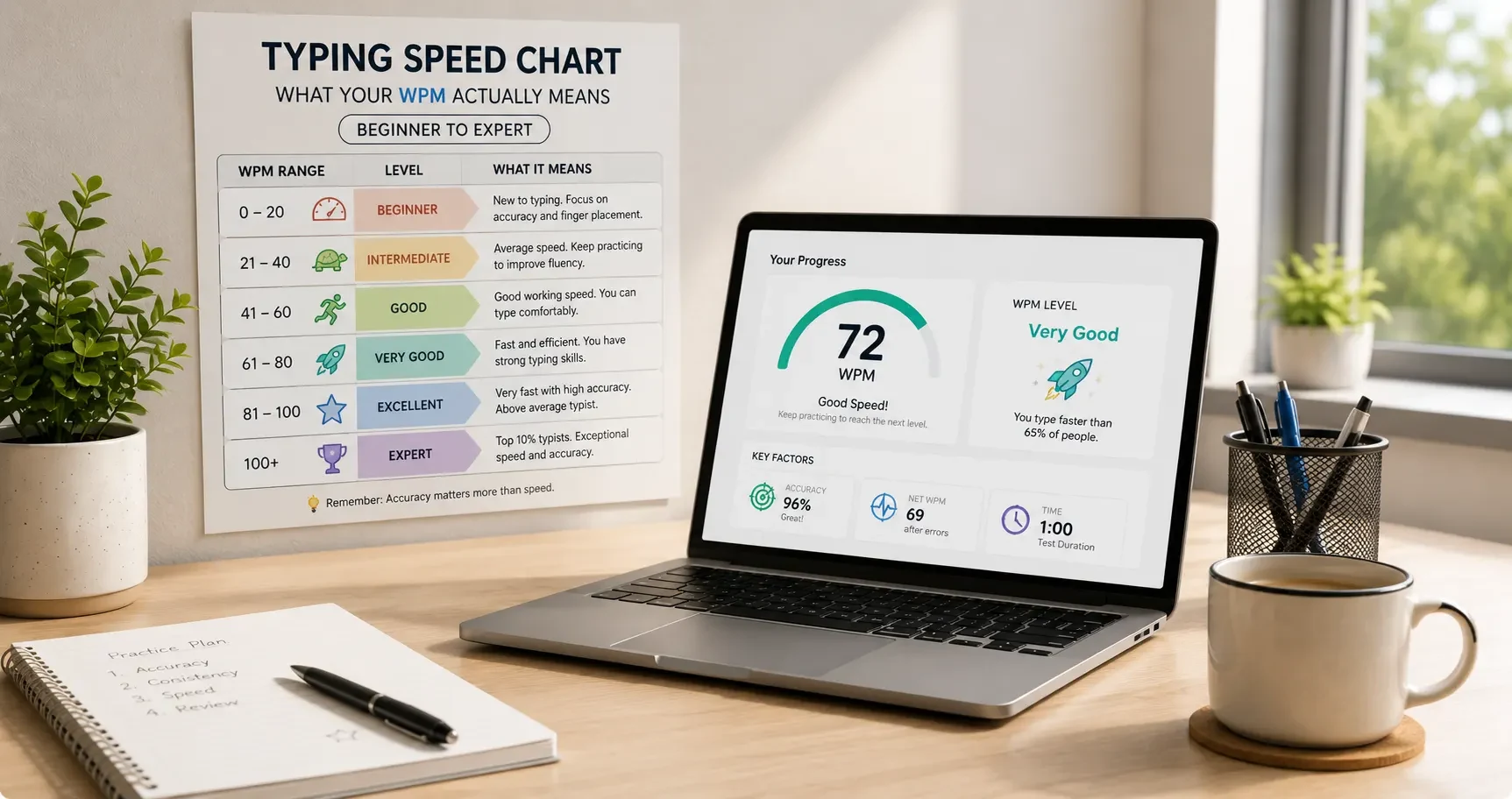
It depends on the exam, but most competitive exams like SSC or CPCT set thresholds between 25 and 35 WPM with 90%+ accuracy. Check the exact requirement for your target exam and practice specifically toward that number using exam-format tests.
Do professionals really need to worry about typing speed if they already type fine?
Yes, particularly in roles like data entry or transcription where speed directly affects output. Even a jump from 45 to 60 WPM, sustained over a workday, adds up to real time saved — and fewer corrections means less rework.
What’s the biggest injury risk for people who type all day?
Repetitive strain in the wrists and forearms from poor posture, non-neutral wrist angles, and lack of breaks. Sitting with wrists bent upward or downward for hours is the most common culprit, not the typing itself.
Should students learn English typing or Hindi typing first?
Whichever your target exam or school curriculum actually tests. If you’re unsure, start with English typing since it builds transferable finger-placement skills, then add Hindi typing once your exam requirements are confirmed.
Can typing games actually replace structured lessons?
No, but they’re a great supplement. Games keep engagement high, especially for younger students, but the actual skill-building happens in structured, sequential lessons.
Do I need to create an account to track progress or get a certificate?
Yes, a free account is what lets the site save your test history over time and generate a certificate once you hit your target speed and accuracy — without one, your results aren’t saved between sessions.
How often should a professional re-test their typing speed?
Roughly once a month is enough after the first couple of weeks of focused practice. Testing daily just adds noise since natural day-to-day variation is normal.
What’s the fastest way to find out what’s actually slowing me down?
Take a short typing test and look at your error breakdown by key, not just your overall WPM. Most people are surprised to find one or two specific keys or symbols account for most of their mistakes.
The truth is neither a student nor a professional needs a “better” typing tutor — they need a different starting point. A student should be building habits step by step with something to show for it at the end; a professional should be diagnosing the exact problem and fixing it in the shortest time possible. Figure out which one you actually are, then stop wasting sessions on the wrong routine. Take a free typing speed test right now to see exactly where you stand, then create a free account to track your progress and earn a certificate once you hit your target.