{ "@context": "https://schema.org", "@type": "BreadcrumbList", "itemListElement": [ {"@type": "ListItem", "position": 1, "name": "Home", "item": "https://simpletyping.in/"}, {"@type": "ListItem", "position": 2, "name": "Blog", "item": "https://simpletyping.in/blog/"}, {"@type": "ListItem", "position": 3, "name": "Why Typing Skills Still Matter in an AI and Voice-Typing World", "item": "https://simpletyping.in/blog/why-typing-skills-still-matter-in-an-ai-world/"} ] }
Somebody in your office chat probably said some version of this in the last month: “why bother getting faster at typing when I can just talk to my phone, or let an AI draft the whole thing for me?” It is a fair question, not a lazy one. Voice typing on a modern phone is startlingly accurate these days, and tools like ChatGPT or Copilot can produce a passable email in the time it takes you to think of a good opening line. But sit through one video call where someone unmutes just to read a message out loud, watch a developer try to dictate a line of code, or ask a call-centre agent who is updating three systems at once whether voice input would actually help — and the picture stops being so simple. Typing skills have not become irrelevant in 2026. They have become unevenly relevant, and that distinction is far more useful than either “typing is dead” or “typing is timeless” would have you believe.
- Why this question is even being asked now
- Where typing skills still clearly matter
- Typing vs voice vs AI: a quick side-by-side
- Where voice and AI are genuinely good enough now
- A real workday: Meera’s Tuesday
- How fast do you actually need to be in 2026?
- Building the skill without wasting your time
- Key takeaways
- Frequently asked questions
Why this question is even being asked now
Ten years ago nobody seriously debated whether typing mattered — it was simply how you used a computer. What changed is that two separate technologies got good enough to be genuine alternatives for some of that work. Speech-to-text on iOS and Android now sits in the high-90s percent accuracy range for clear English speech in a quiet room, which is a real jump from the error-prone dictation of a decade ago. And large language models can generate a structurally sound first draft of almost any piece of writing in seconds. Put those two together and the skepticism makes sense: if a machine can listen to you talk and hand back clean text, or write the text for you before you even open a blank document, why spend weeks building finger speed and muscle memory?
The honest answer is that voice and AI solve the problem of generating words. They do not solve the problem of interacting with a computer, which is a much bigger category that includes chat, code, forms, spreadsheets, exams, and every situation where you cannot or should not speak out loud. Typing is still the default interface for most of that. The rest of this article is about drawing that line honestly, in both directions.
Where typing skills still clearly matter
These are not edge cases — they cover most of an average working day for most people with desk jobs, plus a growing list of exam and access scenarios.
- Real-time chat and collaboration. Slack, Teams, WhatsApp Web, code review comments, live customer support — any conversation happening in text, in real time, alongside other people, is a bad fit for voice. You cannot dictate into a shared channel without narrating your entire inner monologue to the room.
- Coding and technical work. Variable names, brackets, indentation, symbols, and precise syntax are close to impossible to dictate reliably. Developers who have tried voice coding tools generally use them for accessibility reasons, not speed — typing remains faster and far less error-prone for anything beyond plain comments.
- Data entry and forms. Entering numbers, IDs, addresses, and structured fields into a CRM, billing system, or spreadsheet is exact, repetitive, and unforgiving of misheard words. A voice engine that hears “fifteen” as “fifty” once in a billing system is a genuine problem.
- Government and competitive exams. Typing tests are still a hard eligibility gate for roles like SSC CGL, CHSL, and various state-level clerical posts, where candidates must clear a fixed words-per-minute threshold on a keyboard, full stop. Practising on structured government exam typing practice tools is not optional for these candidates — it is the exam.
- Most ordinary office work. Email, reports, spreadsheets, presentations — the bulk of this still gets typed and edited by hand, even when an AI tool wrote the first draft, because editing precisely is itself a typing task.
- Quiet, shared, or public environments. Open-plan offices, libraries, trains, waiting rooms, a call in progress next to you — anywhere speaking out loud is awkward, distracting, or simply not allowed, typing is the only realistic option.
Typing vs voice vs AI: a quick side-by-side
No single input method wins everywhere, and pretending otherwise is how these debates get unproductive. Here is a more grounded breakdown by situation.
| Situation | Best fit | Why |
|---|---|---|
| Live team chat or code review comments | Typing | Precision, silence, and speed of correction all matter at once |
| Writing or editing code | Typing | Syntax and symbols are unreliable to dictate |
| Entering data into spreadsheets or a CRM | Typing | Numbers and IDs need to be exact, not “close enough” |
| Typing test sections of government exams | Typing | It is literally the skill being tested; no substitute is allowed |
| First draft of a long, generic report | AI, then typing to edit | AI is fast at boilerplate; a human still needs to type the fixes |
| Quick message while walking or driving | Voice | Hands are busy, accuracy tolerance is high, speed matters more than polish |
| Brainstorming ideas out loud, alone | Voice | Talking is faster than typing when you are just thinking aloud |
| Replying to email in a shared office | Typing | Speaking your emails aloud in a quiet room is socially awkward and slow for everyone nearby |
| Users with motor or repetitive-strain limitations | Voice | Genuinely the better and sometimes only accessible option |
Where voice and AI are genuinely good enough now
Giving credit where it is due matters more than defending typing at all costs. Voice dictation has become a legitimately excellent tool for capturing thoughts on the move — texting a friend while carrying groceries, leaving yourself a voice-to-text reminder, or drafting a rough note during a commute. For people with RSI, arthritis, or other conditions that make sustained typing painful, voice input is not a novelty; it is genuinely accessible technology that removes real barriers, and it deserves to be taken seriously rather than treated as a lesser option.
AI writing tools, similarly, have earned their place for first drafts of formulaic content: routine status updates, boilerplate emails, meeting summaries, or getting past a blank-page moment. Used well, they save real time. What they do not remove is the need to review, correct, and personalise that output — and every one of those steps is done with a keyboard. Nobody has built a widely-used tool where you talk your way through fixing a misplaced comma in a spreadsheet formula or renaming a variable across a codebase. The generation step got automated; the interaction step largely did not.
A real workday: Meera’s Tuesday
Meera Iyer is an operations executive at a logistics firm in Pune. Her Tuesday starts with forty unread messages across two Teams channels and a WhatsApp group with a supplier — she clears most of it typing one-handed while holding her coffee, faster than she could dictate replies without narrating client names and shipment numbers out loud in an open-plan office. At 11 AM she updates fourteen tracking IDs in the company’s dispatch system; voice input on numeric strings that long invites exactly the kind of misheard-digit mistake that causes a wrong shipment address. Around 2 PM she uses an AI tool to draft a client-facing delay notice, then spends four minutes retyping half of it because the AI’s tone was too stiff for this particular client. Her only real voice-typing moment all day is a WhatsApp voice-to-text note to her sister at 6 PM on the walk home. Meera is not anti-AI or anti-voice — she uses both. But roughly 90 minutes of her working day is still, unavoidably, typed by hand.
How fast do you actually need to be in 2026?
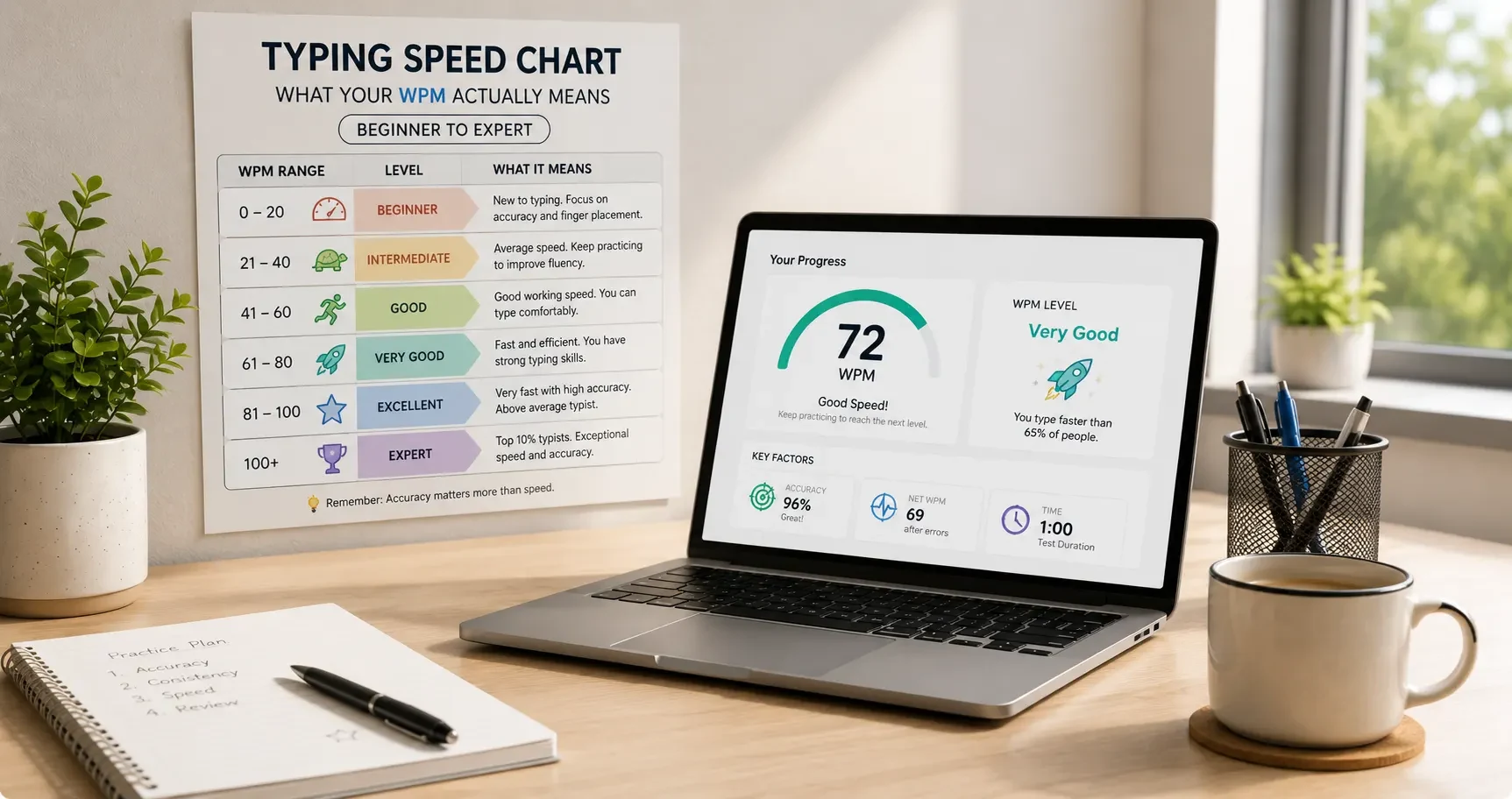
This is where the conversation usually goes wrong in both directions — either “you need 80 WPM or you are behind” or “speed doesn’t matter anymore.” Neither is accurate. For most office roles, 35–45 WPM with high accuracy is genuinely comfortable; it is fast enough that typing stops being the bottleneck in your day. Government exam thresholds are lower and more specific than people expect — SSC-level tests typically require around 35 WPM in English or 30 WPM in Hindi on the actual test format, not the inflated numbers people assume. What has changed with AI in the mix is that accuracy now matters slightly more than raw speed, because you are often typing corrections into AI-generated text rather than composing from scratch, and sloppy fast typing introduces new errors into someone else’s draft just as easily as your own.
If you want a real number instead of a guess, running an actual timed test on a proper English typing practice test tells you more in five minutes than any amount of self-assessment.
Building the skill without wasting your time
You do not need to chase competitive-typist speeds to get the practical benefit. A short, consistent routine works better than the occasional marathon session:
- Start with correct finger placement and touch typing fundamentals before chasing speed — bad habits formed early are hard to unlearn later.
- Practise in short, focused sessions of 10–15 minutes most days rather than one long session once a week.
- Mix in something engaging occasionally — a round or two of typing games keeps the habit from feeling like a chore, especially useful for keeping kids or beginners motivated.
- If your job or exam requires Hindi typing, practise the actual layout you will be tested on rather than assuming English skills transfer directly.
- Track your progress with a proper score rather than guessing — creating a free account lets you see WPM and accuracy trends over weeks instead of one-off snapshots.
Key takeaways
- Voice typing and AI writing tools are genuinely good now — this is not a strawman debate, and dismissing them outright is dishonest.
- They solve word generation, not computer interaction — chat, code, data entry, forms, and exams are still overwhelmingly keyboard-driven.
- Typing tests remain a hard eligibility gate for several government and clerical exams, with no voice alternative permitted.
- Voice input is a genuine accessibility win for people with motor limitations, not just a convenience feature.
- In 2026, accuracy matters slightly more relative to raw speed, since a lot of typing now happens as correction of AI-generated drafts.
- You do not need elite speed — 35–45 WPM with solid accuracy covers most real-world office and exam needs comfortably.
Frequently asked questions
Is typing still a relevant skill in 2026?
Yes, for most desk jobs, students, and exam candidates. It has become less relevant for casual personal messaging, where voice-to-text now handles a lot of the load, but it remains central to chat, coding, data entry, and formal writing.
Will AI writing tools eventually replace the need to type?
Unlikely in the near term. AI tools generate draft text, but reviewing, correcting, formatting, and personalising that text is still done by typing. AI has shifted some of the composing work, not the interacting-with-a-computer work.
Is voice typing as accurate as keyboard typing now?
In quiet conditions with clear speech, modern voice typing is very accurate for everyday language. It struggles more with technical terms, numbers, names, and any environment with background noise, which is exactly why it has not replaced typing in professional settings.
Do government exams still require a typing test?
Many do. SSC and various state clerical exams include a mandatory typing speed and accuracy component with a fixed passing threshold, and no voice or AI substitute is allowed during the actual exam.
Should I still teach my kids touch typing if they grow up with voice assistants?
Yes. Kids will use keyboards for school assignments, exams, coding classes, and eventually work, long before voice interfaces become a full substitute for those tasks. Early, correct habits make later typing faster and less error-prone.
Is it worth learning touch typing if I already type “fast enough” with two fingers?
Usually yes, because hunt-and-peck speed plateaus early and demands constant visual attention to the keyboard, which slows down accuracy under pressure — something a timed exam or a live chat exposes quickly.
Does coding still require strong typing skills if AI can write code for me?
Yes. AI-generated code still needs to be read, edited, renamed, refactored, and debugged by hand, and that editing work is typing-heavy even when the first draft came from an AI assistant.
Where does voice typing genuinely beat keyboard typing?
Hands-free situations — walking, driving, cooking, or when someone has a condition that makes sustained typing physically difficult. In these cases voice is not just acceptable, it is the better tool.
How fast should my typing speed be for a normal office job?
Around 35–45 words per minute with good accuracy is comfortable for most office work. Faster is helpful but rarely essential outside of transcription-heavy or clerical exam roles.
Does typing accuracy matter more than speed now?
Relatively, yes, more than it used to. A lot of modern typing happens as correction of AI-drafted text, and fast-but-sloppy typing introduces new errors into that text just as easily as it would into your own writing.
Is it too late to improve my typing skills as an adult?
No. Touch typing is a trainable motor skill at any age, and consistent short practice sessions over a few weeks produce a noticeable improvement in both speed and accuracy.
Can I check my current typing speed for free?
Yes, a short timed typing test gives you an accurate WPM and accuracy score in a few minutes, which is a far better starting point than guessing based on how fast typing feels.
{ "@context": "https://schema.org", "@type": "FAQPage", "mainEntity": [ {"@type": "Question", "name": "Is typing still a relevant skill in 2026?", "acceptedAnswer": {"@type": "Answer", "text": "Yes, for most desk jobs, students, and exam candidates. It has become less relevant for casual personal messaging, where voice-to-text now handles a lot of the load, but it remains central to chat, coding, data entry, and formal writing."}}, {"@type": "Question", "name": "Will AI writing tools eventually replace the need to type?", "acceptedAnswer": {"@type": "Answer", "text": "Unlikely in the near term. AI tools generate draft text, but reviewing, correcting, formatting, and personalising that text is still done by typing. AI has shifted some of the composing work, not the interacting-with-a-computer work."}}, {"@type": "Question", "name": "Is voice typing as accurate as keyboard typing now?", "acceptedAnswer": {"@type": "Answer", "text": "In quiet conditions with clear speech, modern voice typing is very accurate for everyday language. It struggles more with technical terms, numbers, names, and any environment with background noise, which is exactly why it has not replaced typing in professional settings."}}, {"@type": "Question", "name": "Do government exams still require a typing test?", "acceptedAnswer": {"@type": "Answer", "text": "Many do. SSC and various state clerical exams include a mandatory typing speed and accuracy component with a fixed passing threshold, and no voice or AI substitute is allowed during the actual exam."}}, {"@type": "Question", "name": "Should I still teach my kids touch typing if they grow up with voice assistants?", "acceptedAnswer": {"@type": "Answer", "text": "Yes. Kids will use keyboards for school assignments, exams, coding classes, and eventually work, long before voice interfaces become a full substitute for those tasks. Early, correct habits make later typing faster and less error-prone."}}, {"@type": "Question", "name": "Is it worth learning touch typing if I already type fast enough with two fingers?", "acceptedAnswer": {"@type": "Answer", "text": "Usually yes, because hunt-and-peck speed plateaus early and demands constant visual attention to the keyboard, which slows down accuracy under pressure, something a timed exam or a live chat exposes quickly."}}, {"@type": "Question", "name": "Does coding still require strong typing skills if AI can write code for me?", "acceptedAnswer": {"@type": "Answer", "text": "Yes. AI-generated code still needs to be read, edited, renamed, refactored, and debugged by hand, and that editing work is typing-heavy even when the first draft came from an AI assistant."}}, {"@type": "Question", "name": "Where does voice typing genuinely beat keyboard typing?", "acceptedAnswer": {"@type": "Answer", "text": "Hands-free situations such as walking, driving, cooking, or when someone has a condition that makes sustained typing physically difficult. In these cases voice is not just acceptable, it is the better tool."}}, {"@type": "Question", "name": "How fast should my typing speed be for a normal office job?", "acceptedAnswer": {"@type": "Answer", "text": "Around 35 to 45 words per minute with good accuracy is comfortable for most office work. Faster is helpful but rarely essential outside of transcription-heavy or clerical exam roles."}}, {"@type": "Question", "name": "Does typing accuracy matter more than speed now?", "acceptedAnswer": {"@type": "Answer", "text": "Relatively, yes, more than it used to. A lot of modern typing happens as correction of AI-drafted text, and fast-but-sloppy typing introduces new errors into that text just as easily as it would into your own writing."}}, {"@type": "Question", "name": "Is it too late to improve my typing skills as an adult?", "acceptedAnswer": {"@type": "Answer", "text": "No. Touch typing is a trainable motor skill at any age, and consistent short practice sessions over a few weeks produce a noticeable improvement in both speed and accuracy."}}, {"@type": "Question", "name": "Can I check my current typing speed for free?", "acceptedAnswer": {"@type": "Answer", "text": "Yes, a short timed typing test gives you an accurate WPM and accuracy score in a few minutes, which is a far better starting point than guessing based on how fast typing feels."}} ] }
Typing skills are not obsolete — they have just quietly specialised into the parts of digital life that voice and AI still cannot do well: real-time collaboration, code, forms, exams, and any quiet or shared space where talking to your screen isn’t an option. If you want a real baseline instead of a guess, run a timed English typing test and see where you actually stand, or create a free account to track your speed and accuracy as they improve over the coming weeks.